
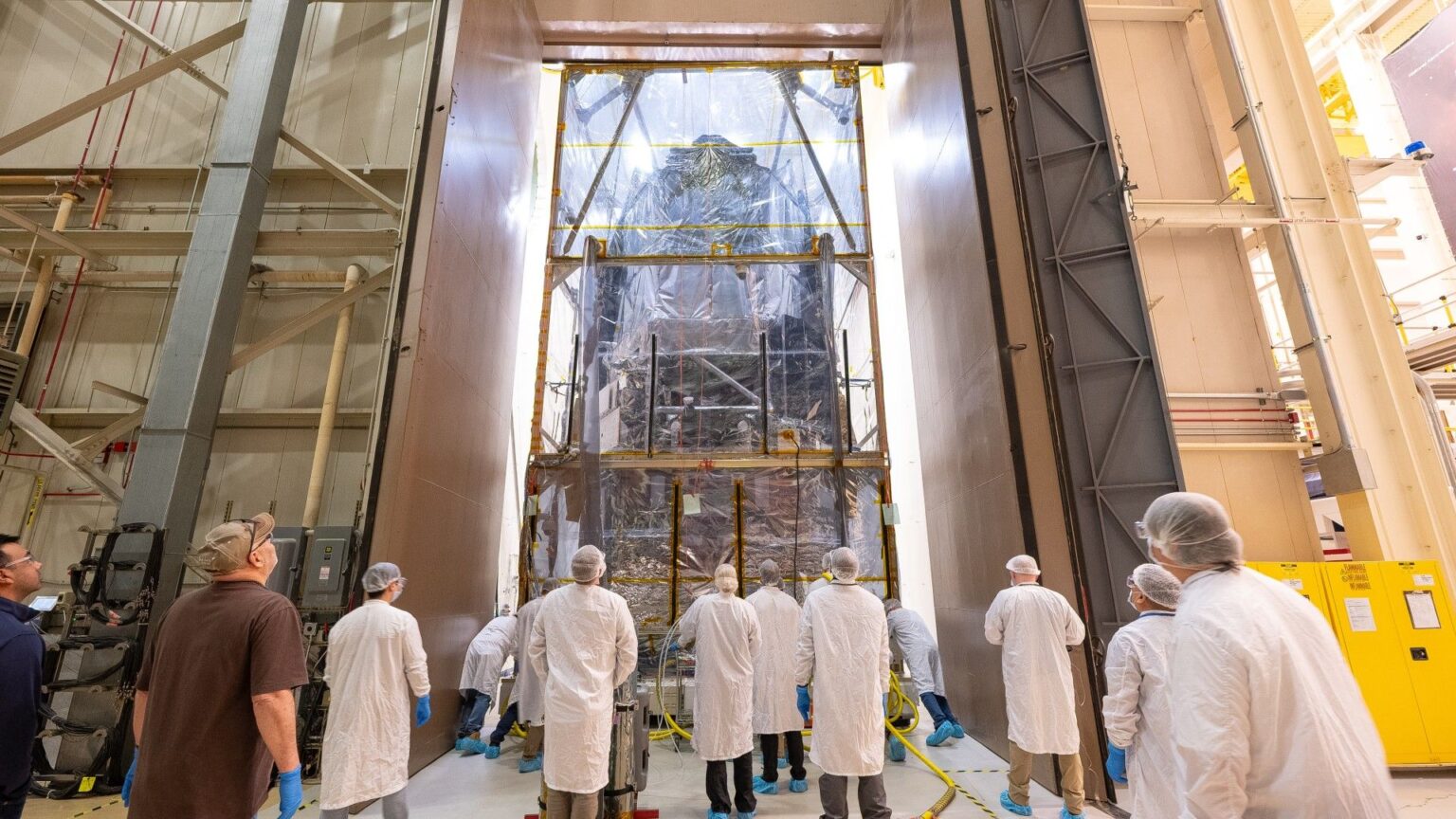
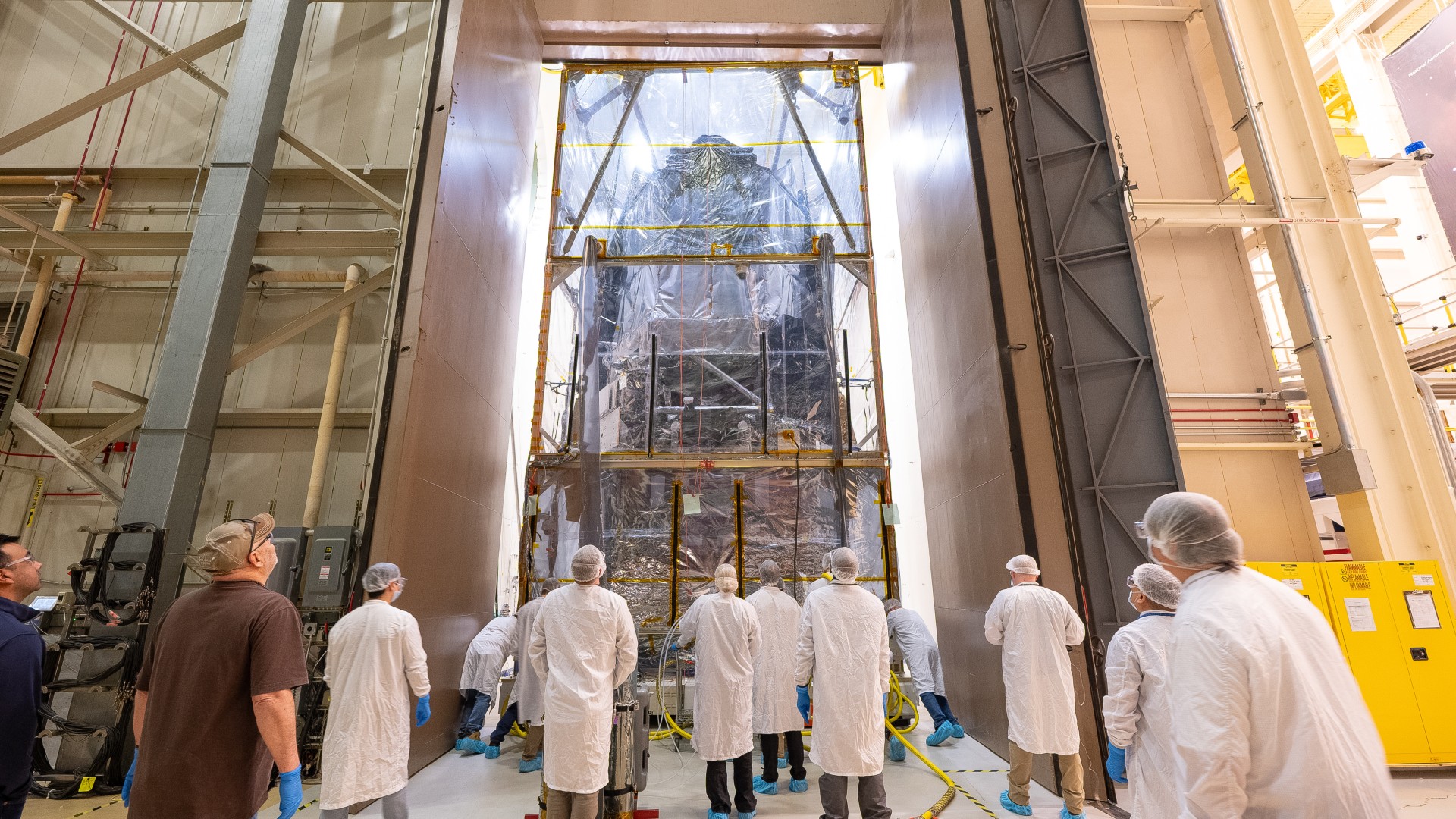
Technicians move NASA’s Nancy Grace Roman Space Telescope into an acoustics chamber for environmental testing at the agency’s Goddard Space Flight Center. (Image credit: NASA/Jolearra Tshiteya)
NASA released a new image of its next-generation Nancy Grace Roman Space Telescope undertaking environmental testing that determined it can withstand vibrations it will experience during launch.
What is it?
Engineers at NASA’s Goddard Space Flight Center (GFSC) in Maryland put the Roman Space Telescope through acoustic testing this month in which the observatory was placed in a sound booth and blasted with acoustic waves up to 138 decibels, or around the loudness of a jet engine from 100 feet (30 meters) away, NASA wrote in a statement accompanying the image.
“If you’ve ever been at a concert with an extremely loud bass, that load you felt was acoustic energy,” said Cory Powell, the lead Roman structural analyst at GFSC. “Now think about how loud a launch is. The acoustics can produce very high loads on a large structure like Roman.”
Article continues below
You may like
Engineers also placed Roman on a “shaker table” that subjected the space telescope to high levels of vibration similar to what it will experience during launch in order to ensure the observatory and its instruments will remain intact after liftoff.
Why is it amazing?
This photo offers a rare peek behind the curtain at the extensive and intricate testing that spacecraft like space telescopes undergo before launch. The Roman Space Telescope is estimated to cost over $4 billion, so ensuring a successful launch is paramount for NASA.
When it becomes operational, the Roman Space Telescope is expected to offer scientists an unprecedented look into the cosmos, boasting an 8-foot (2.4-meter) mirror similar to the Hubble Space Telescope, but with a field of view 100 times larger than Hubble’s. Roman is also outfitted with a coronagraph that allows it to block the light from distant stars, enabling it to see planets that might be orbiting around those stars.
If all goes according to plan, Roman will be able to map structures on cosmic scales, measure dark energy and dark matter throughout the universe, detect distant black holes and potentially discover tens of thousands of alien planets.
Roman is currently estimated to launch as early as fall 2026.