
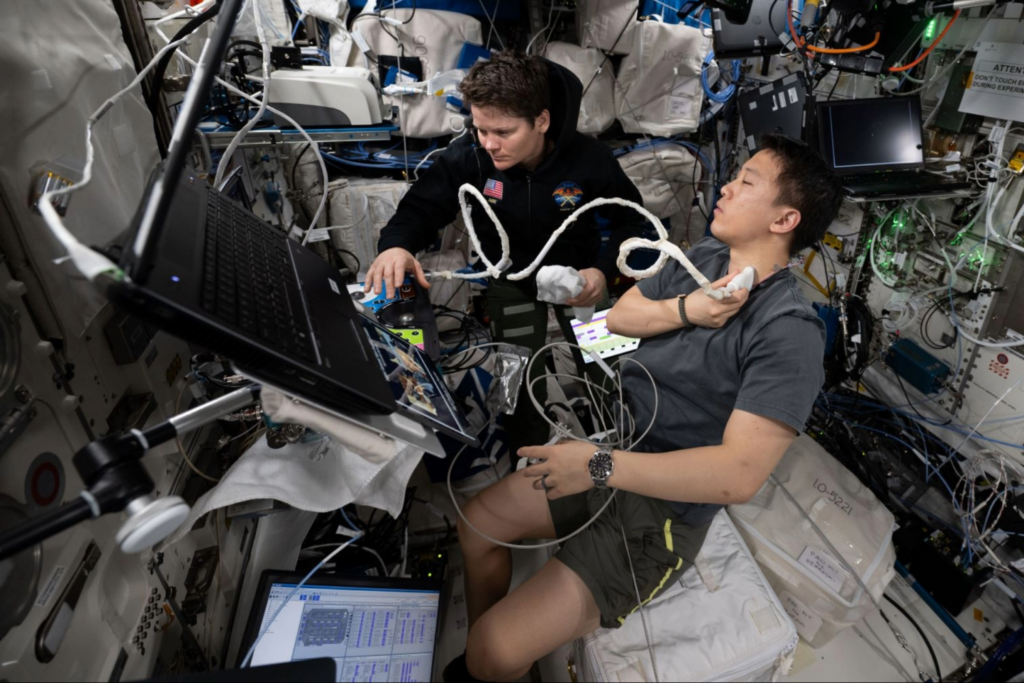
NASA is seeking novel practices to address the risk of blood clots forming in space, known as venous thrombosis.
What Is Venous Thrombosis?
Venous thrombosis is the development of a blood clot in a vein. It’s commonly associated with clots in the deep veins of the leg after surgery, injury, or long periods of sitting on airplanes or lying in bed. Blood clots in the upper body, particularly in the jugular veins in the neck, are much less common.
Venous thrombosis can be associated with local swelling, redness, and pain. If an astronaut develops a clot in their internal jugular vein during spaceflight, there may be no obvious symptoms, but the blood clot could be detected using ultrasound.
What We Are Seeking?
NASA’s Human Research Program (HRP) and the European Space Agency (ESA) are requesting information on current, enhanced, or novel approaches to monitor, reduce risk of, and/or treat venous thrombosis during spaceflight.
What Do We Need from You?
The full text of the RFI and response instructions can be found here. Responses must be submitted electronically using the NSPIRES website.
Appropriate responses to this RFI should address:
Recommendations for development and validation of approach(es) to monitor, reduce risk of, and/or treat venous thrombosis during spaceflight and exploration missions, including rationale and methodology. Approaches might include technologies currently available and those in development as well as applications in low Earth orbit and during missions to the Moon and Mars.
If applicable, recommendations for future spaceflight and spaceflight analog research relevant to venous thrombosis during spaceflight and exploration missions. Relevant applications might include short- and long-duration missions in low Earth orbit, missions beyond low Earth orbit, and habitation in partial gravity environments. Analogs might include relevant patient populations, parabolic flight, and suborbital flight.
Resources
Deadline: April 15, 2026
Apply: Click here to submit your ideas.
Questions: Email us at js-hrp-chief-science-office [at] mail.nasa.gov
Keep Exploring
Discover More Topics From NASA