
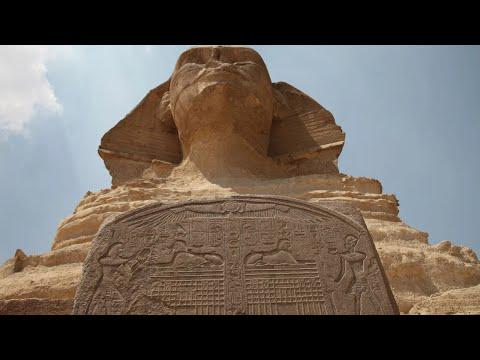
Ancient Egypt continues to attract global scholarly attention due to its complex architectural systems and symbolic cultural heritage. Recently, new research hypotheses have emerged suggesting the possible existence of undiscovered subsurface structures beneath the Giza Plateau, including the idea of a second monument comparable to Great Sphinx of Giza. The Sphinx is traditionally associated with the reign of Khafre, and one of the key historical artifacts linked to it is the Dream Stele of Thutmose IV, which some interpretations suggest may depict dual forms; however, such interpretations remain contested within academic circles, as symbolic representation in ancient Egyptian art does not necessarily indicate physical duplication. In 2025, researcher Filippo Biondi and his team proposed a hypothesis based on geometric alignments and remote sensing data, indicating a potential mirrored point across the plateau that could correspond to a buried structure. Their analysis relies on satellite-based radar techniques capable of detecting subtle ground variations, a method used in geophysics but not sufficient alone to confirm archaeological features. Preliminary data reportedly indicate anomalies such as vertical shafts, dense linear formations, and subsurface inconsistencies that may suggest non-natural formations; however, these remain interpretations rather than verified findings. Similar ideas have previously been discussed by researchers such as Bassam El Shammaa, who drew on ancient texts and mythological narratives, though such perspectives are not widely accepted without material evidence. From a scientific standpoint, there is currently no direct archaeological proof confirming the existence of a second Sphinx or an extensive underground complex, and geophysical indicators must be validated through controlled excavation and official archaeological investigation. Consequently, while these hypotheses contribute to ongoing discussions and demonstrate the integration of modern technology with archaeological inquiry, they remain speculative and require further empirical verification before being considered established historical facts.
by Professional-Fee3323
1 Comment
Oh! It’s Filippo Biondi again. Did he publish any results of his research, or is he throwing some unbased claims again?