
With current chemical propulsion technology, it takes a spacecraft up to 10 months to reach Mars. Reducing that transit time will be critical for future missions to the Red Planet, and a nuclear propulsion startup just took a major step toward rapid deep-space travel.
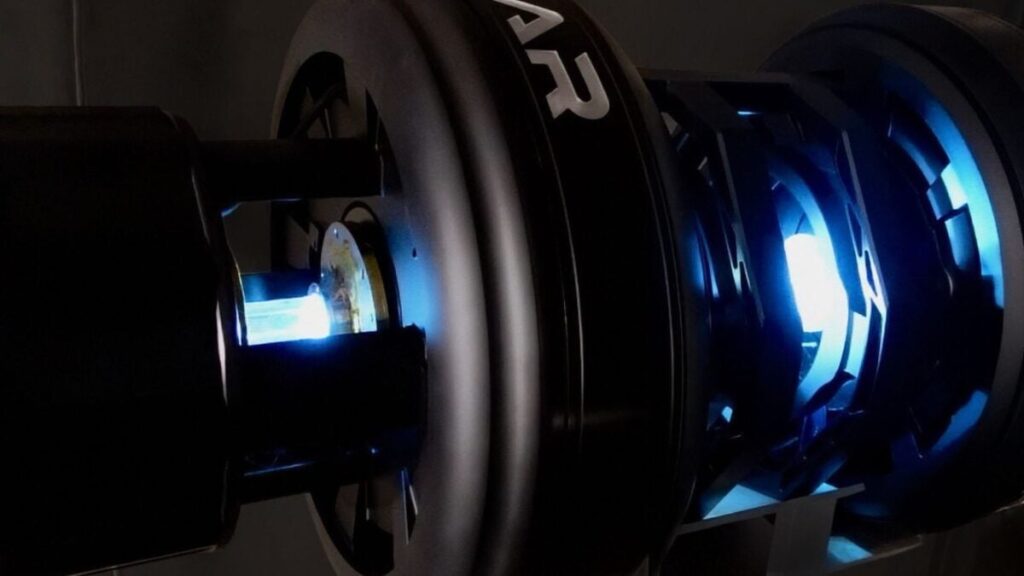
Pulsar Fusion, based in the United Kingdom, announced that it achieved “first plasma” in its Sunbird exhaust test system on Wednesday. This marks the first successful demonstration of plasma confinement in the system and a key step toward developing the Sunbird Migratory Transfer Vehicle—a fusion rocket designed to provide continuous high-thrust propulsion for faster, more efficient interplanetary travel.
Sunbird wouldn’t carry cargo or astronauts itself. Rather, this next-generation space-tug would dock to a spacecraft in low-Earth orbit and then boost it to its destination. According to the company’s website, Sunbird will eventually be able to transport a spacecraft carrying 2,200 to 4,400 pounds (1,000 to 2,000 kilograms) of cargo to Mars orbit in under 6 months.
The next generation of rocket propulsion
Pulsar Fusion scientists in Bletchley, U.K., performed the demonstration of the exhaust test system and live-streamed it to the stage at Amazon’s MARS Conference in Ojai, California. The video above shows the demo in the final 30 seconds.
By showing that the system can generate and confine plasma, Pulsar Fusion validated the core technology for its Dual Direct Fusion Drive (DDFD) engine. The company claims the DDFD will have a remarkably high specific impulse of 10,000 to 15,000 seconds. This would equip Sunbird with far greater fuel efficiency and exhaust velocity than chemical propulsion rockets can achieve.
The DDFD is also designed to generate 2 megawatts of power, providing both continuous thrust and electricity to run spacecraft systems—capabilities that chemical engines lack.
The DDFD will achieve all this by harnessing the power of nuclear fusion: the atomic process that powers stars. Engineers have been working to achieve space nuclear propulsion for decades, but it appears those at Pulsar Fusion could be the first. The company plans to launch an in-orbit demonstration of Sunbird’s core components in 2027.
A long road to launch
In a video released in May, Pulsar Fusion offered a glimpse of how operational Sunbirds would work. Unlike current rockets that launch from Earth, these fusion rockets would be stored on giant orbital docking stations. In the animated clip, a Sunbird undocked from its station and used its eight thrusters to attach to a larger spacecraft and propel it to a distant planet. Kind of like a jet pack, but for spaceships.
Once it reaches its destination, Sunbird detaches and docks with an awaiting station. This system would allow the rocket to repeatedly carry spacecraft to and from deep space.
Demonstrating Sunbird’s core components in orbit by 2027 would be a major milestone, but turning the rocket into a fully operational vehicle will take longer. Building the orbital docking stations in LEO and beyond will be another feat entirely. Still, demonstrating plasma containment in the exhaust test system is a step in the right direction, putting Pulsar Fusion on the path to launching the world’s first nuclear rocket.