
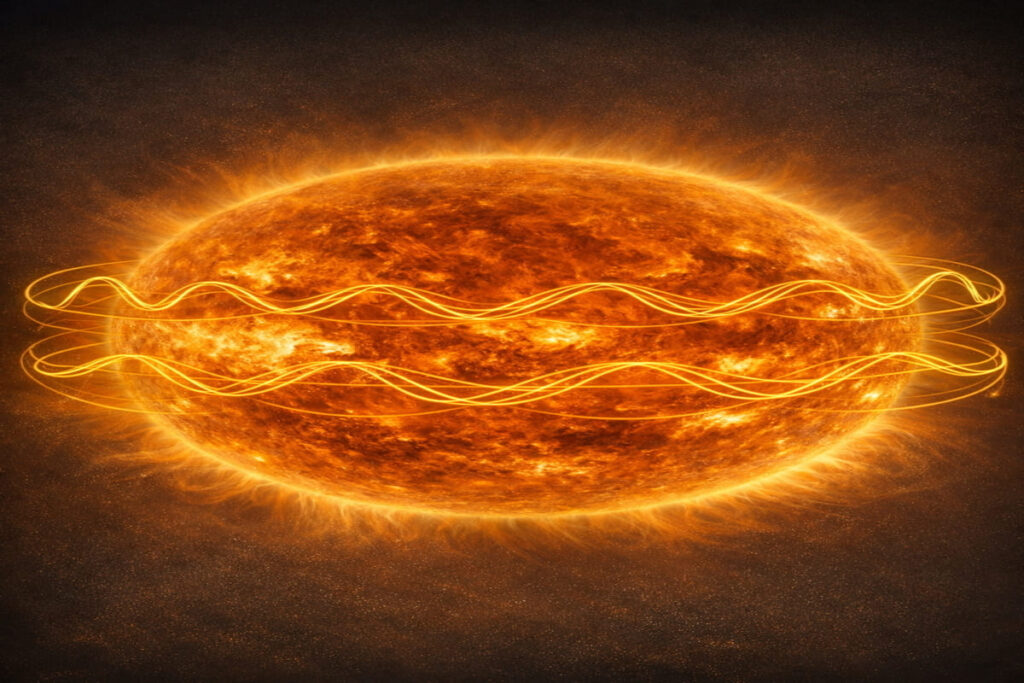
New solar vibrations offer a way to probe otherwise unreachable regions beneath the Sun’s surface
Scientists affiliated with NYU Abu Dhabi have identified new expansive waves traveling deep within the Sun, driven by magnetic fields located far underneath the exterior. These vibrations offer a perspective into regions of the Sun that are otherwise unreachable, providing researchers with a new mechanism to examine the manner in which its magnetic field is created and transforms over duration.
In a recent study published in Nature Astronomy, investigators at NYU Abu Dhabi’s Center for Astrophysics and Space Science examined more than a decade of the Sun’s inherent oscillations. This research builds on a March 2022 study that first identified high-frequency waves moving at unexpected speeds. The latest findings reveal proof for formerly unobserved, broad waves influenced by the Sun’s intrinsic magnetism. By calculating how these waves propagate, the group can deduce the potency and arrangement of magnetic fields far beneath the solar surface.
Anticipating solar activity and space weather
“These waves give us a unique look at the Sun’s hidden magnetic system,” stated Shravan Hanasoge, co-PI at the Center for Astrophysics and Space Science at NYU Abu Dhabi and lead author of the research. “Understanding these internal processes is crucial for predicting solar activity, which can impact satellites, communications, and power systems on Earth.”
The results offer a new method for investigating the Sun’s inner regions and its magnetic development over time. This has consequences for enhancing space-weather prediction and for comprehending magnetic activity in other stars across the universe. This work was supported by the NYU Abu Dhabi Research Institute.
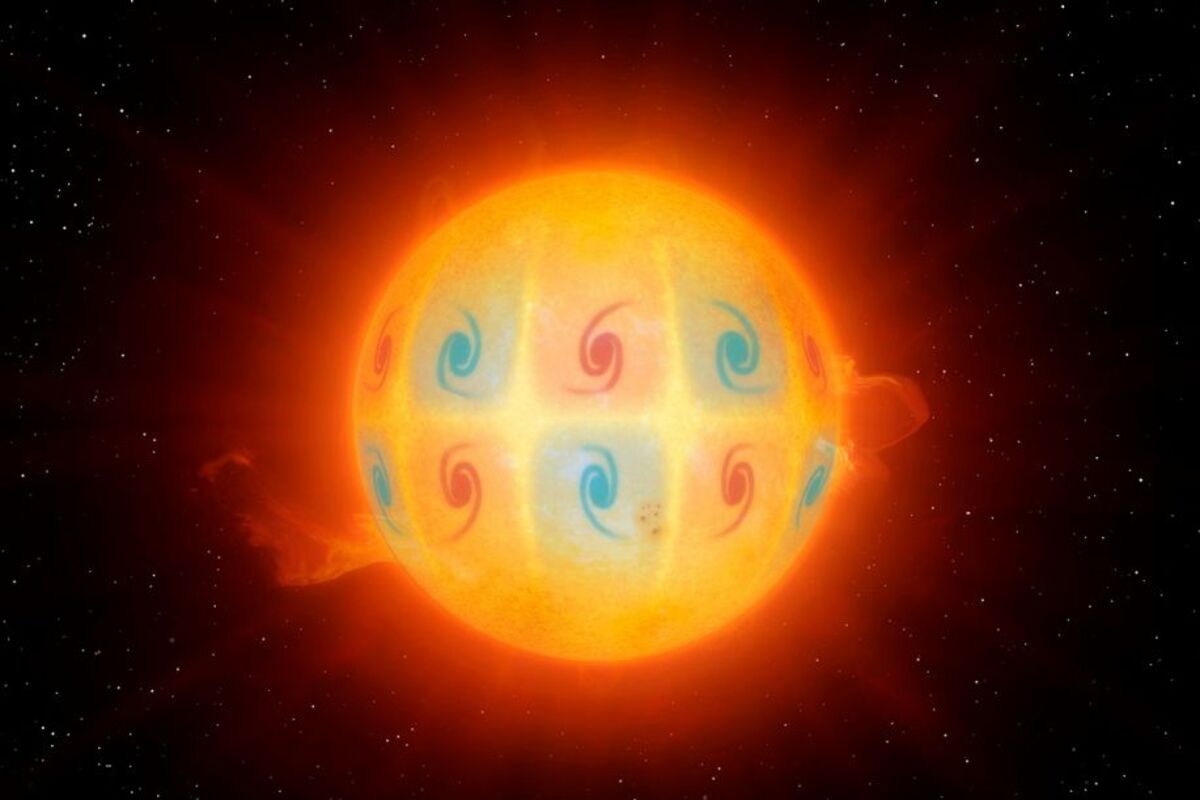 (Photo Credit: NYU Abu Dhabi)
Read more: Abu Dhabi’s observatory captures Boogeyman Nebula image after month of work in UAE skies
High-speed waves challenge existing solar theories
Researchers from NYU Abu Dhabi’s Center for Space Science discovered a new set of waves in the Sun that appear to travel much faster than predicted by current theory.
In the March 2022 study, “Discovery of high-frequency-retrograde vorticity waves in the Sun,” published in the journal Nature Astronomy, the research team—led by Research Associate Chris S. Hanson—detailed their analysis of 25 years of space and ground-based data. These high-frequency retrograde (HFR) waves move in the opposite direction of the Sun’s rotation. They appear as a pattern of vortices, or swirling motions, on the surface of the Sun and move at three times the speed established by established theoretical models.
Because the interior of the Sun and other stars cannot be imaged by conventional astronomy, such as optical or X-ray methods, scientists rely on interpreting surface signatures of various waves to image these hidden regions. These HFR waves represent a critical puzzle piece in our understanding of stellar physics.
Not driven by known forces
While complex interactions between magnetism, gravity, or convection often drive solar waves, these HFR waves do not seem to be a result of those known processes. “If the HFR waves could be attributed to any of these three processes, then the finding would have answered some open questions we still have about the Sun,” said Hanson. “However, these new waves don’t appear to be a result of these processes, and that’s exciting because it leads to a whole new set of questions.”
The research was conducted at NYU Abu Dhabi’s Center for Space Science in collaboration with the Tata Institute of Fundamental Research (TIFR) and New York University. By studying the Sun’s interior dynamics through the use of waves, scientists can better appreciate the Sun’s potential impact on Earth and other planets in the solar system.
“The very existence of HFR modes and their origin is a true mystery and may allude to exciting physics at play,” said Hanasoge who co-authored the paper bac then. “It has the potential to shed insight on the otherwise unobservable interior of the Sun.”