

If you want to survive on the Moon, you currently have to bring everything with you. Every molecule of oxygen, every liter of water, every drop of fuel, all of it hauled from Earth at a cost of thousands of dollars per pound. That logic, expensive and logistically brutal, has long capped how long humans can realistically stay beyond our planet. But something shifted recently, and it happened in a reactor filled with simulated moon dirt.
NASA’s Carbothermal Reduction Demonstration team, known as CaRD, successfully extracted oxygen from simulated lunar soil using concentrated solar energy. The milestone, confirmed through integrated prototype testing, validates a strategy that space agencies have been eyeing for years: instead of importing life support from Earth, let astronauts harvest the landscape they’re standing on.
Moon Dust Is Quietly Loaded With Oxygen, The Problem Is Getting to It
Here’s something that tends to get lost in coverage of the Moon: lunar regolith, that fine and abrasive grey powder blanketing the surface, is nearly half oxygen by mass. The catch is that this oxygen isn’t floating freely, it’s chemically locked inside silicate minerals and metal oxides, bonded tight and utterly unbreathable as-is. The Moon also receives a regular delivery of oxygen from Earth’s magnetotail, the tail-end of our planet’s magnetic field. None of it is accessible without intervention.
The CaRD team’s approach to breaking those chemical bonds is called carbothermal reduction. A solar concentrator focuses energy into a specialized reactor. The heat then triggers a chemical reaction that strips the oxygen away from the soil, producing carbon monoxide as a byproduct. According to NASA, that carbon monoxide is itself a critical precursor for generating both oxygen and fuel, making the whole process something of a two-for-one deal.
A Multi-Organization Machine Built to Work as One
This wasn’t a single-lab operation. The test brought together a web of NASA centers and private partners, each responsible for a distinct component. Sierra Space built the reactor at the core of the system. NASA Glenn and Composite Mirror Applications provided the solar technology, the concentrator and precision mirrors responsible for capturing and directing energy.
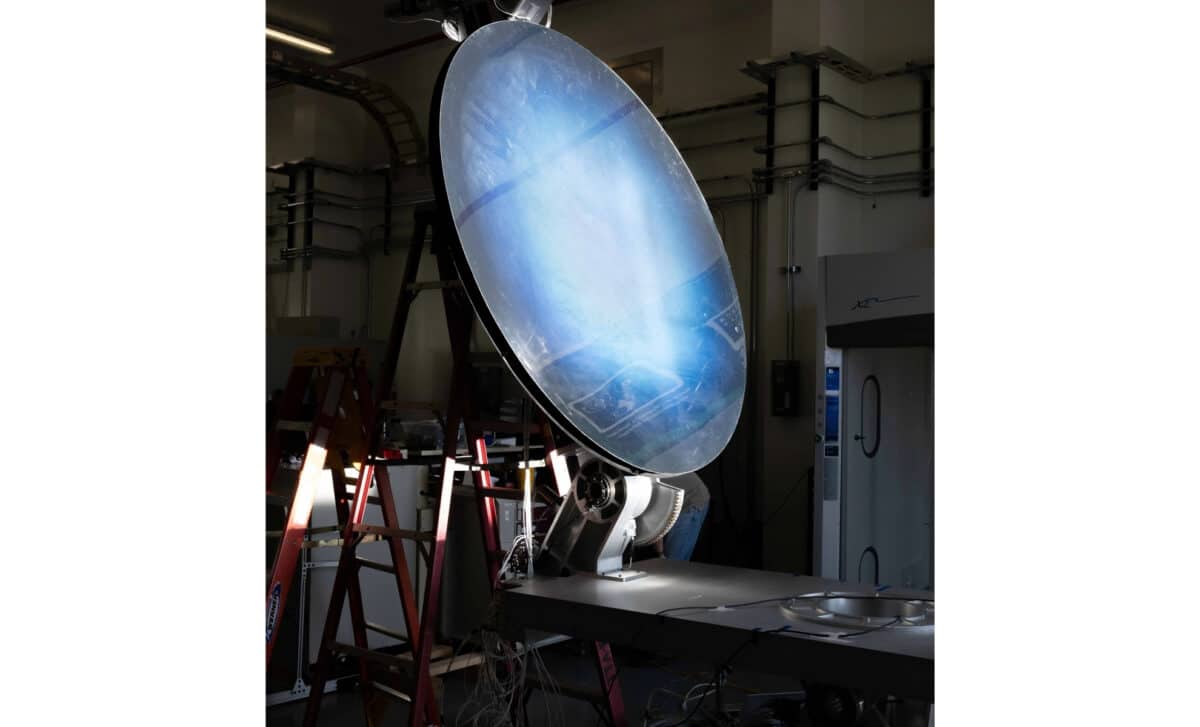 A solar concentrator is tested as part of the Carbothermal Reduction Demonstration (CaRD) project, which aims to produce oxygen from simulated lunar regolith for use at the Moon’s south pole – © NASA/Michael Rushing
NASA Kennedy handled the electronics used for analysis. And overseeing it all, NASA Johnson’s systems engineering team coordinated the various specialized parts to ensure they functioned as one cohesive machine.
According to NASA, the testing used a solar concentrator, precision mirrors, and advanced control software for processing the lunar soil simulant. The agency confirmed that the integrated prototype successfully produced carbon monoxide through a solar-driven chemical reaction, a result that clears a significant bar for future deployment.
From the Moon to Mars, the Same Hardware Could Do Both
The implications don’t stop at the lunar surface. NASA has noted that the same systems used to process gases from regolith can be adapted for use on Mars. On the Red Planet, where the atmosphere is rich in carbon dioxide, this hardware could be reconfigured to produce breathable oxygen and methane, with methane serving as a potential propellant for a return trip to Earth.
This sits squarely within NASA’s broader In-Situ Resource Utilization strategy, or ISRU, a “live off the land” philosophy that prioritizes harvesting local materials over ferrying supplies from home. With resupply missions from Earth being rare and costly, as Interesting Engineering reports, the ability to manufacture oxygen and fuel on-site is less of a bonus and more of a basic requirement for any sustained human presence beyond our planet. By reducing the need to transport heavy life support systems, the CaRD milestone makes long-term lunar stays more affordable and sustainable, and keeps Mars a little more within reach.