
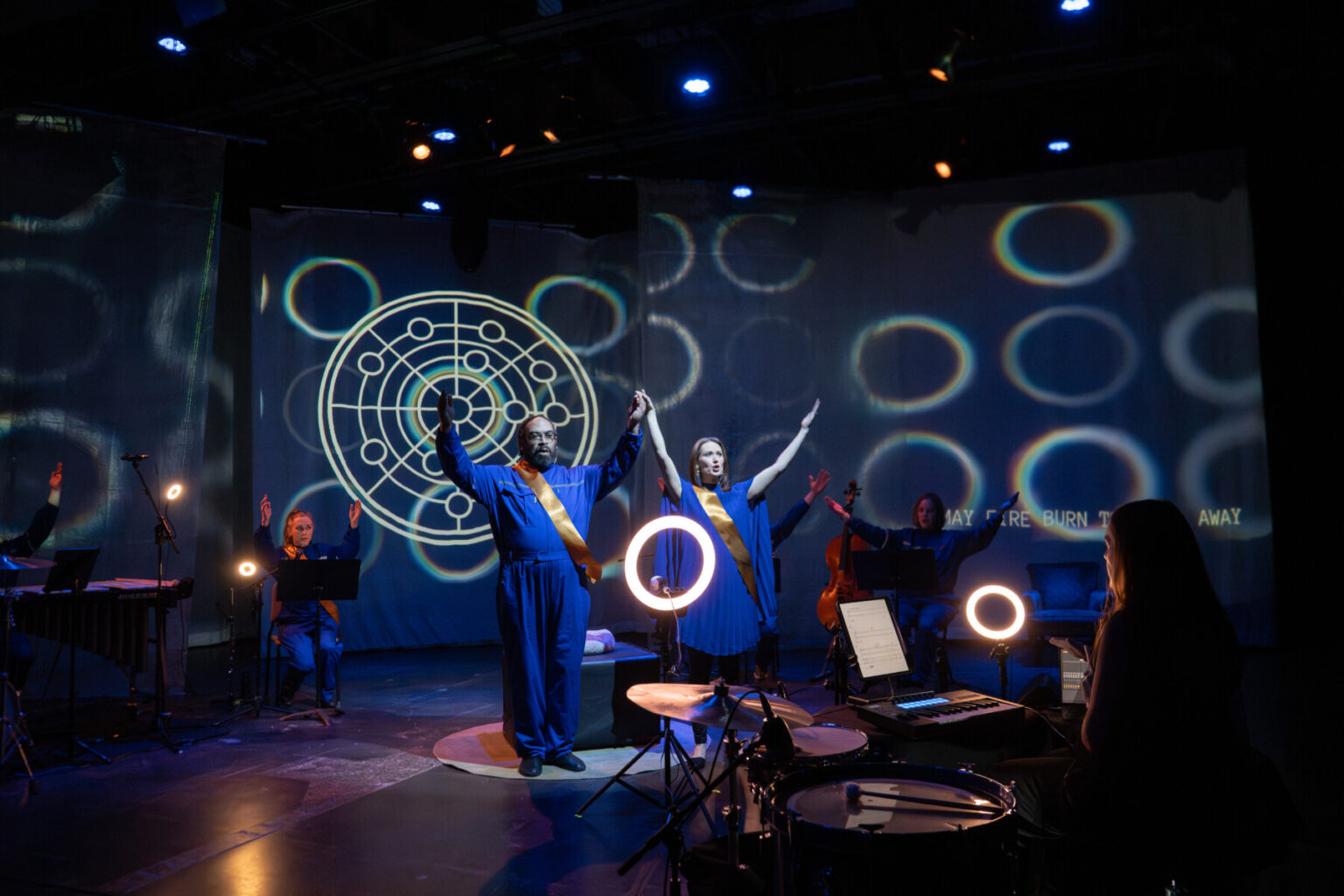
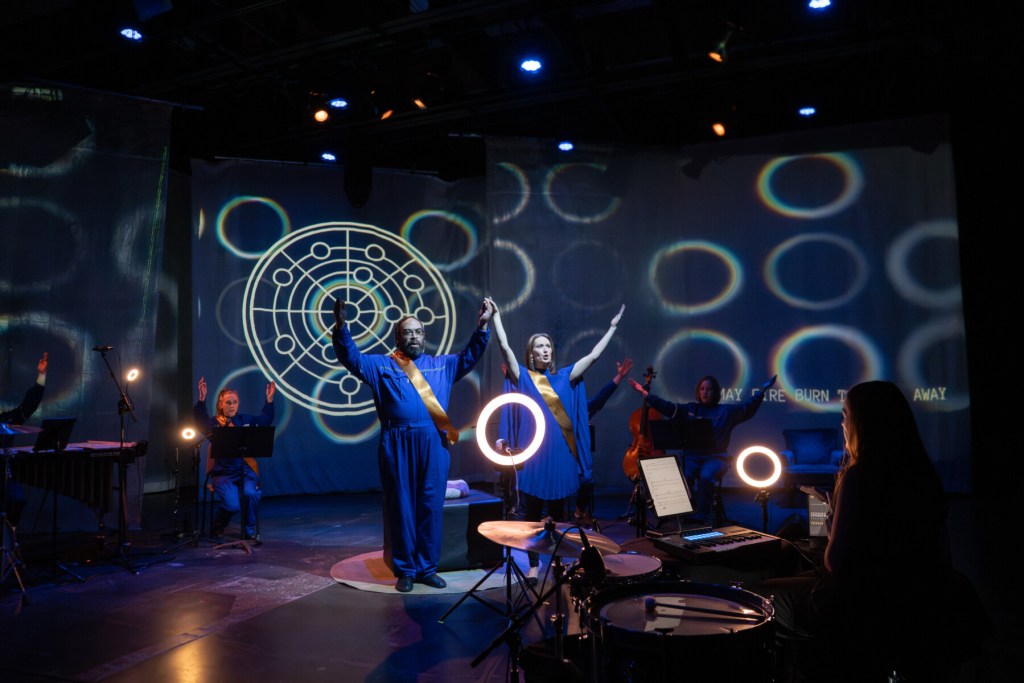
 Third Angle New Music performed Maria Finkelmeier’s “Dies Irae, Desirée” at The Vault Theater in Hillsboro. Photo by Terrellyn Faye.
Third Angle New Music premiered the chamber opera Dies Irae, Desirée the weekend of March 13-15 at the Vault Theater in Hillsboro. The opera is the work of Third Angle’s guest creative director, Maria Finkelmeier, alongside librettist Brady Evan Walker and visual designer Supreetha Krishnan. It tells the story of the rise of a social media influencer (the titular Desirée) who leads an online UFO cult, the New Elyrhans.
Finkelmeier is a Boston-based composer and percussionist. Much of her work interacts with immersive technology, combining light and sound within large installations, or composing multimedia works. One of her coolest projects was Waking The Monster, in which she turned the iconic Fenway Park into a massive percussion instrument. Oregon School composer Kirsten Volness was a collaborator on Waking the Monster.
Dies Irae, Desirée had a unique instrumentation, composed for Third Angle’s great musicians: flute (Sarah Tiedemann), saxophone (Will Pyle), cello (Valdine Ritchie), and percussion (Chris Whyte). Finklemeier performed the electronic elements of the score, and tapped a bass drum and cymbal with a mallet while conducting with her other hand. The sole chordal instrument was a vibraphone, and its mellow metallic tone added to the opera’s spacey feeling. The sax and flute often traded ideas back and forth in counterpoint over growling cello chords and vibraphone arpeggios.
The ensemble was immersed in the action onstage. Tiedemann and Pyle also played followers of Desirée who would occasionally dialogue with the vocalists. The musicians changed into matching sky blue jumpsuits at the start of Act II – uniforms for their eventual ascension into outer space. Desirée, draped in a rich navy blue, wore long flowing garments to evoke comfort, freedom and security.
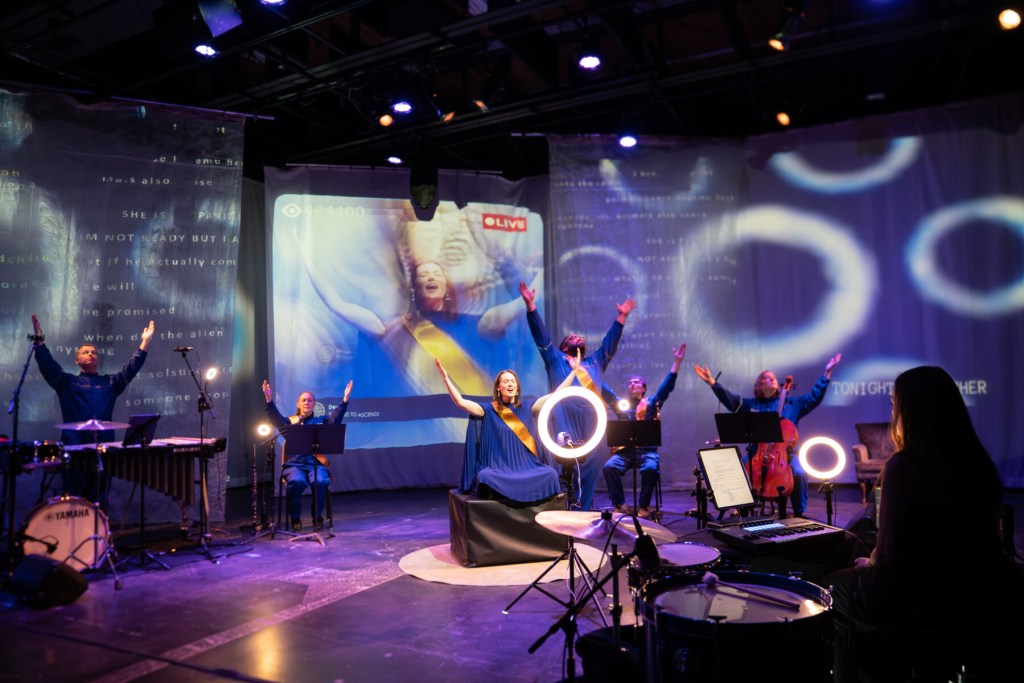 Photo by Terrellyn Faye.
Desirée, performed by mezzo-soprano Sarah Beaty, is a livestreamer who claims to communicate with Praemu, a deity from a distant planet called Elyrha. She preaches to a small audience of voyeurs, skeptics and true believers. Her broadcasts build into ecstatic climaxes over musical ostinatos, chanting and singing, believing Praemu is coming to Earth. But each time, the livestream goes dark and there is no absolution.
The failure of their rapture becomes a test of faith. It failed not because they were wrong, but because they didn’t believe hard enough. Or, their savior is disappointed in them. The skeptics leave, and what remains is a tighter group more committed than ever. Cassie (performed by Madeleine Tran), Desirée’s protege, sees this failure happen twice and has a crisis of faith. But her skeptic boyfriend – tech tycoon Jack Noel, played wonderfully by Quinton Gardner – starts to believe and sees an opportunity for himself.
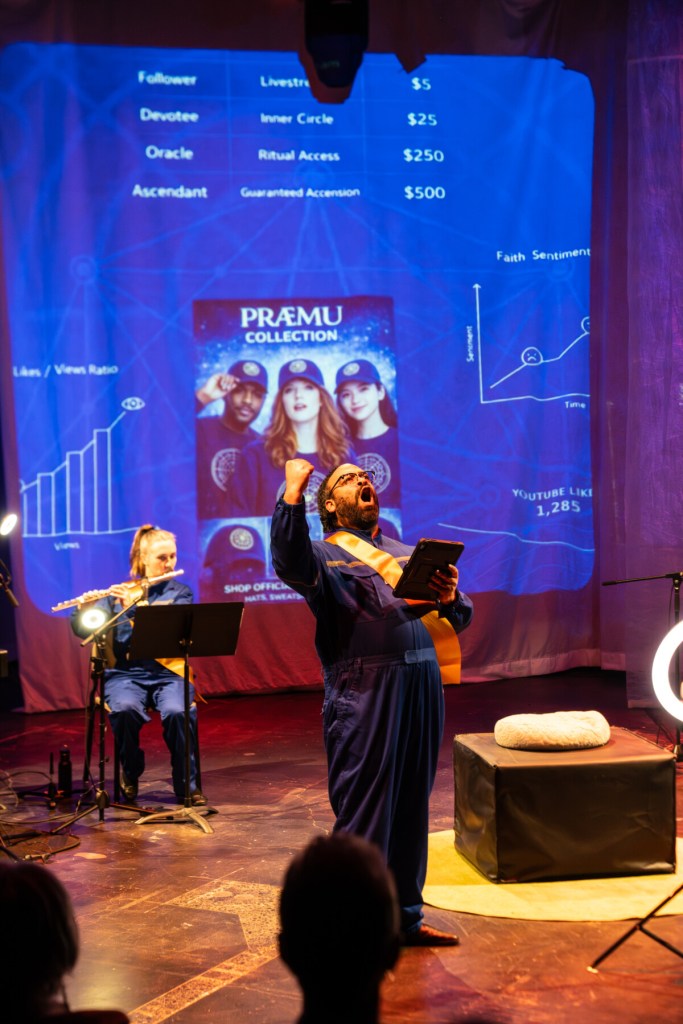 Quinton Gardner in “Dies Irae, Desirée.” Photo by Terrellyn Faye.
At the opera’s opening, only about ten people tune in to watch Desirée’s proclamations. Over the course of the opera that number increases to twenty-five, three hundred, each step an order of magnitude higher. By the end there are over three hundred thousand tuning into her livestreams. This is largely Jack’s doing as he obsesses over seeing lines go up: merch sales, likes, subscribers. Desirée, however, thinks his focus on metrics, merchandise and revenue is distracting from her message: “as if the truth needs marketing.” Upon yet another failure for Praemu to appear, Jack screams in a deep death growl: “The playbook was perfect!” Yet the audience they cultivated is slipping away. The tension between Desirée and Jack is that between the true believer and the grifter, though I’m not sure the difference matters much.
The lighting and projection design by Krishnan worked well. The stage was largely lit by ring lights, a staple of online video production. During the livestreams Desirée is projected behind herself, which gets fed back into the camera in an infinite feedback loop. The splotchy, low-fidelity aesthetic gave the livestream an eerie VHS or Max Headroom vibe. The shadows that fall on Desirée’s face highlight odd angles, making her appear more demonic. The livestream is flanked by a fake chat of admirers and skeptics that becomes the expression of collective groupthink. There were a few chuckle-worthy moments too, including a timely reference to a recent controversy surrounding actor Timothée Chalamet’s dismissive comments about opera and ballet.
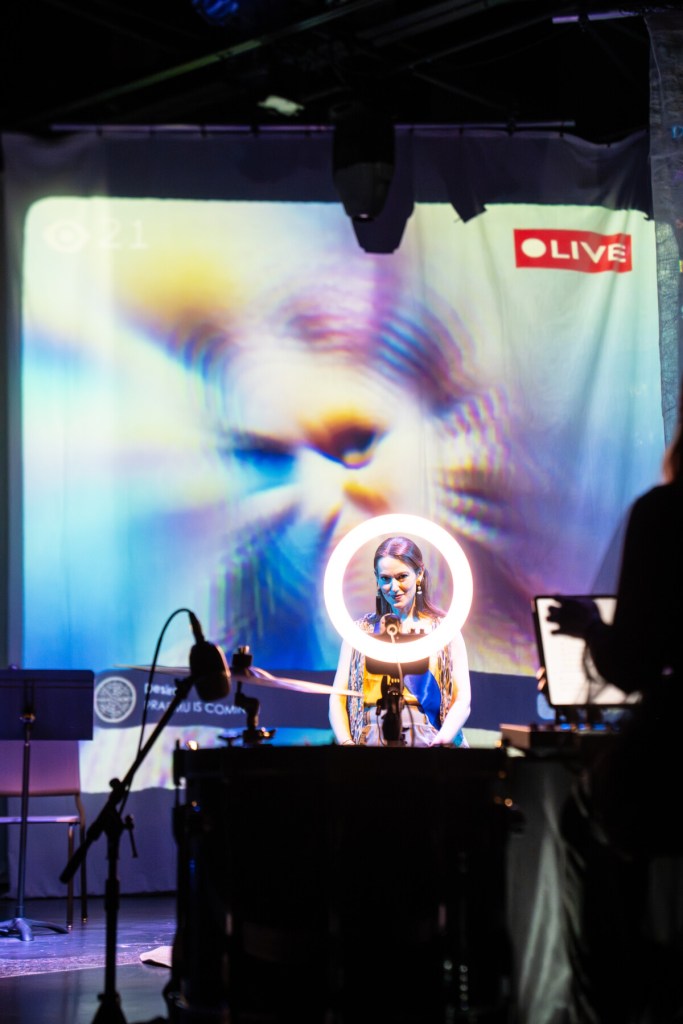 Third Angle New Music performed Maria Finkelmeier’s “Dies Irae, Desirée” at The Vault Theater in Hillsboro. Photo by Terrellyn Faye.
In between scenes were spacey interludes of thick drones with tons of reverb and notes that seem to ring out forever. Aphex Twin-like drum breaks would sometimes enter for a moment. During these interludes they projected fake tweets and front-facing AI videos one would find on TikTok or Instagram. These posts express admiration for Desirée, declaring that her programs and lessons saved their marriage, cured their addictions, and got them a new job. One could criticize their use of AI software to make these videos for Dies Irae, Desirée. Any use of AI, even for creating art that is skeptical or critical of AI, legitimizes its usage. On the other hand, this use might be more understandable. Within the diegesis of the opera, the AI videos are propaganda created by and for the cause. It leans into the uncanny aesthetic and shows how AI videos can propagate misinformation.
The brief Third Act was a celebration. Desirée and Jack, seemingly putting their disagreements aside, got the audience to sing along with their mantras like “reborn in endless blue,” as if the opera suddenly became a mass gathering of initiates. Madeleine Tran comes back onstage as “Sunny St. Cloud,” a pop star supportive of Desirée’s message. (Is this Cassie’s return?) She sang a parody of uplifting pop tunes, riddled with cliché’d lyrics and ear-bursting synth leads. Tran gave it her all with her stage work, emphatic dancing and high notes. But there was still this undercurrent of fear: “If you don’t clap, you’re not coming with us!” The opera ended with the cult still going strong, but diminished from their height of popularity. Maybe they are on the precipice of their ascension, or yet another failed prophecy.
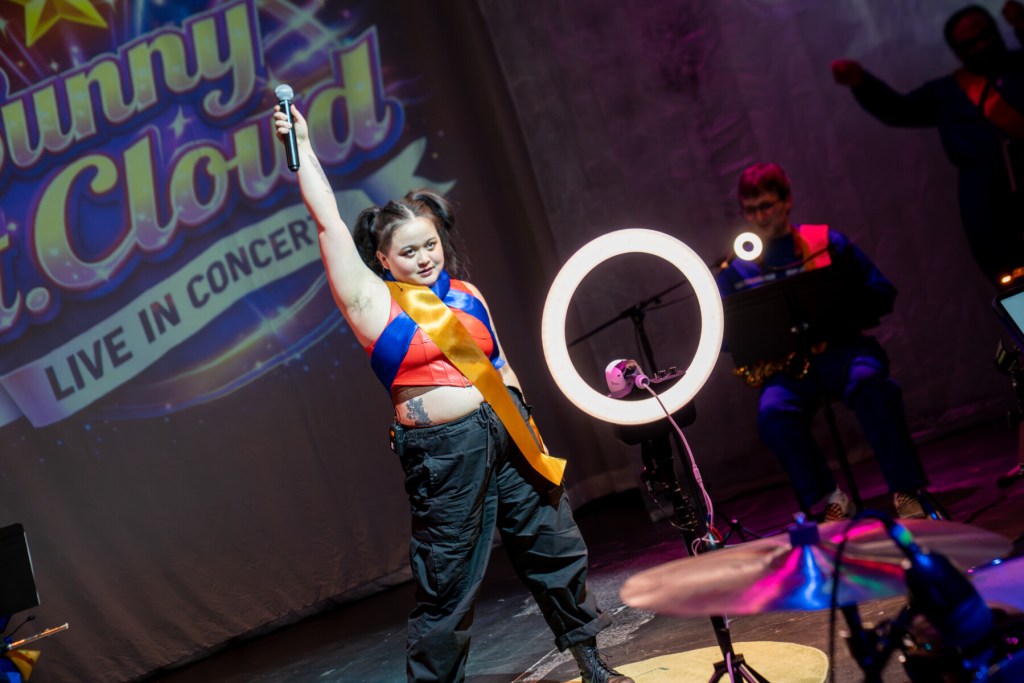 Madeleine Tran in “Dies Irae, Desirée.” Photo by Terrellyn Faye.
Walker’s libretto really shines in the details. At one point Desirée and her cohort deliver an ominous incantation, naming fake planets that may sound familiar to sci-fi fans: Arrakis, Antiterra and Solaris among them. (Another phrase in that incantation, Zazul, isn’t a fake planet but the name of a Stanisław Lem character.) One follower tweets that he made his bed thanks to Desirée, a reference to a meme about Jungian philosophy professor turned right-wing grifter Jordan Peterson.
Dies Irae, Desirée has much to say about the intersection of cult behavior and social media. Cults are defined by their fanatical emphasis on discipline and loyalty to a single leader and their isolation from the rest of society. The body of the cult is maintained via peer pressure, coercion and sometimes abuse. They develop their own mythology and language that signals belonging and shared understanding amongst members. Any organized group of people can become a cult: they often masquerade as religious sects, political parties or fraternal organizations. On the internet, cultish behavior can emerge on any website or platform around any figure, and can appear to outsiders as a benign fanbase for an obscure influencer.
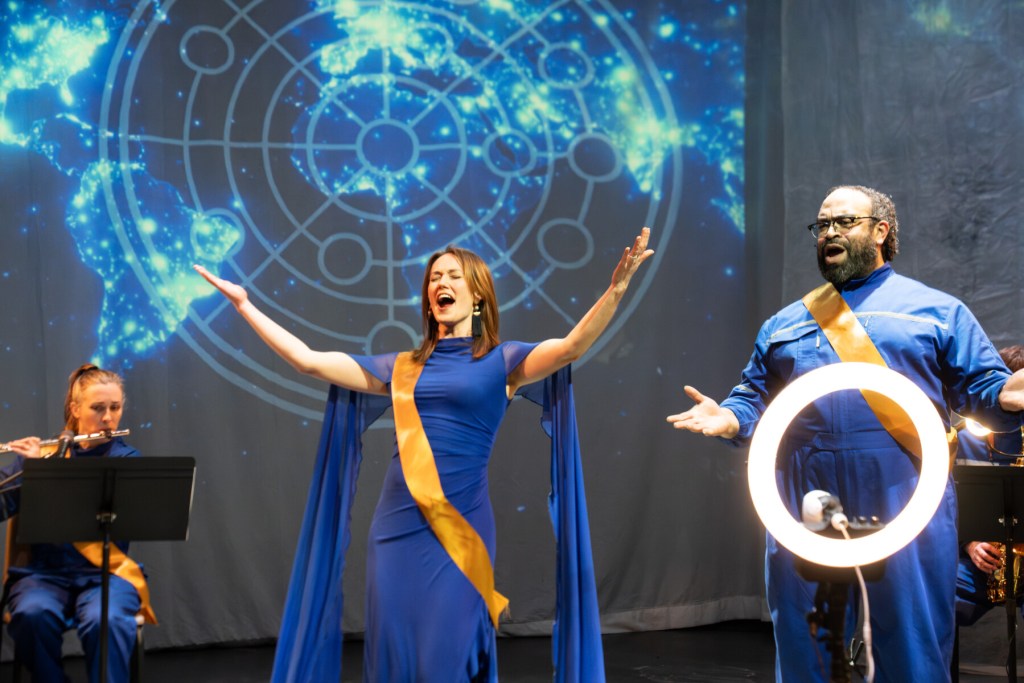 Photo by Terrellyn Faye.
The public internet offers ideas on the fringes of the mainstream a new audience. The most famous online UFO cult is Heaven’s Gate, whose Web 1.0 website is still active. Old Heaven’s Gate videos seem to be a source of inspiration for the distortions to Desirée’s livestreams. Dies Irae, Desirée does not explicitly mention grand unified conspiracy theories like Qanon, but it is in dialogue with its mythos. The opera focuses on one specific niche within internet culture – UFOlogy and new age religions – but there are overlapping connections with other nodes on that web like natural health and conspiracy theories.
Desirée’s charisma and depth of her conviction is a selling point to her audience, but there’s more than just blind faith. At one point she rants about the harm caused by Big Pharma, Big Oil, and Big Data, giving reasons for why people are awaiting the coming of Praemu. Many do seek the truths hidden amid all the slop, but we also seek entertainment and community. It becomes difficult to separate the truth from lies, and this emboldens those who claim to have the answers. A true message can get you far – but it does help to sell that truth with a pretty face, an engrossing voice and clever marketing.

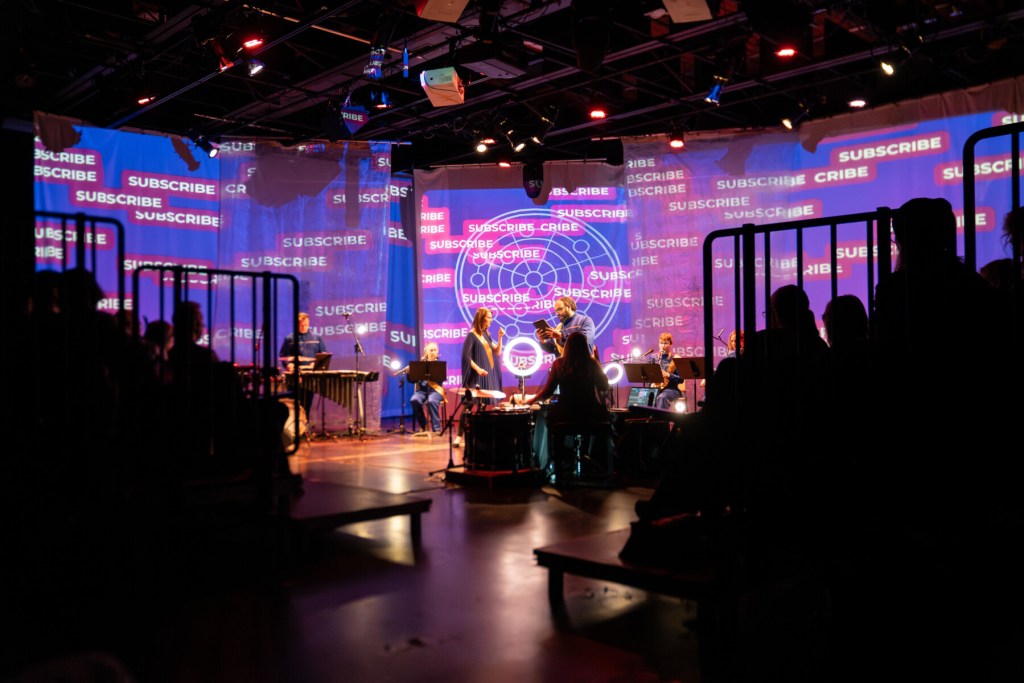 Third Angle New Music performed Maria Finkelmeier’s “Dies Irae, Desirée” at The Vault Theater in Hillsboro. Photo by Terrellyn Faye.
There are many Desirées out there, waiting for their moment to go viral. We say things “go viral” so often that the metaphor can be lost on us: ideas spread like a virus. Richard Dawkins coined the term meme to describe ideas propagating through society, just as genes propagate through reproduction. It’s also hard to ignore the parallel between meme and mimesis: memes become an imitation of reality. No wonder so much online content is now generated or curated by AI, which can only imitate, but never create. Similarly, viruses imitate organic life and take over cells for their own purposes. We should be mindful of these mind-viruses and their effects on our psyches and social selves.
In total, Dies Irae, Desirée was a thought-provoking opera that addressed the way the internet has changed our relationship with truth, belief and celebrity with a unique sonic palette, intricate libretto and careful stage and lighting design. It is a truly contemporary opera–not just “contemporary” in the sense of “new,” but of our current moment. I hope to see more like it in the future.