
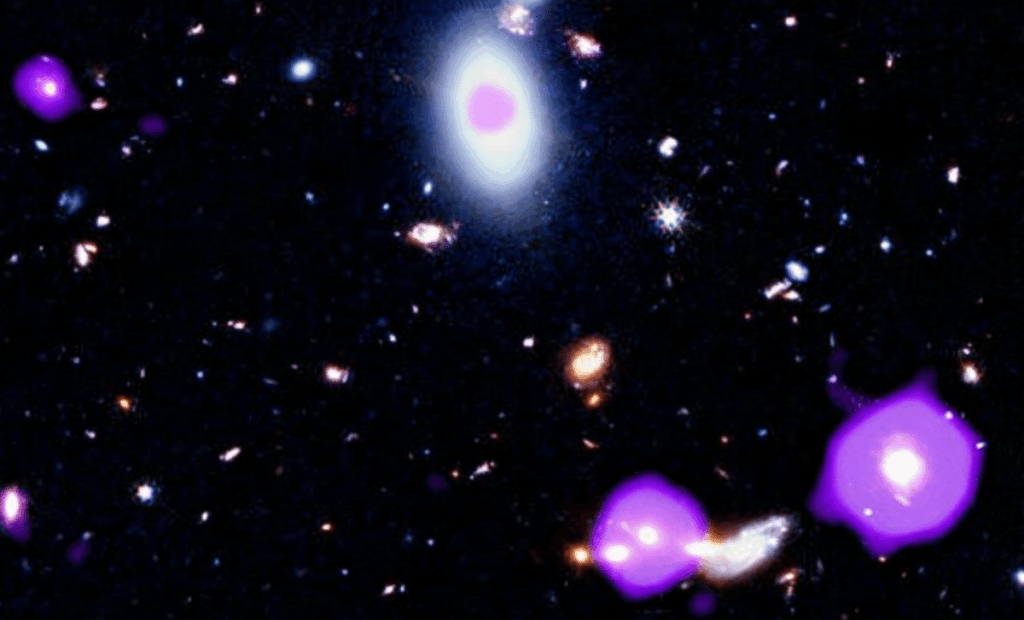
Astronomers using NASA’s Chandra X-ray Observatory have uncovered a striking shift in how supermassive black holes grow, revealing that their once rapid expansion has slowed to a near standstill over cosmic time. The findings, published in The Astrophysical Journal, shed new light on one of the most persistent puzzles in modern astrophysics: why the universe’s most extreme objects appear to have lost their appetite.
A Cosmic Slowdown Hidden In X-Ray Light
The new research draws on deep X-ray observations to trace how supermassive black holes, millions to billions of times the mass of the Sun, have evolved across more than ten billion years. By analyzing the faint glow of hot gas spiraling into these objects, scientists reconstructed a timeline of growth that shows a dramatic decline in activity.
Early in the universe, black holes were voracious, consuming matter at extraordinary rates and powering luminous quasars that outshone entire galaxies. That phase, often described as “hectic,” contrasts sharply with the present-day universe, where most supermassive black holes appear dormant or only weakly active.
“A longstanding mystery has been the cause of this big slowdown,” said Zhibo Yu of Penn State University, lead author of the new study. “With these X-ray data and supporting observations at other wavelengths, we can test different ideas and narrow down the answer.”
The study, published in The Astrophysical Journal, combines multiple datasets to capture both bright and faint black hole activity, offering one of the most comprehensive views yet of this long-term decline.
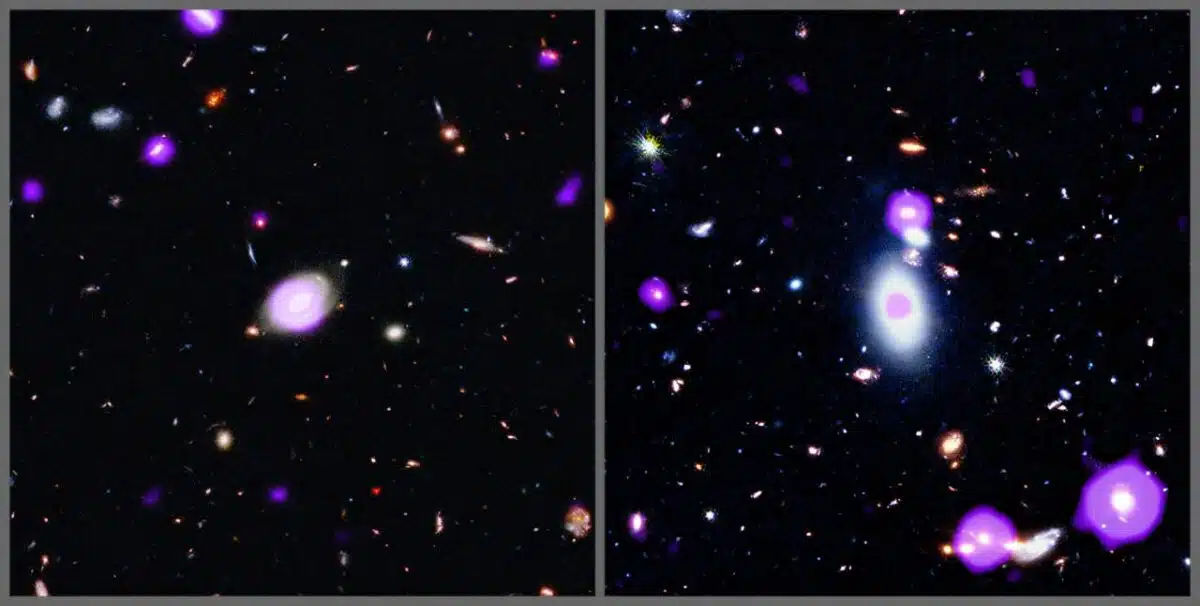 X-ray, Optical, and Infrared Images of J033225 and J033215. Credit: X-ray: NASA/CXC/Penn State Univ./Z. Yu et al.; Optical (HST): NASA/ESA/STScI; Infrared: NASA/ESA/CSA/STScI; Image Processing: NASA/CXC/SAO/P. Edmonds, L. Frattare
Combining Telescopes To Reveal The Full Picture
A key strength of the research lies in its multi-observatory approach. Scientists merged data from Chandra with observations from other X-ray missions, enabling them to detect a wider range of black hole behaviors than any single telescope could reveal.
This approach allowed researchers to account for both the brightest, most active black holes and the far more numerous faint ones that are often overlooked. The result is a more balanced and realistic picture of how black holes grow across cosmic history.
“By combining these data from different X-ray telescopes, we can construct a better picture of how these black holes are growing than any one telescope could do alone,” said co-author Fan Zou of the University of Michigan. “We can find out why over ten billion years the growth of supermassive black holes has gone from hectic to leisurely to glacial.”
The phrase “glacial” is not an exaggeration. The data indicate that modern black holes are accreting matter at rates far below their ancient peak, suggesting a fundamental shift in the conditions of the universe.
Why Did Black Holes Lose Their Appetite?
The findings point toward several possible explanations, each tied to how galaxies evolve over time. In the early universe, galaxies were rich in cold gas, the raw fuel for black hole growth. Frequent collisions and mergers between galaxies likely funneled this material into their central regions, feeding black holes efficiently.
As the universe aged, that supply dwindled. Star formation consumed much of the available gas, while energetic processes, such as winds from stars and feedback from black holes themselves, may have heated or expelled what remained. Without a steady inflow of material, black holes simply had less to consume.
Another factor could be the stabilization of galaxies. As structures matured, fewer disruptive events occurred to drive gas toward galactic centers. This would naturally lead to a quieter phase of black hole evolution.
The study does not point to a single cause but instead narrows the range of viable explanations, marking a significant step toward resolving the mystery.
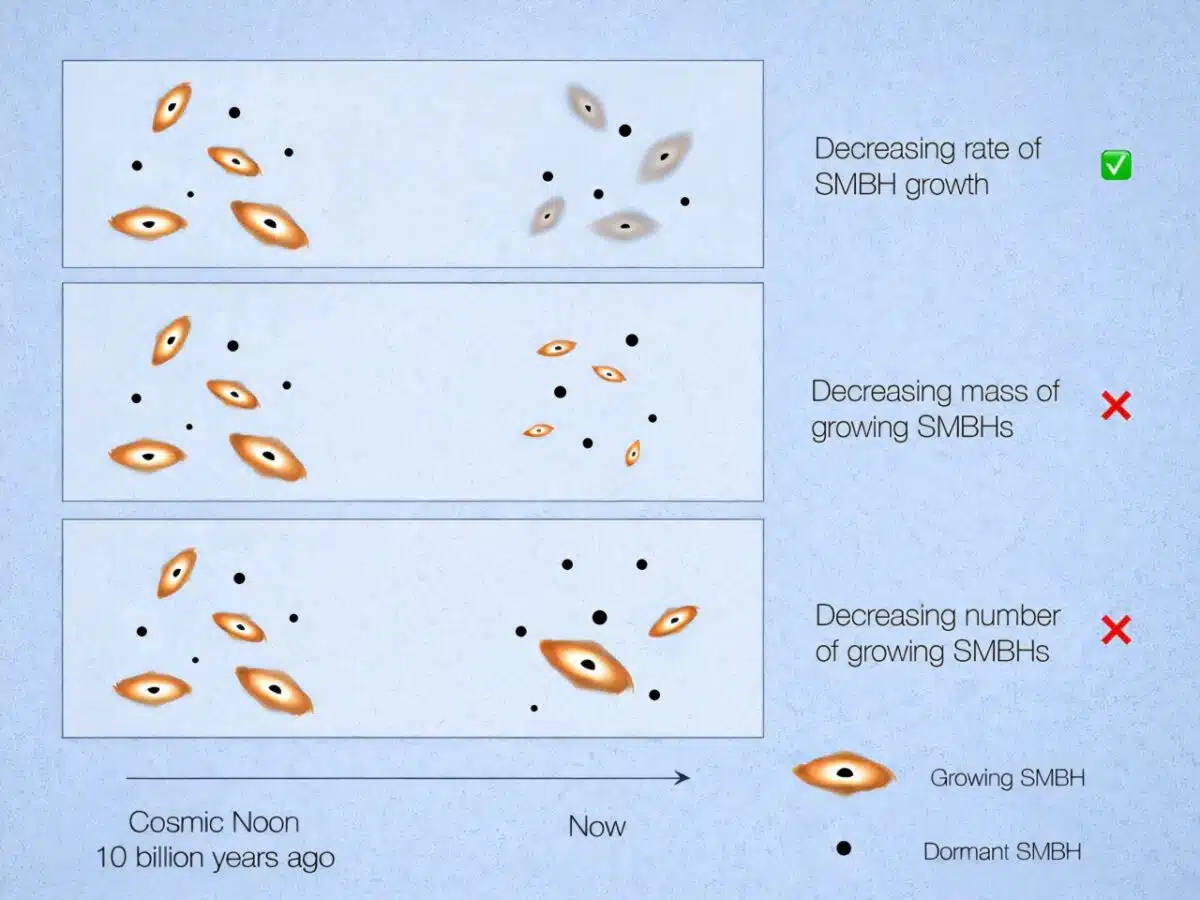 Illustration of Supermassive Black Hole Growth Scenarios. Credit: Penn State/Z.Yu
A New Window Into Cosmic Evolution
Understanding how black holes grow is not just about the objects themselves, it is central to understanding galaxies and the large-scale structure of the universe. Supermassive black holes influence their host galaxies through powerful energy output, shaping star formation and galactic dynamics.
By mapping the decline in black hole growth, astronomers gain insight into how galaxies transitioned from chaotic, rapidly evolving systems into the more stable structures seen today.
The results also highlight the importance of long-term, multi-wavelength observations in astrophysics. Only by combining data across different instruments and timescales can scientists piece together processes that unfold over billions of years.
As new observatories come online, including next-generation X-ray and infrared telescopes, researchers expect to refine this picture even further, probing deeper into the early universe and uncovering how the first black holes began their rise before slowing to the quiet state observed today.