
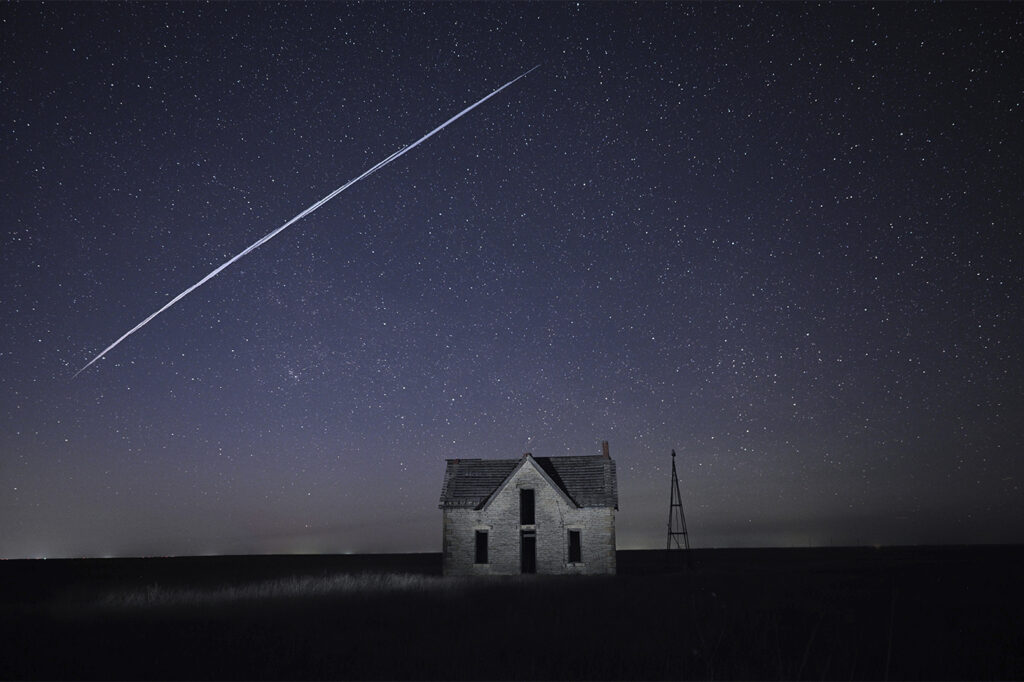
An array of man-made satellites beam sunlight down to Earth. An artificial constellation of thousands of satellites illuminates the night sky.
These scenarios might sound like science fiction. But between SpaceX’s plans to launch 1 million satellites as part of its satellite-based internet network Starlink, and Reflect Orbital’s sunlight reflecting space mirrors, private companies could change the way our night sky looks. In fact, it could look more like daytime.
For life on Earth, which relies on a traditional day-night cycle, that could spell disaster, experts said.
“In places like cities, where you don’t get night anymore in the traditional sense, a lot of species really struggle,” said Anncy Thresher, an assistant professor of public policy, urban affairs and philosophy at Northeastern University who focuses on environmental issues. “We know that’s true just from streetlights and the lights from normal human activity, let alone if you’re pointing a beam of sunlight at areas.”
Radically changing the night sky, which is what the projects underway would do, will impact every form of life on Earth, from humans to plants.
If approved by the Federal Communications Commission (FCC), Reflect Orbital aims to launch 50,000 satellites that would reflect beams of sunlight back to targeted areas of Earth by 2035. The company claims its technology would be used to expand solar energy production, extend agricultural seasons and even replace streetlights in cities. Reflect Orbital did not respond to a request for comment.
Meanwhile, SpaceX, Elon Musk’s commercial space operation, hopes its 1 million satellites would serve as floating data centers. That is more than 70 times the number of satellites currently orbiting Earth, a “completely unprecedented” amount of objects in space, Thresher said. SpaceX did not respond to a request for comment.
 The addition of new light sources in the night sky could offset migratory patterns and circadian rhythms for species across the globe, said Anncy Thresher, an assistant professor of public policy, urban affairs and philosophy at Northeastern University. Photo by Alyssa Stone/Northeastern University
The fundamental problem is that it’s “unclear who has jurisdiction in space,” Thresher said. And the modern space race remains one with few limits for private companies with dreams of reaching the great unknown.
The 1967 Outer Space Treaty and the 2020 Artemis Accords are the only two real pieces of regulation determining how governments and companies can operate in space. In this early stage of commercial space launches, neither agreement requires much of companies. In the last year, the Trump administration has only reduced the amount of oversight for space-based operations in an attempt to “ensure American space superiority.”
In this murky space, are private companies’ efforts to find “a solution in search of a problem,” worth the biological and astronomical cost, Thrasher wondered.
For instance, birds use the stars to navigate and determine their migration patterns. The addition of more “stars” will disrupt those biologically ingrained behaviors with disastrous results, said Tiffany Nichols, an assistant professor of history and civil and environmental engineering at Northeastern. Nichols also co-chaired the American Astronomical Society’s Committee for the Protection of Astronomy and the Space Environment.
“We’re seeing an increase in the death of birds because they’ll start colliding with things because they can’t discern what is real from what is artificial,” Nichols said.
Pollinators such as bees will also be deeply impacted by the creation of more artificial light. While small, these creatures are the keystone to ecosystems worldwide.
“Those particular insects are so highly sensitive to light, so even if it’s in space, that can affect their pollination levels,” Nichols said. “We are starting to see an underpopulation of flowers. If you affect pollination change, it has a cascading effect across the whole ecosystem for other plants and pollinators.”
These effects will hit humans too, and not just biologically.
The human eye is designed to see things more clearly in low light, Nichols said. The more light there is, even from satellites, the more it needs to adjust in dark environments because “we can’t see objects as well as we could if the background was actually darker or lowly lit,” she explained.
Astronomers like Nichols are also increasingly concerned that thousands of new satellites could severely damage humanity’s ability to investigate the cosmos.
The light generated from all these satellites, particularly Reflect Orbital’s, will essentially blind the many powerful ground-based telescopes scientists use, Nichols said.
The American Astronomical Society (AAS) has already lodged a petition with the FCC to deny Reflect Orbital’s satellite project. The society claims that 80,000 satellites, a little more than what the company has planned, would reduce the ability to see massive portions of the night sky.
Northeastern Global News, in your inbox.
Sign up for NGN’s daily newsletter for news, discovery and analysis from around the world.

“If you hold your finger up straight and look behind your fingertip at the night sky, there are probably 80,000 of the oldest galaxies behind your finger,” Nichols said. “So, if one pixel gets blotted out, we are blotting centuries, decades, eons of history and cosmology.”
Without intervention, the inability to see the stars will continue to have ripple effects, Thresher said. Cultures across the globe use the stars to navigate. Farmers use traditional day and night cycles to determine when to plant crops.
“Basically, every community, every culture on Earth has looked up and has narratives, has constellations, has histories, has traditions associated with the night sky,” Thresher said. “The loss of that is hard and is a barrier against our ability to see ourselves as part of a bigger universe.”