
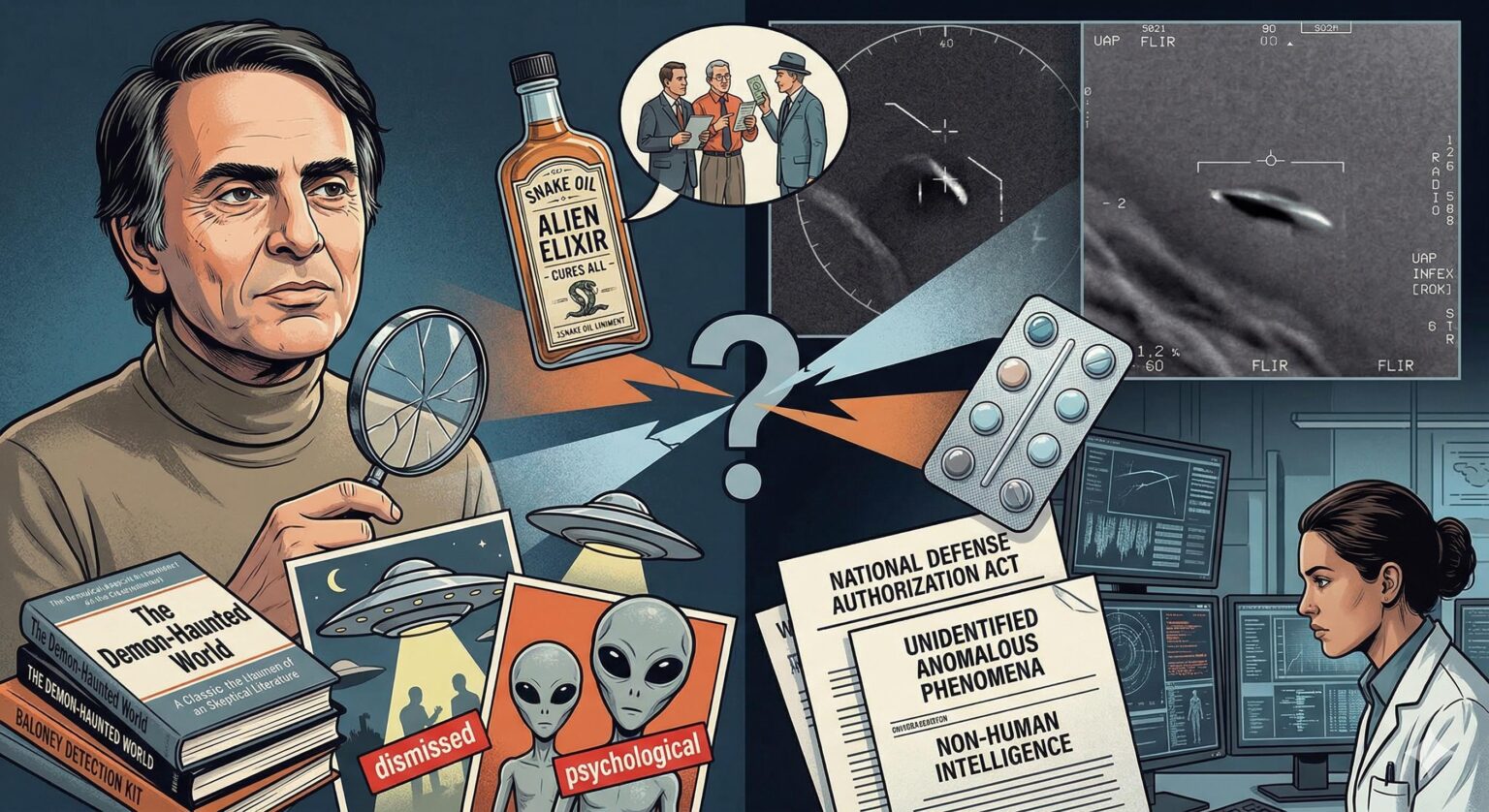
I loved Carl Sagan’s The Demon-Haunted World. I read it before looking into the evidence surrounding the phenomena. So when he explained alien abduction accounts as survivors of childhood abuse constructing a psychological narrative to cope, I was convinced he was right.
The reason everyone sees gray aliens is because everyone in the culture expects aliens to look that way. It’s a social contagion, not a real thing.
The centerpiece of the book is the "baloney detection kit," a set of tools for critical thinking. The fact that spends a lot of words on that tells me that Sagan was worried about critical thinking.
And frankly when one sees the stupid, crazy, awful things people write in 2026, he wasn’t wrong to be worried. Sagan writes that credulous acceptance of nonsense costs people money, and that when governments and societies lose the capacity to separate BS from truth, the results can be catastrophic.
Let’s assume Sagan was aware of unexplained UAP and related things. I’ve read the theory that he was co-opted to dismiss these things publicly. Maybe that’s true, maybe it’s not. But what if Sagan knew some of these things were true, and that there was a Phenomena. But to admit it, would be to open the flood gates to all sorts of charlatans. That would be bad and would hurt people. So, it’s safer to help dismiss it and minimize the damage to society, or at least to the part of society that today clicks the phishing links, and after Disclosure will throw their money at every scammer promising psi training or whatever.
But here's where I think Sagan made a mistake. Consider pharmaceutical drugs. We all accept that real medicines exist and genuinely help people. That fact also empowers snake oil salesmen to sell unregulated garbage by borrowing the credibility of real medicine. The solution has never been to deny that medicine works, or to refuse to discuss it seriously. We handle fraud through regulation and education, not by treating the whole category as a joke. The existence of con artists in a domain is not evidence that the legitimate phenomena in that domain don't exist.
That's essentially what happened to UAP. Serious evidence gets lumped in with psychic healers and astrologers as if they're the same quality of claim.
The charitable read on Sagan is that he understood what would happen if a scientist of his stature said there was something real here. It wouldn't just open the door to serious inquiry, it would flood it. Every charlatan with a newsletter would get a boost. The public doesn't neatly separate "we should investigate this rigorously" from "therefore everything anyone has ever said about aliens is probably true." Sagan knew that, and I think he made a calculated decision that the risks of engaging seriously outweighed the costs of dismissal.
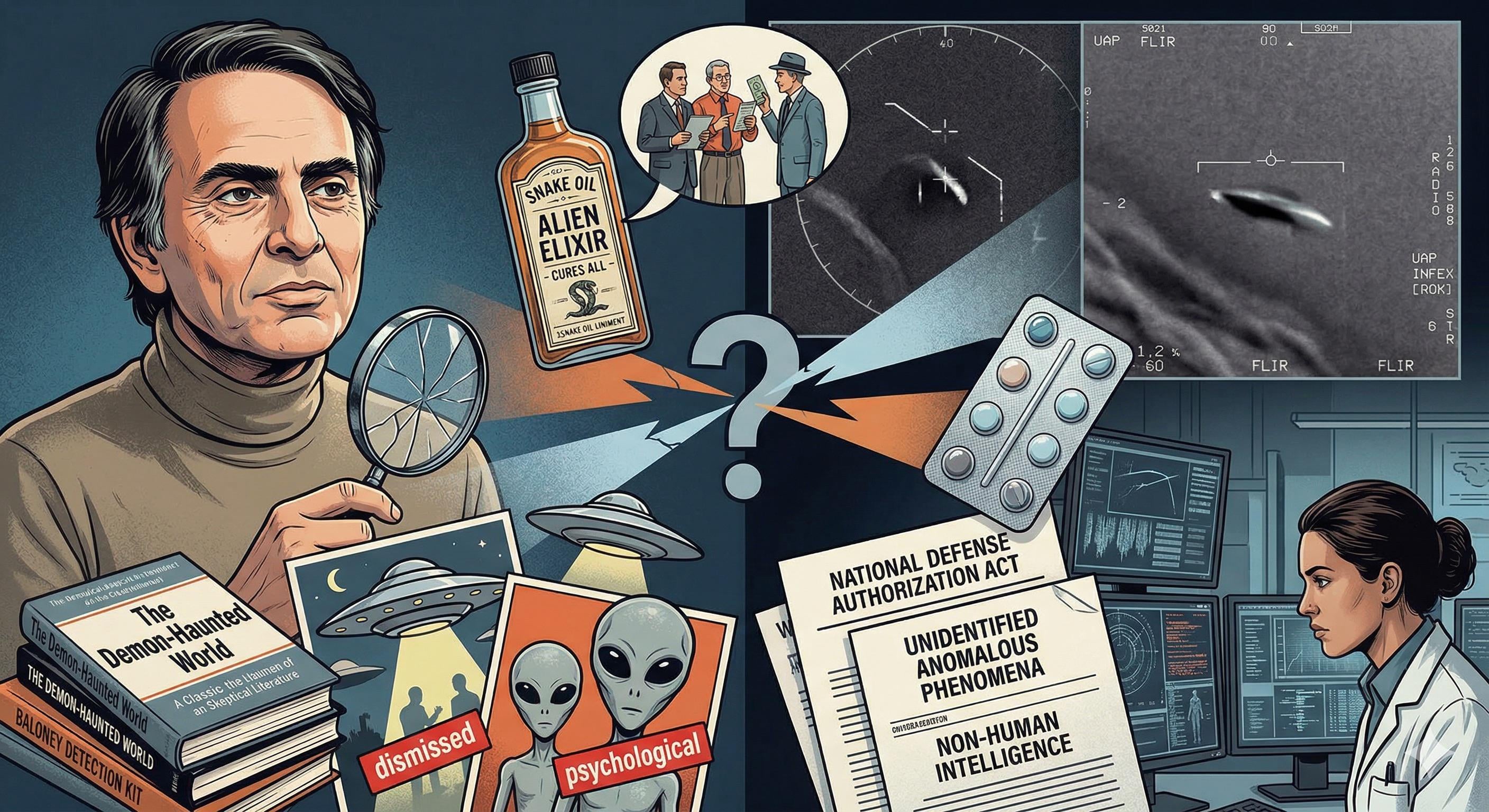
When I first started looking into UFO stuff, I saw an interview with Danny Sheehan on YouTube where he talked about the UAP Disclosure Act as part of the National Defense Authorization Act. The law mandates that every government agency collect and review records relating to, quoting directly from the legislative text, "unidentified anomalous phenomena, technologies of unknown origin, and non-human intelligence."
When I first heard this, I was surprised. Shouldn’t this have been the top story on the news for a week or a month or a year? To me the wording of this law is the best evidence that there’s a there there. I can’t vet every self-claimed experiencer to see if they are for real or not. But when the Congress talk about NHI, it should wake everyone up.
by Immediate_Boss7500
8 Comments
Because extraordinary claims demand extraordinary evidence.
During Sagan’s time, UFO lore had been very tainted and curated by the CIA’s interests and disinformation campaign. It would be extremely difficult for a busy man such as Sagan, to do his own research on the topic that was already discredited.
No evidence, he dealt with reality.
wasn’t it sagan that blased off a plaque into space with instructions on how to find humans and where our earth is ? kind of stupid really.
When Hynek and Sagan were commissioned to debunk UFOs, Hynek realized there was something to investigate and was surprised when Sagan came to conclusions without doing any investigating. That is to say, I think Sagan realized it was better for his career to maintain the status quo and his work reflects that choice.
He was very interested in it as a kid, he possibly dismissed it during that phase.
He also was possibly read in to some extent and believed in the need to maintain the cover up.
He was part of the Condon Committee and was heavily critical of fellow scientists who said that the subject should be respected and researched scientifically.
This is the irony.
He wouldn’t allow for a situation where we had extraordinary evidence, because he shut down anyone trying to find it.
As much as I admire him, this proves he was either onboard with it, or a scientific zealot, for which we have been held back by for far too long.
He did write the book Contact. Which became a brilliant film. He didn’t dismiss them. He hypothesized what meeting them might look like and surmised that our understanding of them is insufficient if they exist.
> But here’s where I think Sagan made a mistake. Consider pharmaceutical drugs.
This is more like AI than pharma. Imagine today’s world but no one has ever considered AI. One gal knows for a fact it’s possible. But telling people that will lead to an AI gold rush and all the issues we face with that. I know there are plenty of people who would have gatekept knowledge about AI if they could
> When I first heard this, I was surprised. Shouldn’t this have been the top story on the news for a week or a month or a year?
One of my examples that showcase how critical thinking close to non existent. I very much give a lot of blame to “extraordinary” evidence. It’s a completely anti science perspective. How does one judge what is extraordinary without having all the answers? It legitimately feels purposely planted.
Credence people, think credence. Take observations, build models, use the ones that are more useful. Very simply. No need to project ones own subjectivity on data. If the model doesn’t match obverse. (think using newtonian gravity when it works and relativity when more precision is needed)
The desire to disregard observations/data because it seems “extraordinary” is flat out NOT SCIENCE.
Big fan of his but he did label something which could be ordinary as extraordinary and then said that type of claim needs extraordinary evidence.