
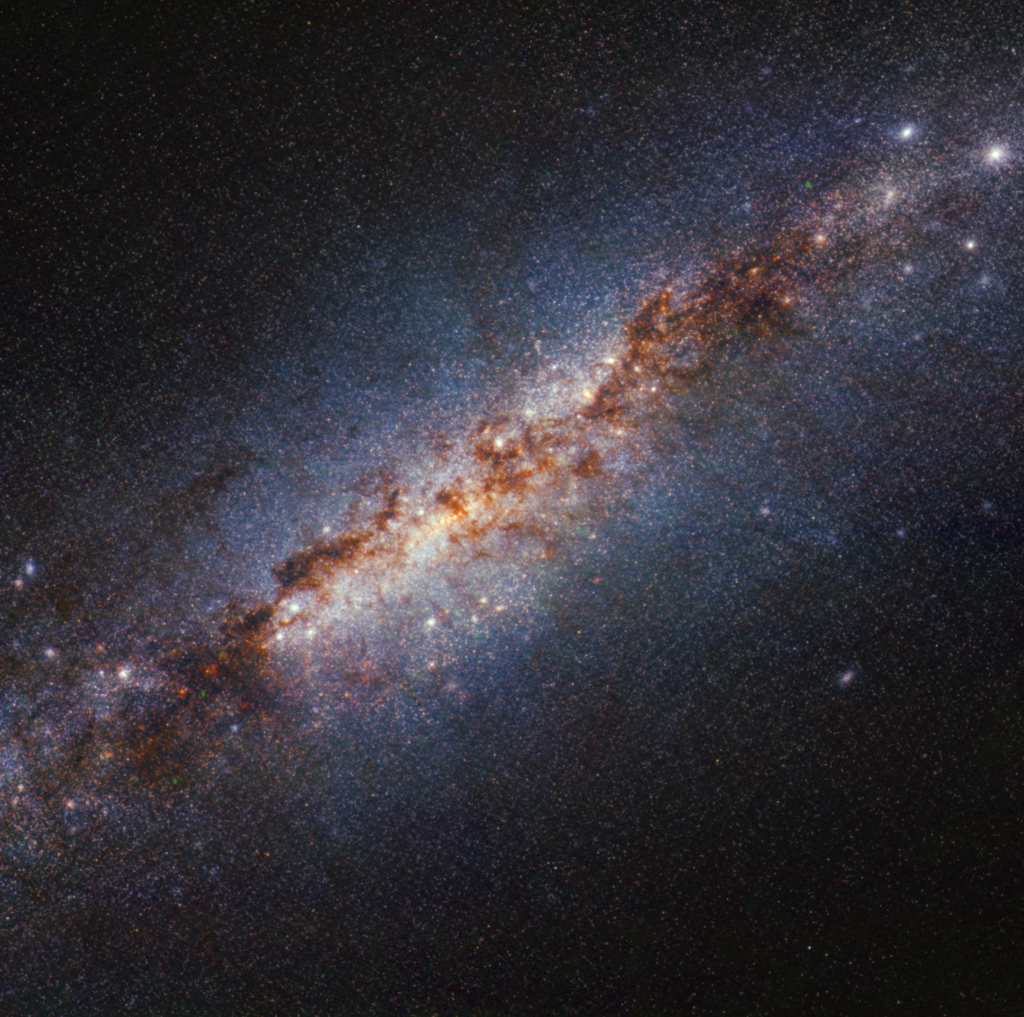
Astronomers at Arizona State University have joined an international team that recently reached a major milestone: For the first time, they directly measured the speed of a superheated wind blowing through the center of a nearby galaxy.
Professor Evan Scannapieco and PhD candidate Skylar Grayson from ASU’s School of Earth and Space Exploration helped measure that gas shooting out of galaxy M82 moves at speeds over 2 million miles per hour, fast enough to travel the distance between the Earth and the moon in about six minutes.
Their results, published today in Nature, used data from the Resolve instrument on the XRISM spacecraft, which can detect tiny changes in X-ray light from superheated gas.
The cool wind of galaxy M82 drives gas and dust up to 40,000 light-years from its core, as shown here using data from NASA’s Chandra X-ray Observatory and Hubble and Spitzer space telescopes. The inset shows a Chandra view of the galaxy’s central region, where a cauldron of stellar activity kick-starts the larger-scale outflow. Photo credit: NASA’s Goddard Space Flight Center; X-ray: NASA/CXC/JHU/D.Strickland; Optical: NASA/ESA/STScI/AURA/The Hubble Heritage Team; Infrared: NASA/JPL-Caltech/University of Arizona/C. Engelbracht; XRISM Collaboration et al. 2026
The XRISM mission is led by JAXA, the Japan Aerospace Exploration Agency, working with NASA and the European Space Agency (ESA). NASA and JAXA also worked together to develop the Resolve instrument.
“Some of our early models of starburst galaxies were developed in the 1980s, and we’re finally able to test them in ways that weren’t possible before XRISM,” Grayson said. “It’s fun because it provides opportunities to figure out why the model might not be capturing everything that’s going on in the real universe.”
M82, also known as the Cigar Galaxy, is 12 million light-years away and creates stars about 10 times faster than the Milky Way.
In astronomy, M82 is well known for its extended wind, which stretches out to 40,000 light-years and propels huge quantities of gas and dust. Scientists have studied it with many missions, including NASA’s Chandra, Webb, Hubble and retired Spitzer space telescopes, trying to connect the dots between the stellar activity and the large-scale outflow.
Researchers particularly want to understand the role of cosmic rays. These high-speed charged particles are found throughout the cosmos and are accelerated by some of the same events scientists think produce winds like in M82. There’s a possibility they are a main source of outward pressure on the gas.
The Resolve instrument aboard the XRISM (X-ray Imaging and Spectroscopy Mission) spacecraft captured data revealing the velocity of the hot wind at the center of starburst galaxy M82. The energy range of iron emission lines show that the gas moves around 2 million miles (about 3 million kilometers) per hour. Inset: XRISM Xtend instrument’s image of M82. Photo credit: NASA’s Goddard Space Flight Center, JAXA/NASA, XRISM Collaboration et al. 2026
Thanks to the high resolution and sensitivity of XRISM’s Resolve instrument, the team measured the speed and temperature of the hot wind by studying X-ray signals from ultrahot iron in the galaxy’s center. The cause of this wind was a mystery, but XRISM has now shown that the gas is heated enough to drive the larger outflow without extra help from cosmic rays.
The X-ray light indicates that the temperature of this gas is about 45 million degrees Fahrenheit, roughly 5,000 times hotter than the surface of the sun. This intense heat creates pressure that pushes the gas outward. The wind forms as gas moves from high-pressure to low-pressure areas, the same basic process that causes winds on Earth.
“Outflows like this are one of the most important ways that galaxies regulate their growth. By finally measuring the speed of the hot gas in M82, we are one step closer to building realistic models of how star-driven feedback drives galaxy evolution over cosmic time,” Scannapieco said.
The discovery also brings up new questions. Each year, the center of the M82 galaxy releases enough gas to make seven stars the size of our sun, but only four solar masses go into the wind. The rest is still missing, and ASU researchers hope to find out where it goes.
For astronomers like Grayson and Scannapieco, the discovery demonstrates how ongoing fundamental science transforms long-standing theories into tested facts. As real-world measurements now put models of interstellar evolution to the test, ASU continues to hold a significant role in increasing our understanding of the universe.
Press release written by Jeanette Kazmierczak of NASA’s Goddard Space Flight Center with contributions from Kim Baptista of Arizona State University’s School of Earth and Space Exploration.