
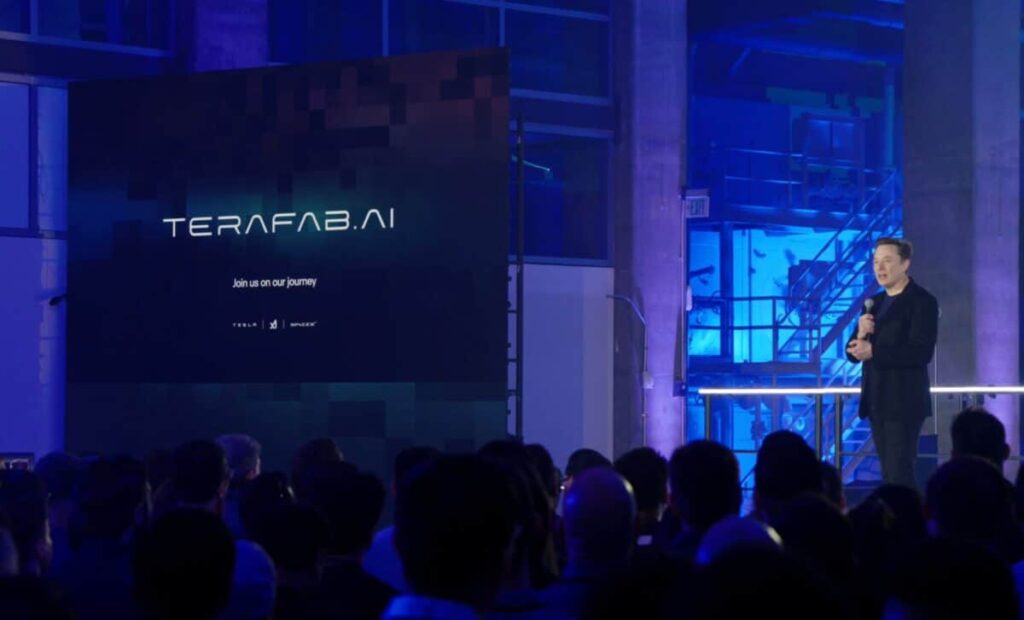
Elon Musk has unveiled a plan to move AI infrastructure off Earth entirely, and launch it into orbit using electromagnetic “cannons” built on the Moon. The proposal, revealed during a weekend presentation at Giga Texas, centers on a concept called Project TERAFAB, targeting what Musk calls the “terawatt ceiling” of Earth-bound computing.
The ambition is staggering in scale. Where the world’s chipmakers currently produce around 20 gigawatts of compute power annually, Musk is targeting a terawatt, and eventually a petawatt. To get there, he’s betting on the Moon’s unique advantages: a vacuum environment, low gravity, and solar panels roughly five times more efficient than anything deployable on Earth’s cloud-covered surface.
It’s an idea that fuses cutting-edge AI ambition with one of science fiction’s oldest concepts. And while the engineering challenges are immense, Musk insists the underlying technology is not entirely new territory.
A Moon-Based Launch System With 19th-Century Roots
The electromagnetic mass driver at the heart of Musk’s proposal isn’t a new idea. According to a 1937 book called Zero to Eighty, Princeton engineering professor Edward Fitch Northrup first theorized the concept of a modern “mass driver” or railgun, a system that uses sequentially energized electromagnets to accelerate a magnetic object along a track, eliminating the need for chemical propellants entirely.
Northrup, who held 104 patents including an induction furnace capable of reaching 3,600 degrees Fahrenheit, published the book pseudonymously at age 71, framing his technical ideas as the autobiography of a fictional character. In it, he described not just working models, but a logical extension of the technology: a manned spaceflight to the Moon.
Nearly 90 years later, Musk’s version envisions electromagnetic tracks stretching dozens of kilometers across the lunar surface, flinging AI-packed satellites to lunar escape velocity using solar energy alone, with no discarded booster stages and no volatile rocket fuel.
The Hardware Behind the Vision
Two competing designs are under consideration for the lunar launcher. Railguns deliver a single powerful burst of electromagnetic force, while coilguns use a sequence of timed magnets for steady, controlled acceleration. According to reporting by Interesting Engineering, the coilgun approach is the preferred option, as it better protects sensitive AI cargo from the shock of rapid launch.
The satellites themselves would be compact, each packing around 100 kilowatts of compute power, roughly equivalent to a full rack of high-end AI hardware. Over time, Musk envisions scaling those units to megawatt-class satellites feeding into a distributed orbital network delivering 1,000 times the capability of current systems.
To manufacture those satellites at the required scale, Musk’s plan calls for a lunar robotics factory producing solar-powered AI hardware on-site, then dispatching it via mass driver. SpaceX’s Starship would handle initial hardware delivery to the Moon before the system becomes, in Musk’s framing, largely self-sustaining.
The Math, and the Skeptics
The numbers invite scrutiny. According to The Register, reaching a petawatt of orbital computing power would require launching over a million tons of material into space, which, by back-of-envelope calculation, means roughly 135 Starship launches every single day, or one every ten minutes around the clock.
Musk has also announced a parallel chip fabrication initiative, with an “advanced fab” in Austin, Texas, called Terafab, designed to produce any kind of chip and iterate designs rapidly. He mentioned “some very interesting new physics” that he is “confident will work,” though he offered no timeline. His suppliers, Nvidia, Samsung and Micron, have reportedly been told he intends to buy whatever new capacity they can produce.
NASA has previously studied electromagnetic launching seriously, with Stan Starr of Kennedy Space Center’s Applied Physics Laboratory noting that the core components “have already been developed or studied.” Still, no mass driver has ever left the drawing board for an actual lunar deployment. Musk, now 54, summed up his personal stake simply: “I want to live long enough to see the mass driver on the Moon.”