
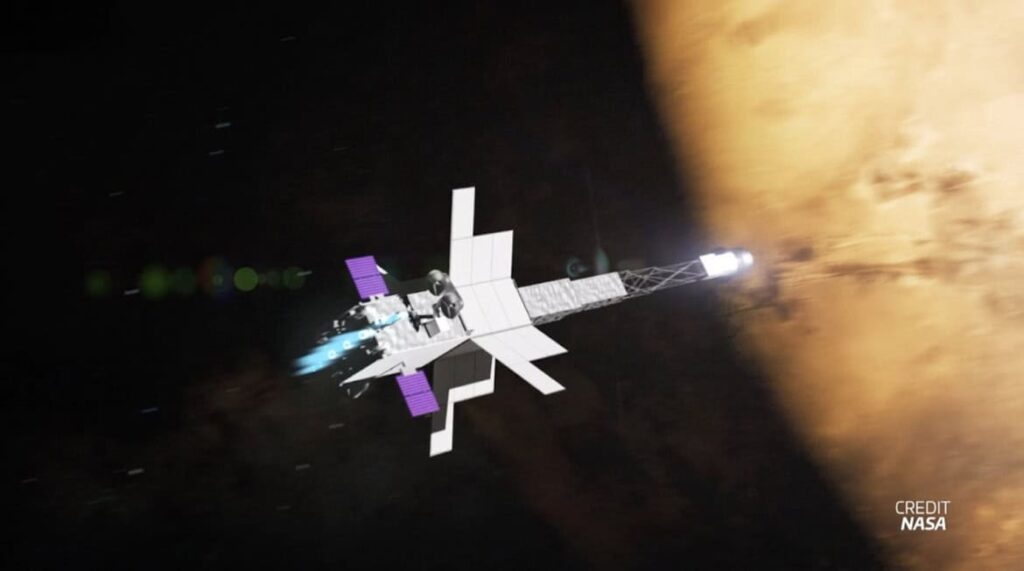
 Illustration of NASA’s SR-1 Freedom spaceship with Mars in the background. Credit: NASA.
NASA is officially sending a fleet of robotic helicopters to Mars in 2028.
The mission, called Skyfall, will deploy three advanced rotorcraft to scout future landing sites for human astronauts. But the Martian choppers aren’t the biggest news. To get this fleet to the Red Planet, NASA is resurrecting a technology it hasn’t used since the 1960s: nuclear fission.
During its “Ignition” event on Tuesday, the space agency announced that Skyfall will hitch a ride on Space Reactor-1 (SR-1) Freedom. When it launches, SR-1 Freedom will become the first nuclear-powered interplanetary spacecraft in human history. By trading traditional chemical rockets for a live fission reactor that powers electric thrusters, the agency hopes to fundamentally rewrite how we move heavy cargo across the solar system.
Breaking a 60-Year Nuclear Curse
NASA had previously used nuclear power in space, but not like this. Deep-space probes like Voyager, which are now traveling in interstellar space beyond the solar system, have relied on radioisotope thermoelectric generators (RTGs). RTGs are essentially nuclear batteries. They capture the heat of radioactive decay to power instruments. However, they do absolutely nothing to actually push the spacecraft forward.
Nuclear electric propulsion (NEP) is a completely different beast. It operates much like a miniature nuclear power plant right here on Earth, using a live onboard fission reactor.
“Requiring operating temperatures less than nuclear thermal propulsion, the thermal energy produced by the reactor generates electricity, which is then used to power highly efficient electric thrusters,” NASA officials explained in a description of the agency’s NEP efforts.
The United States has not successfully flown a fission reactor in space since the SNAP-10A mission back in 1965. Since then, the government has burned through more than $20 billion on various flight programs without ever launching a working system.
NASA plans to break that curse by starting small. Rather than building a massive megawatt-class reactor, SR-1 Freedom will use an existing, smaller 20-kilowatt-electric (kWe) reactor. This reactor runs on high-assay low-enriched uranium and uranium dioxide, encased in a boron carbide radiation shield.
×
Thank you! One more thing…
Please check your inbox and confirm your subscription.
The reactor will solely generate electricity to power xenon ion thrusters. The ion thrusters and power systems will come from repurposed Lunar Gateway hardware, initially designed as the lunar space station’s power and communication hub.
 Schematic of nuclear reactor on NASA’s SR-1 Freedom spaceship, meant to power its ion thrusters. Credit: NASA.
“SR-1 Freedom will close a 60-year gap in American space fission flight heritage. Along with our Department of Energy and industry partners, it establishes the regulatory precedent, the nuclear-qualified workforce and the flight-proven hardware that every future space nuclear mission will inherit. It is the foundation for everything that follows,” Steve Sinacore, program executive for NASA’s Space Reactors Office, noted during the event.
A Martian Scouting Party
Once SR-1 Freedom completes its year-long journey and arrives at Mars in late 2029, it will deploy the Skyfall payload.
We already know that rotary flight works on the Red Planet. Ingenuity, the plucky technology demonstrator that arrived with the Perseverance rover, proved that by logging a staggering 72 flights before retiring earlier this year. Skyfall simply scales up that ambition.
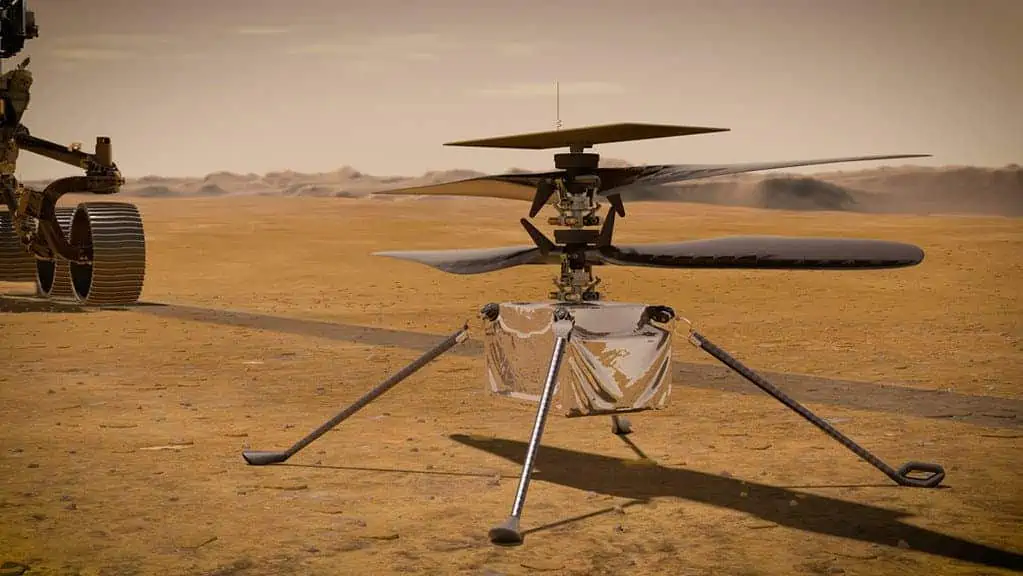 Illustration of the Ingenuity Mars Helicopter. Image credits GPA Photo Archive / Flickr.
Unlike Ingenuity, which was essentially a proof-of-concept, the three Skyfall helicopters have serious jobs to do. They are an advanced scouting party. Their primary mission is to assess specific target areas and determine if human astronauts can safely land and survive there.
They will also look beneath the Martian dirt.
“The Skyfall helicopters will carry cameras and ground-penetrating radar to scout a future landing site, to understand the slopes and hazards for human-scale landers,” Sinacore said during the briefing.
“They will also map and characterize the subsurface water ice to find out where the water ice deposits are, along with the size, depth and other important characteristics,” Sinacore added.
Water is heavy and incredibly expensive to launch from Earth. If humans are going to survive on Mars, they need to live off the land. Finding accessible subsurface ice is the first step toward generating breathable oxygen, drinking water, and even rocket propellant for the trip home.
 Skyfall helicopter being deployed on Mars. Credit: AeroVironment.
Building Space Railroads
Why is NASA pushing so hard for nuclear propulsion right now? It comes down to basic physics and the harsh realities of space exploration.
Solar power works great near Earth. But the farther you travel from the Sun, the less useful solar panels become. By the time you reach Jupiter, the efficiency of solar cells plummets to about 4 percent. Beyond Jupiter, it is virtually zero.
Even on the surface of Mars or the Moon, solar power is fragile. Mars is infamous for planet-wide dust storms that can block out the sun for months, which is exactly how NASA lost the Opportunity rover.
“Nuclear power will keep lunar bases operating through the 14-day (354-hour) night,” Sinacore explained during the Ignition event.
Nuclear fission provides continuous, reliable energy regardless of the weather or the distance from the Sun. It also provides a vastly superior method for moving heavy cargo through space. Chemical rockets are fast, but they are incredibly inefficient, requiring massive amounts of fuel.
“Nuclear-powered electric propulsion spacecraft will move cargo in space like railroads move freight on earth with incredibly high efficiency compared to chemical propulsion,” Sinacore said.
Scrapping the Orbiting Outpost
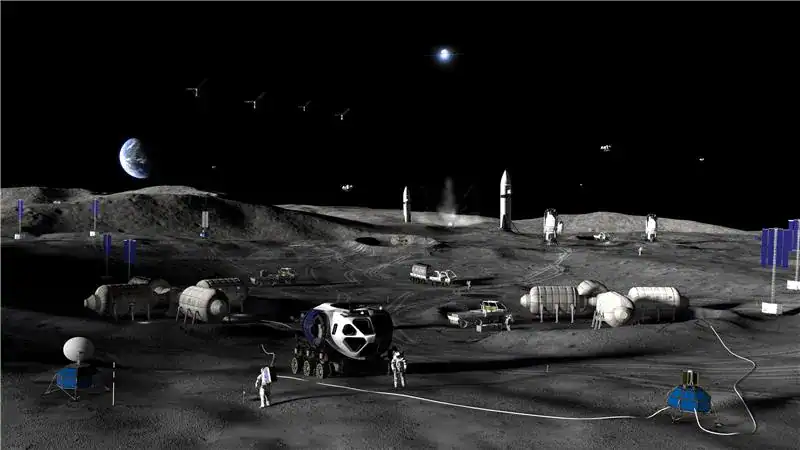 Image credits: AeroVironment/NASA.
SR-1 Freedom was not the only massive pivot announced at the Ignition event. NASA is fundamentally restructuring its approach to lunar exploration to align with President Donald Trump’s National Space Policy.
The most shocking casualty of this realignment is Gateway, the long-planned space station meant to orbit the Moon.
NASA Administrator Jared Isaacman announced that the agency is pausing Gateway to pour its resources directly into a permanent lunar surface base.
“NASA is committed to achieving the near‑impossible once again, to return to the Moon before the end of President Trump’s term, build a Moon base, establish an enduring presence, and do the other things needed to ensure American leadership in space,” Isaacman said in a statement.
The agency plans to repurpose some of Gateway’s hardware for surface operations. The new lunar strategy rolls out in three distinct phases, shifting away from bespoke, one-off missions. First, NASA will use commercial deliveries to test robotic infrastructure. Next, they will establish semi-habitable outposts. Finally, they will deliver the heavy infrastructure needed for a permanent, continuous human foothold.
This is a massive operational shift. It moves NASA away from building orbital waystations and forces a commitment to putting people on the lunar regolith.
“Today, we are aligning NASA around the mission. On the Moon, we are shifting to a focused, phased architecture that builds capability landing by landing, incrementally, and in alignment with our industrial and international partners,” NASA Associate Administrator Amit Kshatriya said in a statement.