
It’s the stuff of nightmares: stuck in outer space, alone, with no way to get to safety except by exposing yourself directly to the cold, deadly vacuum around you.
But that was the reality for Alexei Leonov as he floated outside of his spacecraft some 61 years ago this week. “My suit was becoming deformed, my hands had slipped out of the gloves, my feet came out of the boots,” the cosmonaut recalled years later. “The suit felt loose around my body.”
“I couldn’t pull myself back using the cord,” he told the BBC in a rare interview in 2014. “And what’s more with this misshapen suit it would be impossible to fit through the airlock.”
What had gone wrong? How had Leonov ended up in this situation? And, most importantly of all, how was he going to get out of it?
A propaganda war
It’s easy to forget, from our post-Moon landing perspective, how long the US lagged behind in the Space Race. It was the USSR that, with the ill-fated flight of Laika in 1957, put the first mammal in orbit; it was they, too, who first managed to send animals and plants into space and get them back alive, which is arguably a more meaningful accomplishment. It was a USSR cosmonaut who first flew in outer space; a Soviet citizen who was the first civilian and first woman in space; and USSR probes made the first ever attempted Mars flybys.
And, in 1965, another first: spacewalking.
“A sailor must be able to swim in the sea,” announced Sergei Korolev, the lead rocket engineer and spacecraft designer of the USSR, to the cosmonauts assembled before him. “Likewise, a cosmonaut must be able to swim in outer space.”

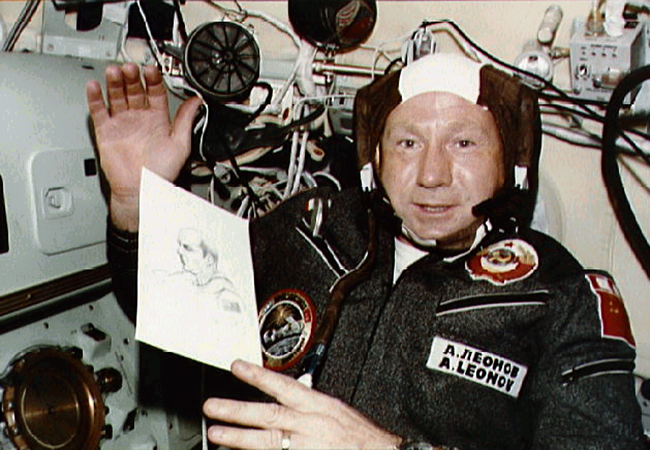
This later image of Leonov shows him with a sketch of NASA astronaut Thomas Stafford on the first joint US-Soviet mission in 1975.
He was presenting them with something they’d never seen before: a spacecraft with an airlock. Called the Voskhod 3KD, it was “almost solely for propaganda purposes,” Asif Siddiqi, a professor of science history at Fordham University in New York, told the BBC; with “not enough safety built in [and] not enough redundancy,” he explained, the ships were “extremely dangerous.”
But the craft offered another chance to one-up the United States – and so, up they would go. Singled out by Korolev, Leonov was given just two hours to work out how to safely enter and exit the spacecraft. He managed it, and the job was his.
“It was complicated and risky,” acknowledged Georgy Grechko, a cosmonaut who flew on three Soviet missions for a total of 135 days in space. “We wanted [to] be ahead of the US, and they wanted to be ahead of us.”
Walking in space
Before Alexei Leonov and his friend and commander Pavel Belyayev left Earth on March 18, 1965, there were a few things they needed to do. They had to complete a physical exam. They had to break out the champagne and sign the bottle in a promise to finish it once they got back. They had to piss on the wheels of the bus that took them to the launch pad. You know: science stuff.
Then, at noon local time, they blasted off into space.
Their mission was as dangerous as it was clandestine. Once in orbit, Leonov was to strap on a life support system and crawl into the small airlock – a tube barely more than three times his own shoulder span, not accounting for the bulky space suit protecting him. There, he would wait while Belyayev depressurized the airlock, until, eventually, the door was opened onto empty space.
“The silence […] was broken only by the sounds of my beating heart and breathing,” Leonov later recalled in the 2006 book Two Sides of the Moon. “Suspended 500 kilometers above the surface of the Earth, I was attached by just an umbilical cord of cables to our spacecraft, Voskhod 2, as it orbited the Earth at 30,000 kph.”
“Yet it felt as if I were almost motionless,” he wrote, “floating above a vast blue sphere draped with a colorful map […] For a few moments I felt totally alone in this pristine new environment, taking in the beauty of the panorama below me with an artist’s eye.”
The mission had been a success, at least so far: the venture had proven that Soviet suits could withstand the void of space, and given the Americans a kick in the butt to boot. But it was risky, and not just from a technical point of view: “The main doubt was the psychological condition of the person who was in outer space,” Sergey Pozdnyakov, the general director and chief designer of NPP Zvezda, which manufactured the spacesuits for Soviet (and now Russian) cosmonauts, told the BBC.
“In the ship, you have walls, you have communications with Earth, you are protected,” he explained. “But to go into outer space… the stress is, in my opinion, so high, that to predict how a person will behave in this situation is impossible.”
As such – and in keeping with Soviet protocol when it came to space missions – almost nobody besides Leonov himself knew about his record-breaking mission that day. “When my four-year-old daughter, Vika, saw me take my first steps in space […] she hid her face in her hands and cried,” Leonov wrote. “’What is he doing? What is he doing?’ she wailed. ‘Please tell Daddy to get back inside.’”
“My elderly father, too, was upset,” he added. “‘Why is he acting like a juvenile delinquent?’ he shouted in frustration ‘[…] Somebody must tell him to get back inside immediately. He must be punished for this.’”
It wasn’t until Leonid Brezhnev, General Secretary of the Communist Party of the Soviet Union, broadcast his message of congratulations to Leonov that anybody knew the outing had been planned.
“No one had warned me I would be receiving such a transmission from the Kremlin,” Leonov recalled. “Brezhnev’s address to me was broadcast simultaneously on state radio and television across the Soviet Union. So was my reply, though at the time I hardly knew how to respond.”
No one can hear you scream
After 10 minutes or so floating above the Earth, Leonov eventually – reluctantly – came back to the spacecraft. But if he had thought the most perilous part of his mission was over, he was sorely mistaken.
“It was then I realized how deformed my stiff spacesuit had become, owing to the lack of atmospheric pressure,” he wrote. “My feet had pulled away from my boots and my fingers from the gloves attached to my sleeves, making it impossible to reenter the airlock feet first.”
With only five minutes or so before he was plunged into the total darkness of Earth’s shadow, Leonov had to think quickly. “The only way I could see to [get back inside] was pulling myself into the airlock gradually, head first,” he wrote – but even then, there was a problem. The pressure differential hadn’t just warped his suit; it had inflated it, so much so that Leonov could no longer fit through the airlock.
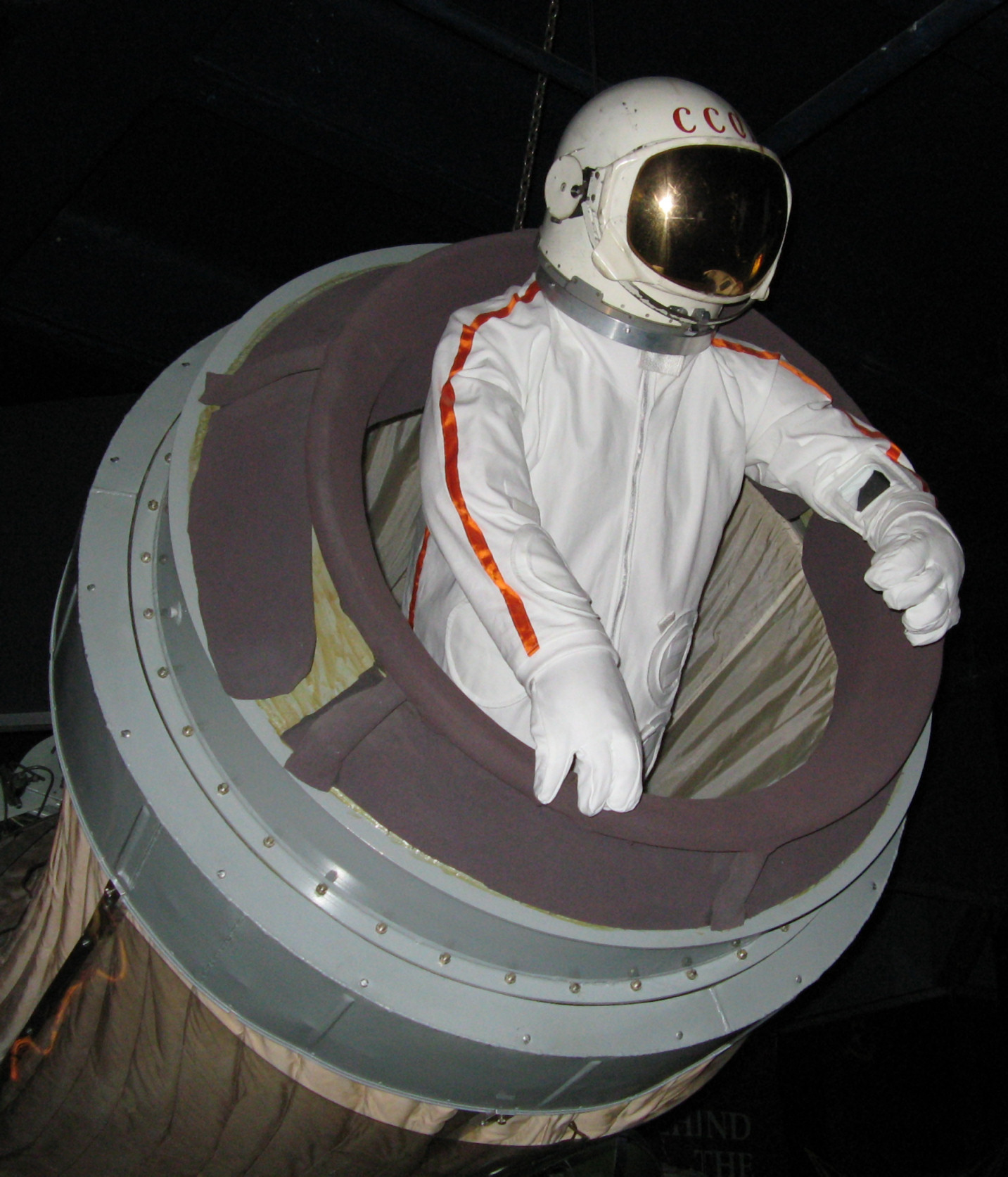
The airlock really was quite a tight squeeze for cosmonauts.
He could see only one option. “I would carefully have to bleed off some of the high-pressure oxygen in my suit, via a valve in its lining,” he recalled. “I knew I might be risking oxygen starvation, but I had no choice. If I did not reenter the craft, within the next 40 minutes my life support would be spent anyway.”
With time running out, Leonov gradually let out half of the oxygen in his suit – enough to trigger the first signs of decompression sickness. He started feeling the telltale pins and needles that signal the condition; at the same time, thanks to the extreme physical exertion in the unobstructed sunlight, he was overheating to the point of risking heatstroke. Sweat filled his helmet: “with the perspiration, I couldn’t see anything,” he told the BBC. “I don’t normally sweat much, but on that day I lost 6kg in weight.”
A scrappy ending
At long last – and with no small effort – Leonov made it back into the spacecraft. But now he faced yet another problem: because he had entered the airlock head first, he would have to turn around to close the door. Still in a bulky and misshapen space suit, such a manoeuvre would be nigh impossible within the cramped tube – but if he didn’t make it, he would die. So he made it.
“Once Pasha was sure the hatch was closed and the pressure had equalized, he triggered the inner hatch open,” Leonov recalled. “I scrambled back into the spacecraft, drenched with sweat, my heart racing.”
Nobody knew just how close Leonov had just come to death. Not wanting to cause a panic down on Earth, he hadn’t even told mission control about his situation – “and anyway,” he reasoned, “I was the only one who could bring the situation under control.”
Still, the mission had been a success: the first ever human spacewalk, now a Soviet claim to fame. Leonov was safe – or at least, as safe as it’s possible to be 500 kilometers above Earth – and all the pair needed to do now was make it back down.
Unfortunately, things were about to go even more haywire – but that’s another story.
This is part 1 of a dual article on the first ever spacewalk. Part 2 can be found here.