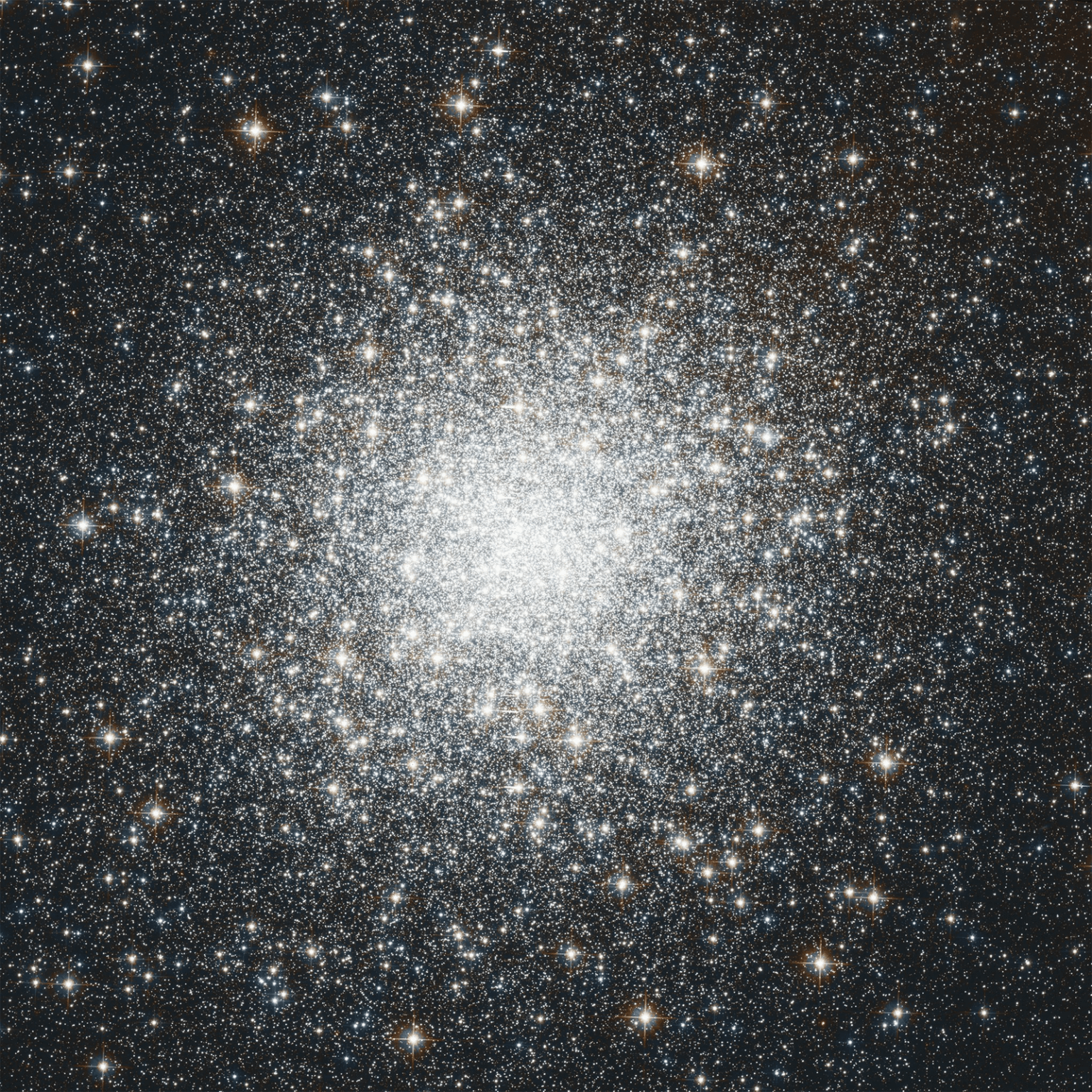
Hubble image of Messier 2’s core was created using observations taken at visible and infrared wavelengths. M2 contains over 150,000 stars.
NASA, ESA, STScI and A. Sarajedini (University of Florida)
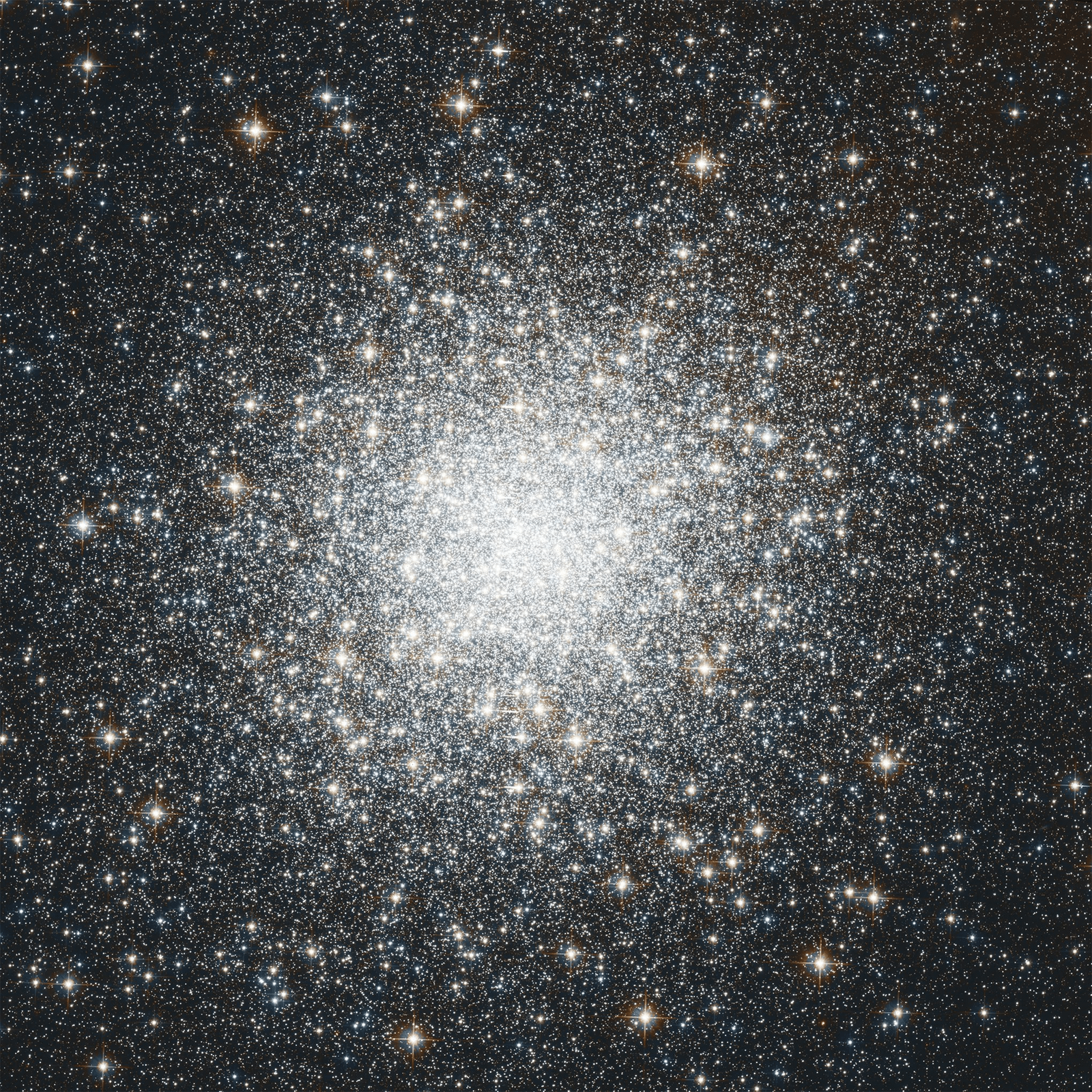
Hubble image of Messier 2’s core was created using observations taken at visible and infrared wavelengths. M2 contains over 150,000 stars.
NASA, ESA, STScI and A. Sarajedini (University of Florida)
The first globular cluster to be added to the Messier catalog, M2 is located roughly 37,000 light-years from Earth in the constellation Aquarius. A globular cluster is a spherical group of stars that are bound together by their mutual gravitational attraction. M2 has a diameter of over 150 light-years and is one of the largest clusters of its kind. It was discovered in 1746 by the French astronomer Jean-Dominique Maraldi while he was observing a comet.
Most of the cluster’s mass is concentrated at its center, with shimmering streams of stars extending outward into space. It has an apparent magnitude of 6.3 and can be seen with the naked eye in ideal viewing conditions. The best time to observe M2 is during the month of October. Large telescopes will resolve the cluster’s individual stars.

1 Comment
The first globular cluster to be added to the Messier catalog, M2 is located roughly 37,000 light-years from Earth in the constellation Aquarius. A globular cluster is a spherical group of stars that are bound together by their mutual gravitational attraction. M2 has a diameter of over 150 light-years and is one of the largest clusters of its kind. It was discovered in 1746 by the French astronomer Jean-Dominique Maraldi while he was observing a comet.
Most of the cluster’s mass is concentrated at its center, with shimmering streams of stars extending outward into space. It has an apparent magnitude of 6.3 and can be seen with the naked eye in ideal viewing conditions. The best time to observe M2 is during the month of October. Large telescopes will resolve the cluster’s individual stars.