
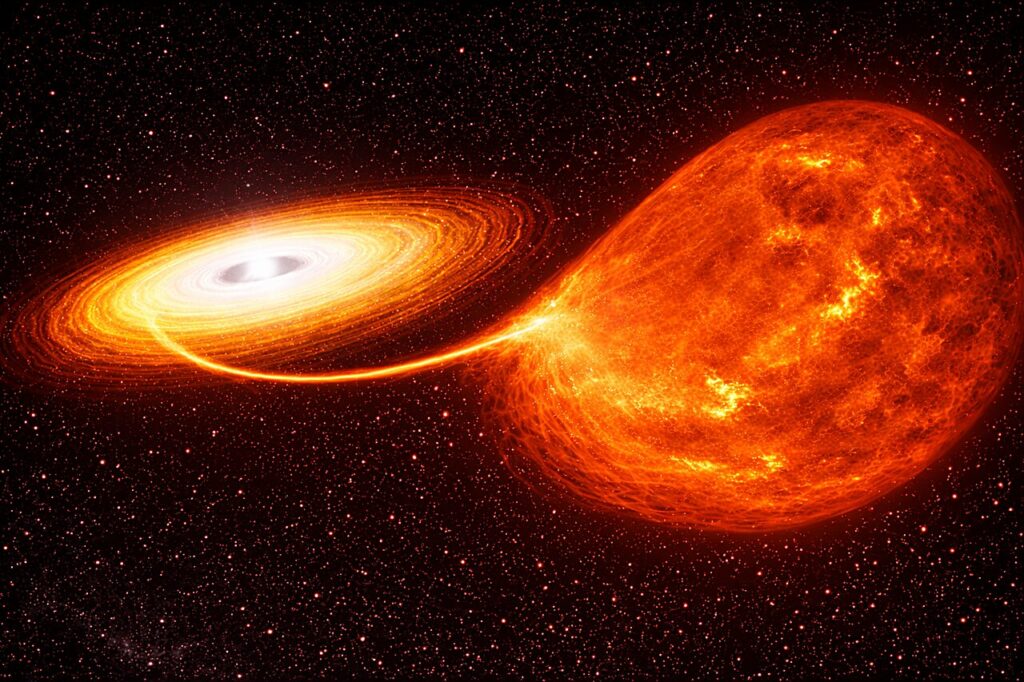
Cataclysmic variables are a broad class of binary systems that periodically undergo powerful outbursts, which we perceive as novae. However, in the intervals between these events, their brightness can also increase. And now scientists have a good idea of why this happens.
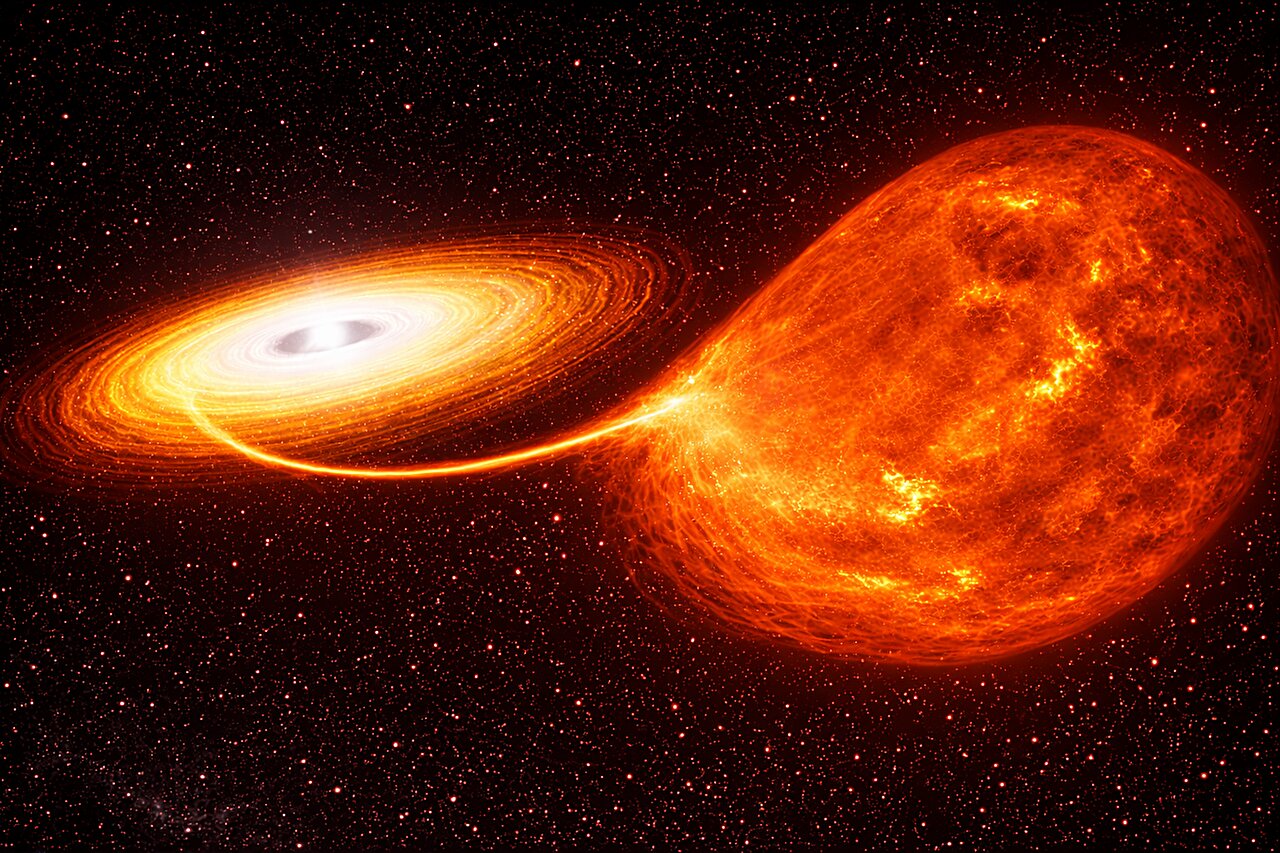 Cataclysmic variables. Source: phys.org
Cataclysmic variables
Researchers from the University of Nevada, Las Vegas recently published a study in Astrophysical Journal Letters in which they solved one of the greatest mysteries surrounding cataclysms. This term generally refers to star systems in which powerful flares occur from time to time, causing these objects to temporarily become very bright in our sky.
These events are known as nova eruptions. You can read more about them here. In short, they form in close binary systems where one of the components is a white dwarf or a neutron star.
Despite its small size, this object has a greater mass than its companion, which is why matter is constantly flowing from the latter to it. When there is a very large amount of it, a thermonuclear reaction occurs—in other words, an explosion.
However, this is not the end of the behavior of these cataclysmic variables. In the intervals between outbursts, which can last for a decade, they exhibit an increase in brightness that appears as a superhump on the graph.
And it is precisely this that remains a mystery to modern scientists. Because there should be some kind of physical process behind it, but they don’t understand exactly what it is. The increase in luminosity lasts a very long time—longer than the system’s rotation period—and this is the longest of all the processes occurring in the system.
A new theory
Previously, scientists had a theory that the hump on the graph was caused by the precession of the accretion disk around the white dwarf. The latter is the substance that was drawn toward it and is now rotating in the same plane.
Indeed, if the rotation is precessing—that is, slowly changing its orientation like a spinning top, so that the disk faces us first with its flat side and then with its edge—that could explain its behavior. However, the nature of precession is so strange that scientists still cannot say whether it can be sustained.
But now they have a new idea. And the point is that the accretion disk is actually asymmetrical, and this asymmetry itself is the cause of such unusual precession. In other words, its shape is an ellipse, not a disc, and that is precisely why it behaves so strangely.
According to phys.org