
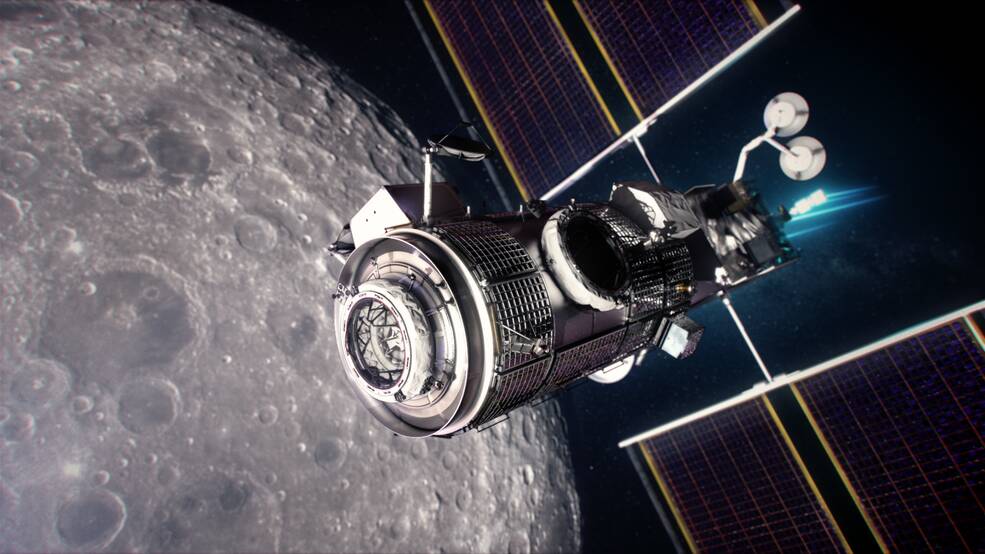
NASA’s ambitious plans to build a space station in orbit of the Moon are officially on hold, administrator Jared Isaacman said Tuesday, with the space agency instead skipping the orbital habitat in favor of building a permanent base on the Lunar surface.
Isaacman made the announcement during the opening keynote for NASA’s Ignition Day event during which the space agency was providing updates on a number of Artemis-related initiatives and Trump’s National Space Policy.
“It should not be much of a surprise that we intend to pause Gateway in its current form and focus on building lunar infrastructure that supports sustained operations on the surface,” Isaacman told attendees. “We will pivot agency talent and hardware already working on Gateway to the surface or other programs.”
However, suspension of the Gateway project – which would have resulted in the construction of the first space station outside of Earth orbit – may come as a surprise to NASA’s international partners on the project, namely the European Space Agency, Canada, and Japan. All had discussed the project as an international effort to continue the partnership established on the ISS into the next frontier in space.
JAXA, the CSA, and ESA have already supplied components and systems for the Gateway, most notably the European-built HALO habitation module, which was delivered to NASA in April 2025, along with multiple modules constructed by ESA for inclusion on the now-mothballed space station.
An ESA spokesperson told The Register that its director general, Josef Aschbacher, is at the Ignition event in Washington DC today, adding: “ESA is consulting closely with its Member States, international partners and European industry to assess the implications of the announcement with further information to follow.”
JAXA and the CSA didn’t immediately respond to requests for comment.
NASA hasn’t said what it intends to do with the HALO module, though Isaacson implied NASA plans to repurpose equipment to support surface objectives.
Despite scrapping its planned lunar-orbiting space station, NASA still aims for a 2027 Artemis III launch, administrator Isaacman confirmed.
The NASA administrator said that, beginning with Artemis III, NASA intends to establish a once-a-year Moon landing cadence with Artemis IV scheduled for 2028. Isaacman said the launch cadence would advance to once every six months following the launch of Aertemis V, “with the potential to increase cadence as capabilities mature.”
NASA now plans to split its Moon base plan into three phases, beginning with a $10 billion phase one that will see the agency shift from “bespoke, infrequent missions to a repeatable, modular approach” that tests out concepts for permanent lunar habitation. Phase two and three will see NASA and its partners establish early infrastructure and permanent fixtures on the Moon’s surface.
Against this background, NASA seems intent on adopting a practically insane development pace that its record to date hasn’t proven it is capable of.
“It is essential we leave an event like Ignition with complete alignment on the national imperative that is our collective mission,” Isaacman said. “The clock is running in this great‑power competition, and success or failure will be measured in months, not years.”
In other words, time is running out to beat China to the Moon.
But what of Mars – does the abandonment of the Gateway mean the Red Planet is on hold? Apparently not.
“The surface will be the technology proving ground for the capabilities required to undertake future missions to Mars, not to mention that it is safer and enables incredible opportunities for science,” Isaacman said.
We wouldn’t suggest placing any bets about NASA’s ability to meet this new, even more ambitious, Moon timeline. ®