
Every year in the Canadian Arctic, seawater freezes and grows thick, creating large swaths of sea ice.
A University of Calgary geographer is now leading an international team to better study and understand that Arctic sea ice.
Dr. John Yackel, MSc’95, PhD, a professor of geography in the Faculty of Arts, has received funding from the European and Canadian space agencies (ESA and CSA) to lead an international team, including NASA scientists, on what he describes as a large-scale electromagnetic physics project.
“It uses a lot of electromagnetic waves, lidar, radar, and other microwave frequencies to better measure and characterize the thickness of sea ice,” says Yackel.
Measuring the thickness of sea ice is important as it plays a key role in regulating the temperature of the Arctic. If there is lots of ice around, then it can reflect more of the sun’s radiation and keep temperatures in the Arctic cool. If the ice is gone, the sunlight goes into the ocean and heats the ocean water instead.
“We want to better understand how the Arctic can stay cool because, if it can stay cool, it can help control the planet’s temperature as climate change continues,” explains Yackel.
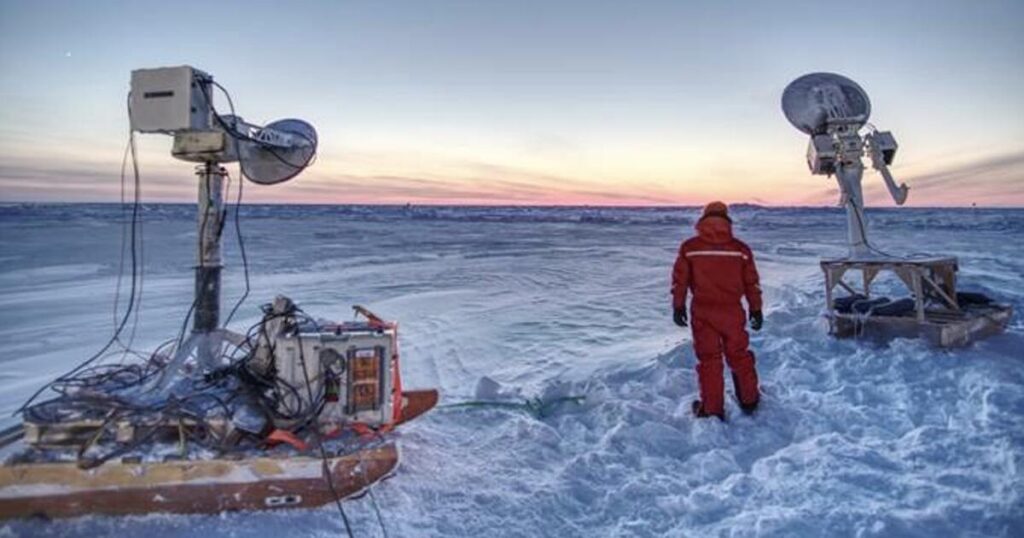
The team will collect data from ground-based and aircraft-mounted sensors in order to better calibrate images and other electromagnetic signals that received from satellites.
“What we’re trying to do is develop methods that can constrain how accurate our ice thickness estimates are,” says Yackel.
Many of the sensors are actually measuring the thickness of the snow that sits on top of the ice, and then predictive models are used to determine the underlying ice thickness.

Science work being conducted by the light of a research icebreaker.
John Yackel
By doing this project, Yackel and team are supporting the work of the CSA and ESA, as they are working to ensure the images and data captured by billion-dollar Earth observation satellites are as accurate as possible.
The team of 30-plus scientists from nine different countries will head to the Canadian Arctic at the end of March, when the ice is thickest, to set up at the Canadian High Arctic Research Station (CHARS) in Cambridge Bay, Nunavut, and they will run the experiment for six weeks starting at the beginning of April.
Yackel serves on an advisory committee for the ESA, and he was able to convince it the Canadian Arctic was the best place to do this calibration and validation work for its upcoming satellite, as it had a great research base in CHARS, the ice is landfast and locked in place, and, despite brutally cold temperatures expected in late March, it’s a safe environment to do research in and collect a lot of data from due to the near-24-hour daylight.
“This will be a combined effort with a lot of agencies and countries involved,” says Yackel. “It’s all countries working together for science.”
On top of developing improved methods to measure snow and ice thickness from satellites, the project will also have a local community impact.
Sea ice serves as a vital hunting platform and travel route for remote Northern communities.
By getting better measurements of the sea ice, the group will be able to provide local Inuit communities with safety maps to ensure they know where the unstable ice edges are and if there are any hidden cracks in the sea ice beneath the snow, which could lead to them being stranded during their hunting activities.
“It’s an important application of our project,” says Yackel. “We can help support preventative measures as well as search and rescue measures with the data we will be able to collect.”
More details on the project can be found here.