
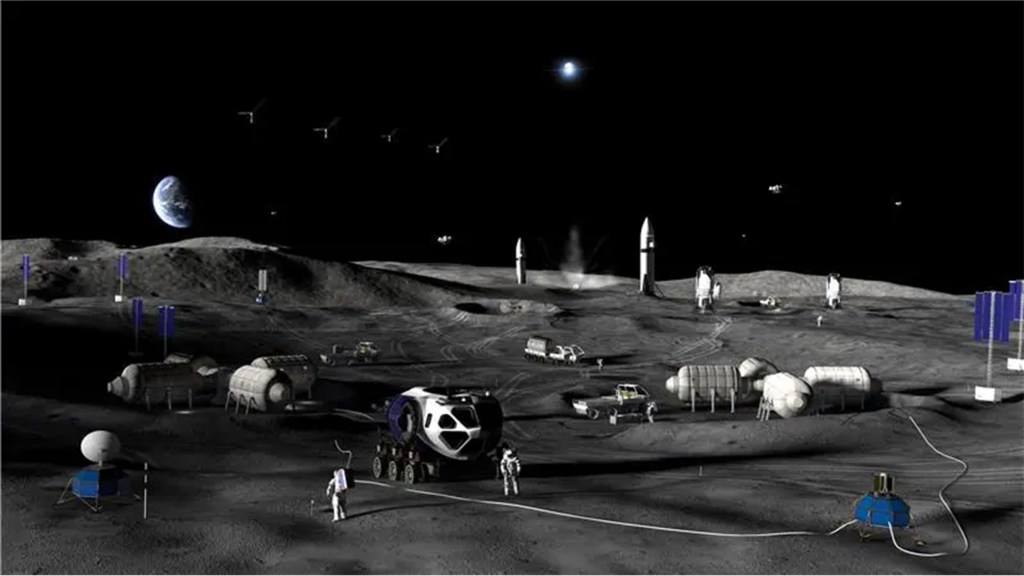
NASA unveiled a new vision for its near-term future Tuesday, including construction of a complete moon base, a major increase in robotic missions and a nuclear-powered spacecraft to bring a slew of helicopters to Mars.
NASA Administrator Jared Isaacman revealed the plans during a daylong session dubbed “Ignite” held in Washington, characterizing the efforts as “transformative agency-wide initiatives.”
“NASA is committed to achieving the near‑impossible once again, to return to the moon before the end of President Trump’s term, build a moon base, establish an enduring presence, and do the other things needed to ensure American leadership in space,” Isaacman stated in a NASA press release.
“This is why it is essential we leave an event like Ignition with complete alignment on the national imperative that is our collective mission,” he added.
Moon changes
For the moon, NASA’s approach will be “shifting to a focused, phased architecture that builds capability landing by landing, incrementally,” said Amit Kshatriya, NASA’s associate administrator.
A major aspect of NASA’s lunar intentions is the construction of a moon base, and with it ending plans for a small lunar space station called Gateway.
“As part of this strategy, the agency intends to pause Gateway in its current form and shift focus to infrastructure that enables sustained surface operations,” NASA stated in a press release.
NASA revealed a three-phase plan to build out the ground base. Phase One’s “Build, Test, Learn” approach would continue to use the Commercial Lunar Payload Services program to deliver one or more lunar rovers that have been in the works.
NASA said it looks to increase robotic landings on the moon to as many as 30 in 2027, and was releasing a new call for payload pitches not just to the moon, but for future missions to Mars.
“We are opening the lunar surface to researchers and students nationwide,” Kshatriya said.
Another big part of its lunar plans is looking beyond the end of the Artemis program, which could be the final flight of NASA’s Space Launch System rocket, and shifting to “more commercially procured and reusable hardware” to get crewed missions to the moon at least every six months.
For now, Artemis II, which could launch as soon as April 1, will be a crewed, lunar-fly by mission while Artemis III will be a crewed flight close to Earth. The Artemis IV and V missions, flying as early as 2028, are planned to return humans to the surface of the moon for the first time since Apollo 17 in 1972.
Beyond that, companies SpaceX and Blue Origin could offer their own rocket solutions, coupled with either Artemis’ current crewed spacecraft Orion or other alternatives, to continue to bring humans to the moon.
Phase Two is “Establish Early Infrastructure,” which will aim for semi‑habitable buildings and regular logistics that allow for recurring trips by astronauts to the surface. NASA plans to rope in international partners, including a pressurized rover built by the Japan Aerospace Exploration Agency.
Phase Three is “Enable Long‑Duration Human Presence” that will include multi-purpose habitats from the Italian Space Agency and a lunar utility vehicle from the Canadian Space Agency. Those will arrive with cargo-capable human landing systems that have yet to be developed.
No timelines were set for accomplishing the phases beyond a moon landing in 2028.
Nuclear-powered Mars mission
For the uncrewed Mars mission dubbed Space Reactor-1 Freedom aiming to launch in 2028, Kshatriya said “we are finally putting nuclear propulsion on a trajectory out of the laboratory and into deep space.”
The spacecraft would be the first nuclear-powered interplanetary spacecraft, a demonstration of the nuclear-electric propulsion needed for missions to deep space in the future. It would allow for a more efficient way to move large amounts of cargo over long distances and solves the issue of limited solar energy beyond Jupiter, according to the NASA release.
The payload on SR-1 Freedom is called “Skyfall,” which will be multiple helicopters similar to the groundbreaking Ingenuity helicopter that was part of the Mars Perseverance mission.
“SR-1 Freedom will establish flight heritage nuclear hardware, set regulatory and launch precedent, and activate the industrial base for future fission power systems across propulsion, surface and long‑duration missions,” NASA’s release states.
Just what kind of reactor would be used on the spacecraft was not revealed, but regulatory moves that include the U.S. Department of Energy have previously sought to use what is known as HALEU fuel, which stands for high-assay low-enriched uranium.
While likely to launch from the Space Coast, the reactor would not be turned on until it reaches space safely, making it what NASA officials previously called a “cold reactor.” NASA had previously been working with Defense Advanced Research Projects Agency (DARPA) on such a mission called DRACO, but it was canceled in 2025.
The end goal of the shift to nuclear-powered spacecraft is to make space travel faster. Right now with chemical propulsion, a one-way trip to Mars, for instance, would take around nine months with optimum planetary positions, which also limits the launch window. Nuclear propulsion could speed that up by at least 25%, according to Department of Energy.
Low-Earth orbit
For low-Earth orbit, Kshatriya said “we are recognizing where the market is and where it isn’t, recognizing the incredible value of the International Space Station, and building a transition that builds a competitive commercial ecosystem rather than forcing a single outcome the market cannot support.”
A recent move by Congress seeks to extend the ISS life to at least 2032 instead of deorbiting in 2030. NASA has plans in place to support commercial space stations from several companies, but is floating a new idea that would keep the current space station alive until at least one suitable replacement is in place.
So NASA wants industry feedback for a phased approach that would attach a government-owned core module to the International Space Station that could allow for commercial modules to attach afterward, taking advantage of the current ISS architecture.
“NASA would be one of many customers purchasing commercial services,” the NASA release stated.
It’s similar to a plan of Axiom Space, one of the companies under contract to build its own station. Other companies that look to build their own freestanding space stations include Vast, Blue Origin and Voyager Space.
“The clock is running in this great‑power competition, and success or failure will be measured in months, not years,” Isaacman said. “Returning to the moon and building a base will pale in comparison to what we will be capable of accomplishing in the years ahead.”