
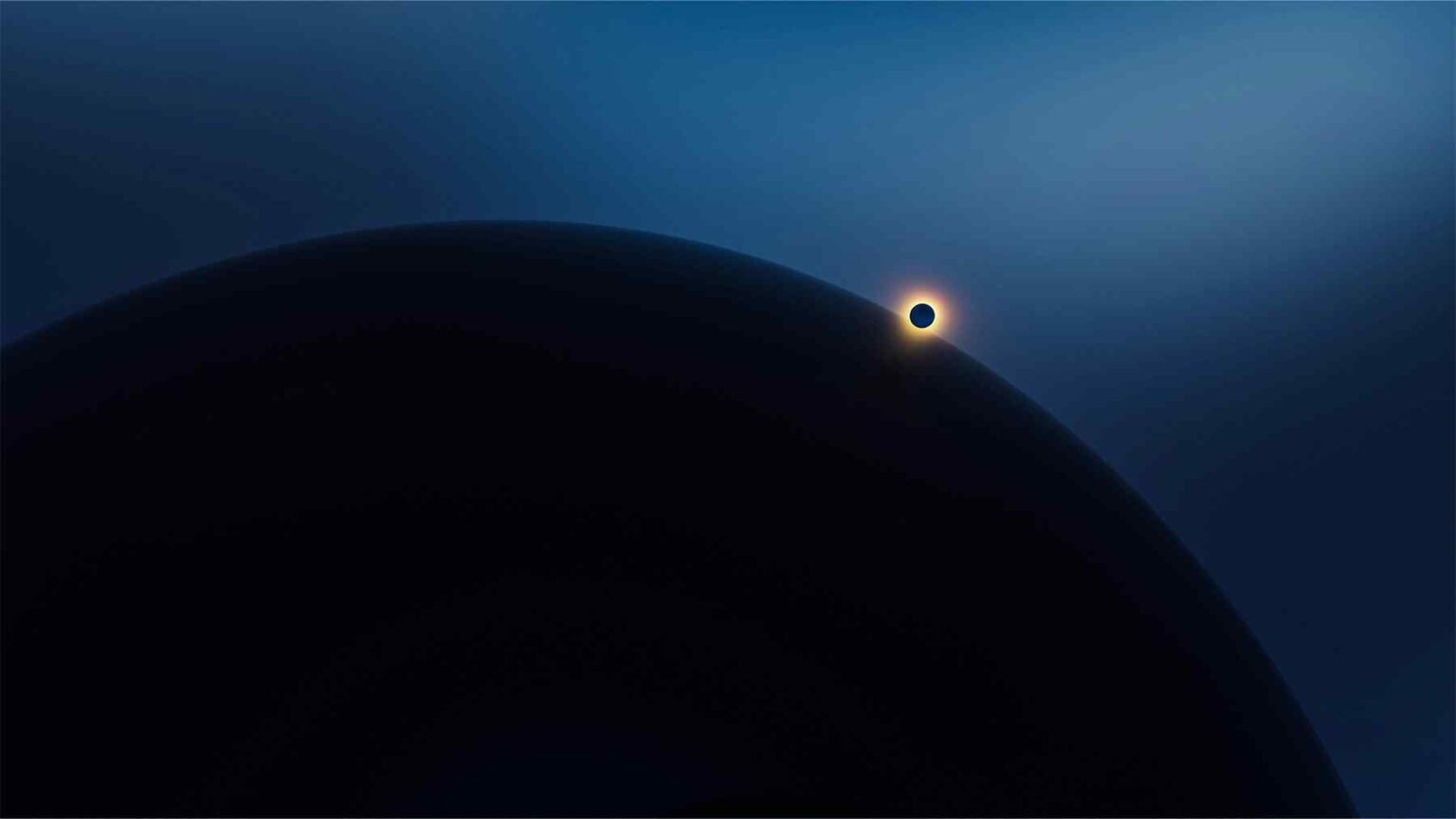
Even black holes are subjected to the rules of space and time.
Our most significant understanding of how black holes behave and what makes them tick has come from some of the most iconic and revolutionary minds in history. And a recent finding may have confirmed a prediction made by Stephen Hawking 50 years ago.
How do you feel about the space mystery that is black holes?
How our basic knowledge about black holes has shifted over the last century
Over the past 100 years, black holes have gone from odd and embarrassing mathematical glitches into some of the most studied celestial objects ever.
In 1916, Karl Schwarzschild was the first in recorded history to develop a mathematical theory about black holes. Even the most iconic mind in the last century, Albert Einstein, spent years attempting to prove that black holes were physically possible.
Einstein held the belief that nature would never allow a star to collapse into what he called an “absurd” singularity.
We never even got a glimpse of a black hole until the 1960s, and even then, it was just an X-ray image from a rocket that detected emissions that suggested a black hole’s presence. Recently, through the collective efforts of thousands of physicists, we have captured the first-ever actual real-time image of one of the largest black holes in the universe.
Our ability to study the universe has become a focal point for society
The revelations in space science have led us as a society into a new era of progression.
New types of Earth-based telescopes have enabled us to study the “ghosts” of stars that died long before our planet formed. And that is just the start of a wave of technological advancements that have come to light in recent years.
Einstein’s General Theory of Relativity explained how gravity bends the very fabric of space and time.
But as far as black holes go, even a great mind like Einstein did not have the technology or capacity to explain. As we enter a new era of space exploration with NASA accelerating the next lunar mission, a new finding has proven that Einstein and Hawking were on the right track regarding black holes.
Cornell University’s Department of Astronomy has made a remarkable discovery that will change the way we look at black holes forever.
Stephen Hawking’s bet on the impossible has finally paid off
The team from Cornell University actually listened to the universe to reanalyze GW150914, which is the first-ever gravitational wave signal detected in 2015.
The picture that they are trying to paint for us is of two massive black holes performing a spiral dance of death before slamming into each other. The team measured the surface area of these massive structures and compared them to the measurements of the new, even bigger black hole.
The combined area of the two black holes before they merged into a new one was roughly twice the size of New York State.
The “newcomer” was measured to be roughly 141,699.492 square miles, or roughly the same size as several states combined. Studying black holes and the space around them has puzzled the minds of scientists for a very long time indeed.
The team has proven a 50-year-old theory to be true
Stephen Hawking theorized that the surface area of a black hole’s event horizon could never decrease over time. This mathematical theory stood for the past five decades, but was never actually proven with evidence. Until now.
The findings made by the team have confirmed that Hawking’s Black Hole Area Theorem was, in fact, correct, ending a multiple-decade-long mystery that has become the basis of our knowledge about black holes. The births and deaths of celestial objects are becoming easier to understand.
Are you ready for the universe to reveal its secrets about black holes?