

Every time two black holes collide somewhere in the universe, they send ripples through the fabric of spacetime itself. We call these ripples gravitational waves. The problem is detecting them since they are almost impossibly faint by the time they reach Earth. LIGO, the Laser Interferometer Gravitational-Wave Observatory, solves that problem with a 4 kilometre laser tunnel so sensitive it can measure a change in distance a thousand times smaller than a proton. But what if there was another way to measure such changes?
Researchers at Stockholm University, Nordita, and the University of Tübingen think there might be. Their new theoretical study, published in Physical Review Letters, suggests that gravitational waves leave detectable fingerprints in the light emitted by atoms and that a cloud of atoms just a few millimetres across might one day serve as a gravitational wave detector.
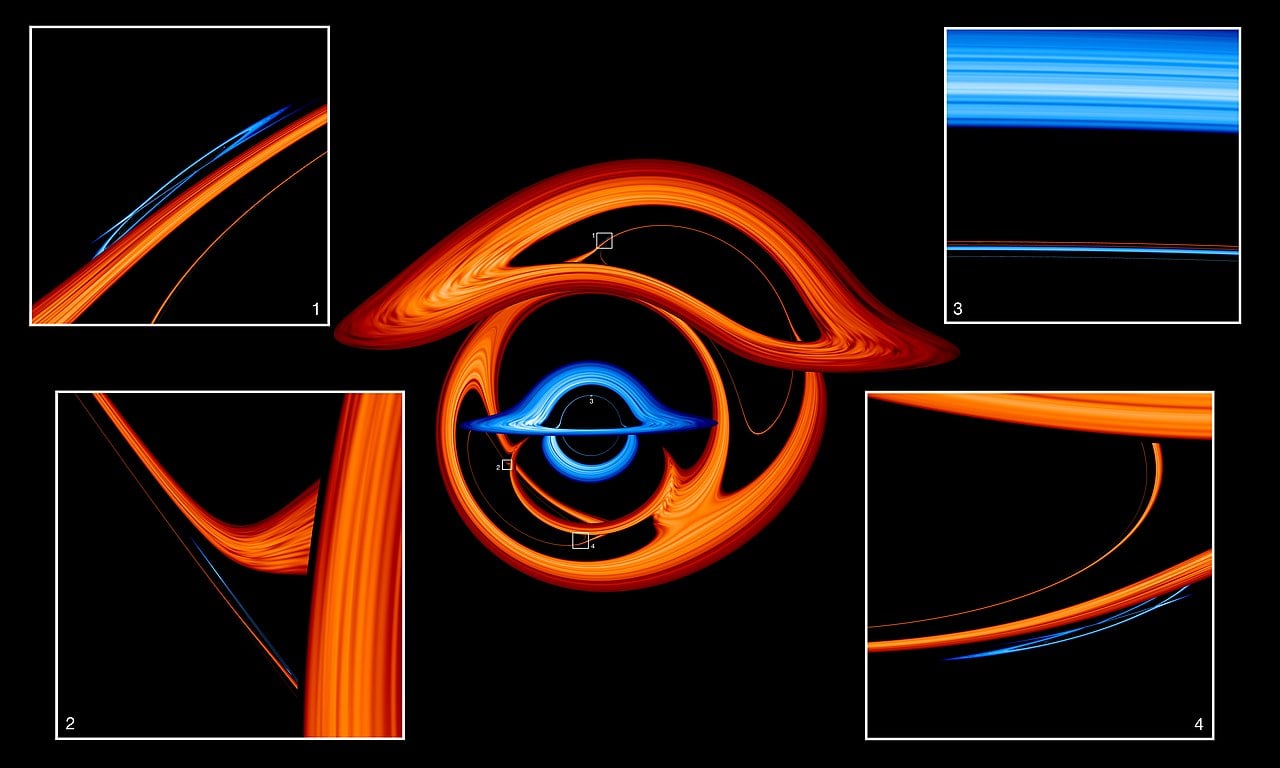 A computer simulation of two black holes orbiting each other, with accretion disks whose images are highly distorted by gravitational lensing. Such objects are often the source of gravity waves (Credit : Jeremy Schnittman, Brian Powell, and Scott Wiessinger/NASA’s Goddard Space Flight Centre)
Here is the key idea. When an atom gets excited by heat, light, or a laser it doesn’t stay that way for long. It quickly relaxes back to a lower energy state, releasing a photon of light at a precise, characteristic frequency. This process, called spontaneous emission, is usually rock steady and predictable and it has been studied for decades. What nobody had fully considered was what happens when a gravitational wave passes through.
Gravitational waves don’t just stretch space, they also disturb something called the quantum electromagnetic field. This is an invisible field that permeates all of space, and it is the medium through which light itself travels. Every time an atom emits a photon, it does so by interacting with this field. A passing gravitational wave subtly remodulates it, which in turn tweaks the frequency of the photons the atom emits. Think of an atom like a music player producing a perfectly steady note. A gravitational wave doesn’t change the volume, the atom still emits the same amount of light overall but it changes how that note sounds depending on which direction you’re listening from.
That directional signature is the crucial discovery made by the team. Because the frequency shift varies with emission direction, it encodes information about where the wave came from and how it is polarised making it far easier to separate a genuine signal from background noise. It is a subtlety that had been overlooked until now, precisely because the overall emission rate stays constant.
The researchers point to atomic clock systems as the most promising experimental testbed. These ultra precise instruments already exploit narrow optical transitions in cold atoms, giving long interaction times and incredible stability. In such an environment, even the vanishingly small frequency shifts induced by a gravitational wave might one day become measurable.
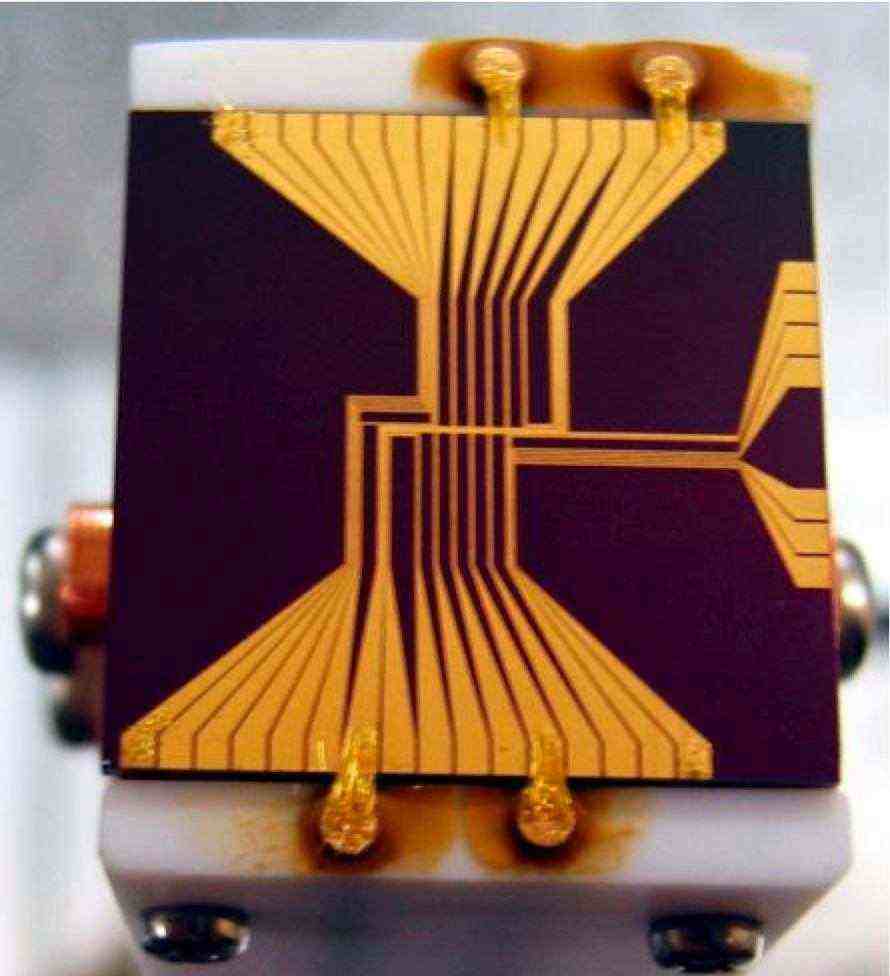 Microchip atomic cold trap developed at the Institute for Laser Science in 2005 of the sort that might help unravel the mystery of gravitational waves (Credit : Ken-Ichi Nakagawa)
This is still theoretical of course and real experiments will face serious challenges, not least in distinguishing the signal from the cacophony of other noise sources. But the early estimates are encouraging and the implications are tantalising.
Giant interferometers like LIGO are extraordinary, but they are also extraordinarily expensive and fixed in place. Compact atomic detectors, if they can be made to work, would open up entirely new possibilities particularly for detecting low frequency gravitational waves that current instruments struggle to catch, and which future space based observatories are specifically designed to hunt.
Source : Gravitational Waves Leave Imprints on Light Emitted by Atoms