
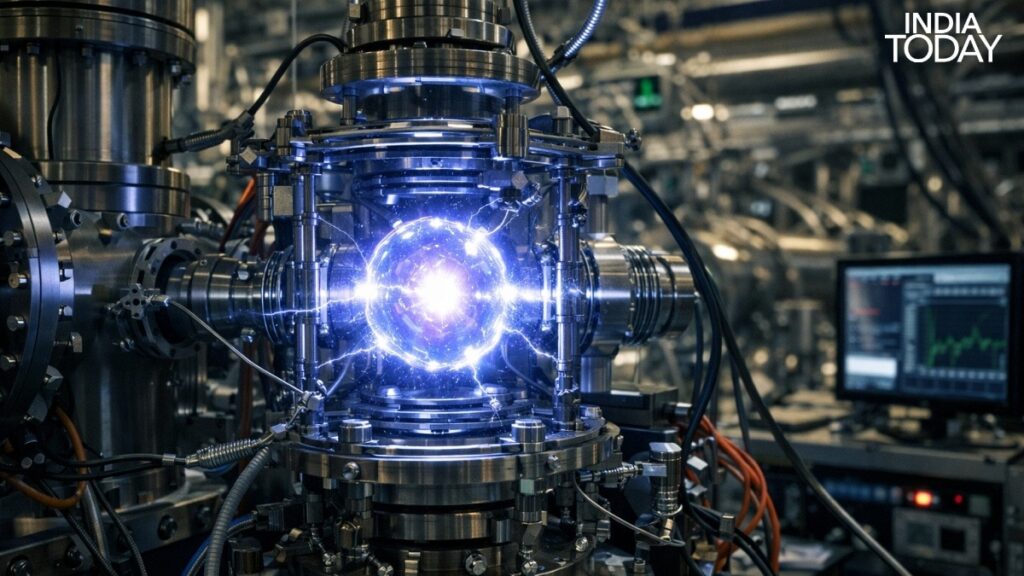
Scientists at CERN have carried out a daring and unusual experiment, moving antimatter, one of the most fragile and mysterious substances known to science, outside the place where it is normally created.
In this first-of-its-kind test, researchers worked with Antiprotons, which are tiny particles similar to protons but with the opposite electric charge. The goal was simple but challenging: safely transport these particles without letting them touch ordinary matter.
Read Full Story
That is easier said than done. Antimatter cannot come into contact with regular matter, not even for a split second. If it does, both instantly destroy each other in a burst of energy. Because of this, scientists must store antimatter in special containers that use magnetic fields to keep it suspended, preventing any physical contact with the walls.
WHAT IS ANTIMATTER?
Antimatter is a special type of matter made of particles that are the opposites of normal particles.
For example, an Electron has a negative charge, while its antimatter version (called a positron) has a positive charge. Similarly, a Proton has a positive charge, while an antiproton has a negative charge. Their mass is the same, but their charges are opposite.
When antimatter meets normal matter, both get destroyed instantly and release energy. This process is called annihilation. Antimatter is very rare and difficult to store because it must not touch anything. Scientists create and study it in labs like CERN.
Studying antimatter helps scientists understand how the universe formed and why most of it is made of normal matter instead of antimatter.
WHAT DID CERN DO?
The recent experiment involved carefully taking antiprotons out of their usual storage area and moving them to another location for further study. This “test drive,” as some researchers describe it, is a major step forward in handling antimatter more flexibly.
Why does this matter? Being able to move antimatter could open new doors for research. Scientists want to better understand how antimatter behaves and why the universe today is made mostly of normal matter, even though both should have been created in equal amounts during the birth of the cosmos.
There are also practical possibilities. Antimatter is already used in small amounts in medical imaging, such as PET scans. In the future, better control over antimatter could lead to new technologies, though such applications remain far off.
For now, the focus is on proving that antimatter can be safely handled outside tightly controlled environments. The success of this experiment shows that what was once thought nearly impossible, transporting antimatter, may soon become routine in advanced physics research.
– Ends
Published By:
Sibu Kumar Tripathi
Published On:
Mar 24, 2026 16:41 IST