
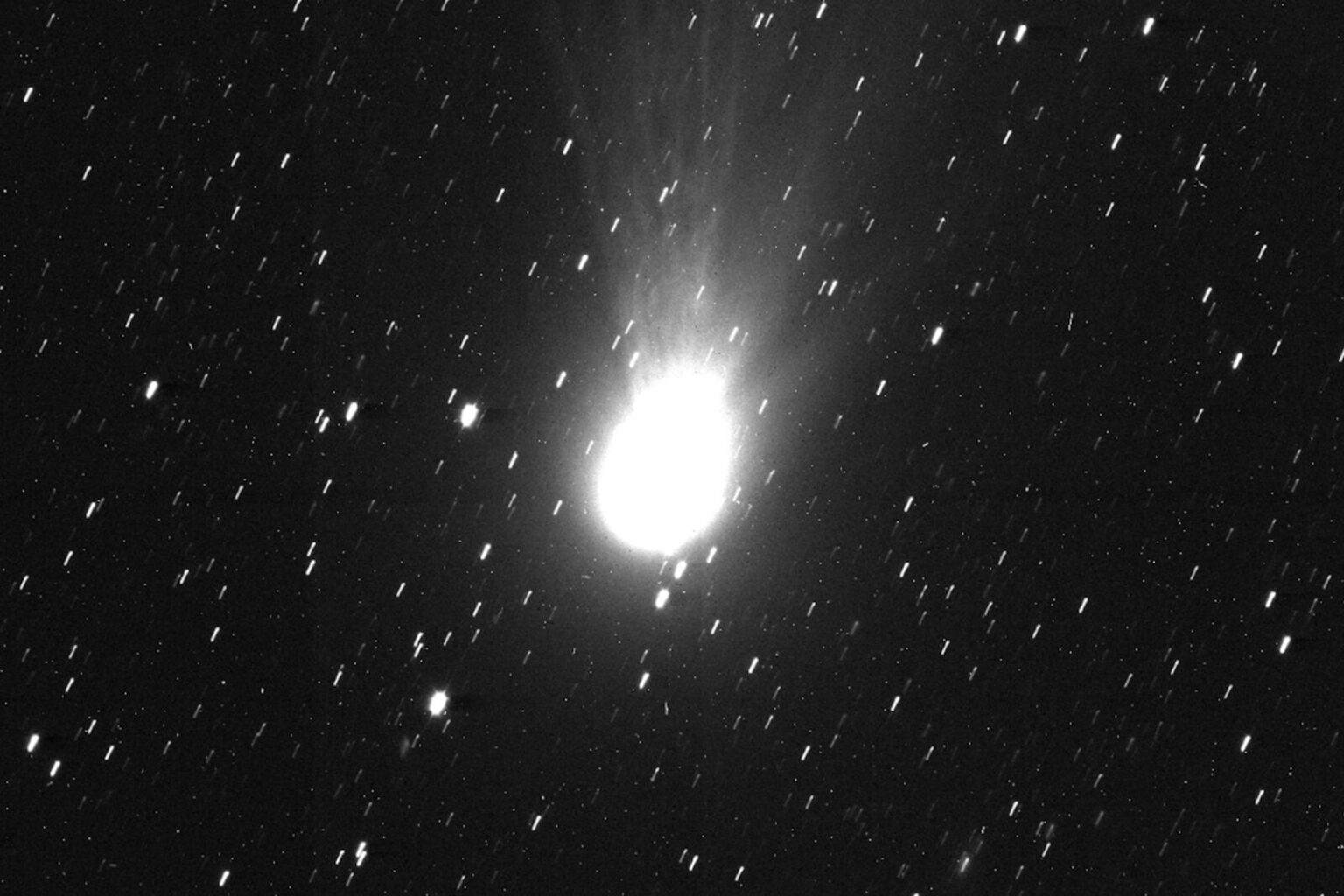
A Chinese research team has revealed fresh insights into the interstellar comet 3I/ATLAS, showing it released far more water vapor than expected as it approached the Sun. Much of it came from icy grains in its surrounding cloud rather than the nucleus itself.
The findings, published in The Astrophysical Journal Letters, were based on high-sensitivity observations from the 65-metre Tianma Radio Telescope at the Shanghai Astronomical Observatory (SHAO), marking the telescope’s first confirmed detection of an object from beyond the solar system.
First spotted in July 2025, the object attracted attention and stirred speculations for its unusual behaviour.
3I/ATLAS is the third confirmed interstellar object after 1I/’Oumuamua and 2I/Borisov and only the second with clear comet-like activity. Unlike typical solar system comets, it displayed dust and gas emission at large distances from the Sun, hinting at a volatile-rich composition.
Coma Ice Grains Fuel Water Release
The researchers measured 3I/ATLAS’s water release using a special radio signal called the 1.6-GHz hydroxyl (OH) line. They found that when the comet was 2.27 astronomical units (au) from the Sun, it released about 0.43 tons of water per second. As it moved closer, at 1.96 au, the water output rose to 0.62 tons per second—an increase of more than 40%.
A key finding was that much of this water didn’t come straight from the comet’s surface. Instead, icy grains that had already drifted away from the nucleus continued to release water in the surrounding cloud, or coma.
The study suggests that before reaching its closest point to the Sun, up to 80% of the water came from these grains, not the nucleus itself. Even near perihelion, these particles still contributed roughly half of the total water.
The researchers explained that this ‘extended source’ effect helps account for why different telescopes measuring the comet at the same distance reported very different water production rates. Most of the water was being released gradually by the ice in the coma rather than all at once from the nucleus.
A Colder Birthplace Than the Solar System
Beyond water, the team also examined carbon monoxide (CO) levels using the 13.7-metre Delingha Telescope. They found an average production rate of 0.27 tons per second, giving a CO/H2O ratio of roughly 28%. While lower than 2I/Borisov, this is still significantly higher than most solar system comets at comparable distances, signalling a rich reservoir of highly volatile material.
Researchers said this mix of CO and other gases suggests 3I/ATLAS formed in a much colder planetary system than ours, where such ices could survive. They also noticed that CO was more common compared with hydrogen cyanide, which further supports the idea of a cold birthplace.
Comparing 3I/ATLAS with comets from our solar system highlights some interesting differences. For example, 103P/Hartley also releases water from drifting icy grains, but 67P/Churyumov-Gerasimenko mostly ejects dry dust. This shows that even comets with similar activity can have very different ways of releasing water and retaining ice.
Implications for Interstellar Studies
The findings provide a window into the diversity of planetary systems beyond the Sun. By separating water contributions from the nucleus and the coma using a two-component parametric model, the team has shown that interstellar comets may carry far more complex reservoirs of ice than previously appreciated.
Future studies aim to track 3I/ATLAS through perihelion, charting the evolution of its water and gas output in detail.
Researchers hope this will shed light on why the comet’s grains are unusually ice-rich, and what that can tell us about the environments where such interstellar bodies form.
This research, supported by the National Natural Science Foundation of China, reveals the hidden histories of worlds far colder and chemically distinct from our own.