
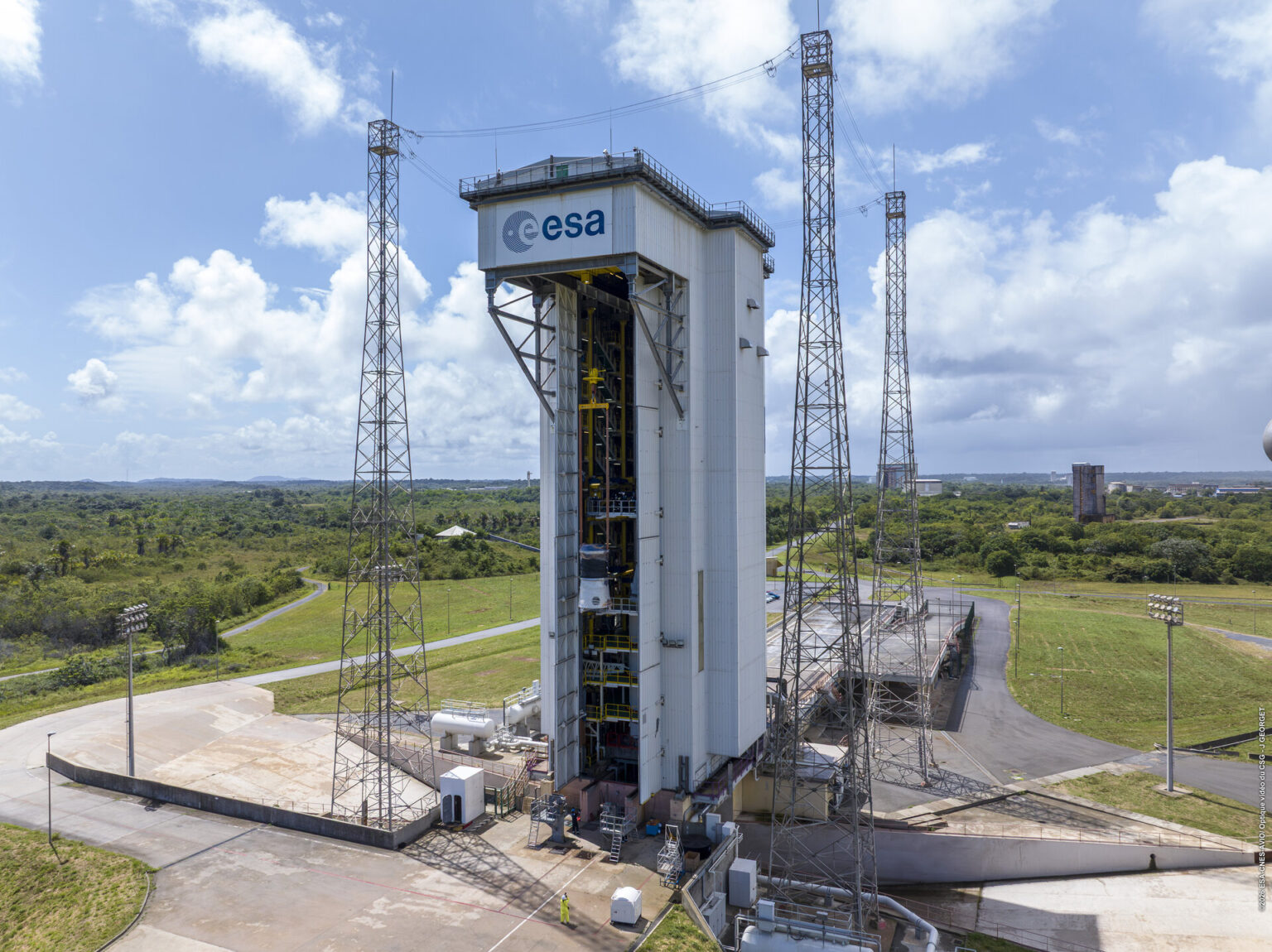
Launch technicians prepare the arrival of the third stage for Vega-C by the launch pad at Europe’s Spaceport, 2 March 2026.
The third stage, Zefiro-9 holds 10 tonnes of solid propellant, taking ESA’s Smile mission to orbit.
Vega-C is a single-body rocket nearly 35 m tall with that weighs 210 tonnes on the launch pad.
Smile (the Solar wind Magnetosphere Ionosphere Link Explorer) is a joint mission between the European Space Agency (ESA) and the Chinese Academy of Sciences (CAS).
Smile will use four science instruments to study how Earth responds to the solar wind from the Sun. In doing so, Smile will improve our understanding of solar storms, geomagnetic storms and the science of space weather.
ESA is responsible for providing Smile’s payload module (which carries three of the four science instruments), one of the spacecraft’s four science instruments (the soft X-ray imager, SXI), the launcher, and the Assembly Integration and Testing facilities and services. ESA contributes to a second science instrument (the ultraviolet imager, UVI) and the mission operations once Smile is in orbit.
CAS provides the other three science instruments and the spacecraft platform, and is responsible for operating the spacecraft in orbit.
[Image description: An aerial view of the Vega-C launch tower on a cloudy but sunny day.]