
BANGOR, Maine (WABI) – Ever wandered what would happen to yeast after being sent into the edge of space? It’s a question on the minds of students at William S. Cohen School in Bangor after being chosen to take part in a nationwide challenge.
“It’ll be exposed to UV radiation, gases, cold temperatures, then when it comes back down, that will be their question. Will the components that are up in near space affect the yeast,” says science teacher Margaret Pietrak.
The experiment, titled “Yeast in the Stars,” started out as a proposal based on student curriculum that was submitted for the NASA Student Tech Rise Challenge last October as part of Future Engineer’s yearly competition.
“7th graders do a yeast fermentation lab so it’s kind of like that except its more extreme, that it could be genetically altered while up in the stratosphere,” says project manager and 6th grader Case Hurly.
“That was the idea of taking the yeast that goes up to 70,000 to 90,000 feet and then using it in the fermentation lab the following year for the 7th grade, possibly baking some bread and sharing it with different schools,” says Pietrak.
It was announced in January the Cohen School was 1 of only 25 across the nation to have their project being given a designated spot on a NASA sponsored high altitude balloon.
While it wasn’t the school’s first time participating, students say their excitement levels skyrocketed.
“I was really excited when I first got here. I was literally like internally freaking out. I was super-duper happy when I heard that our school won,” says 7th grader Abagail Foster who is a member of the wiring team.
“Getting called up in the middle of the school day, and watching a video on the screen a few groups, one from Guam and other high schools, and seeing our name up there,” says 8th grader and project manager Jack Bennett.
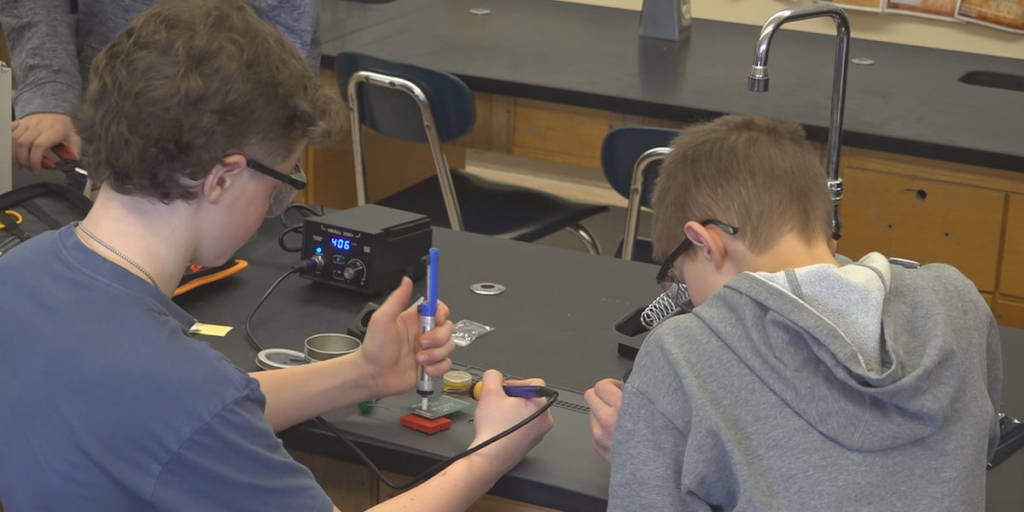
Alongside meeting with Future Engineer experts via Zoom, students have also divided into multiple teams in order to develop necessary skills in soldering, coding, and mounting to make their experiment a reality. The process helps to leverage skills for future careers.
“The most exciting to learn is how the mount the stuff but also learning that we were selected and that we were able to do this in the first place,” says mounting team member Chirath Ranasinghe.
“I’m planning on working in engineering and programming, probably mechanical, some electrical as well,” said mounting team member Aiden Emanetoglu.
“I’ve been learning to update the M4 computer’s and how the code is starting to work, and how the various components work together,” says 6th grader Avram Folsom.
“Without the coding, it would just be a box that wouldn’t do anything, so it’s important to learn,” says 8th grader Felipe Mulia.
“We’re learning how to solder, we’re learning a lot of hands-on stuff. We’ve really learned a lot. Wiring and mounting teams have learned a lot. It’s amazing,” says Bennett.
“You see the grit because at first, they’re not sure, they’re not really confident that they can actually get this completed. And then you see that confidence grow and it’s how it all works. It’s really fascinating, and it’s great to see them really flourish,” says Pietrak.
Once completed, the team will be presenting their work virtually during the NASA TechRise Student Showcase on May 15th, before sending their project for final testing on May 16th.
A launch party will be scheduled for later in the summer, with the yeast being sent back to the Cohen School in August for use in next year’s curriculum.
Copyright 2026 WABI. All rights reserved.