
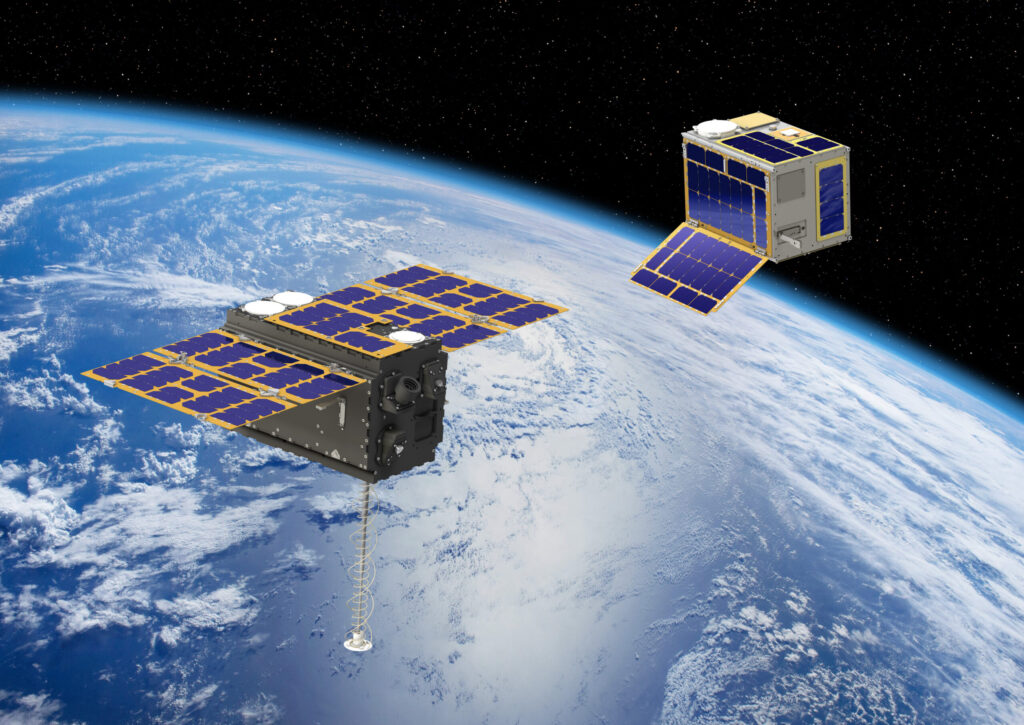
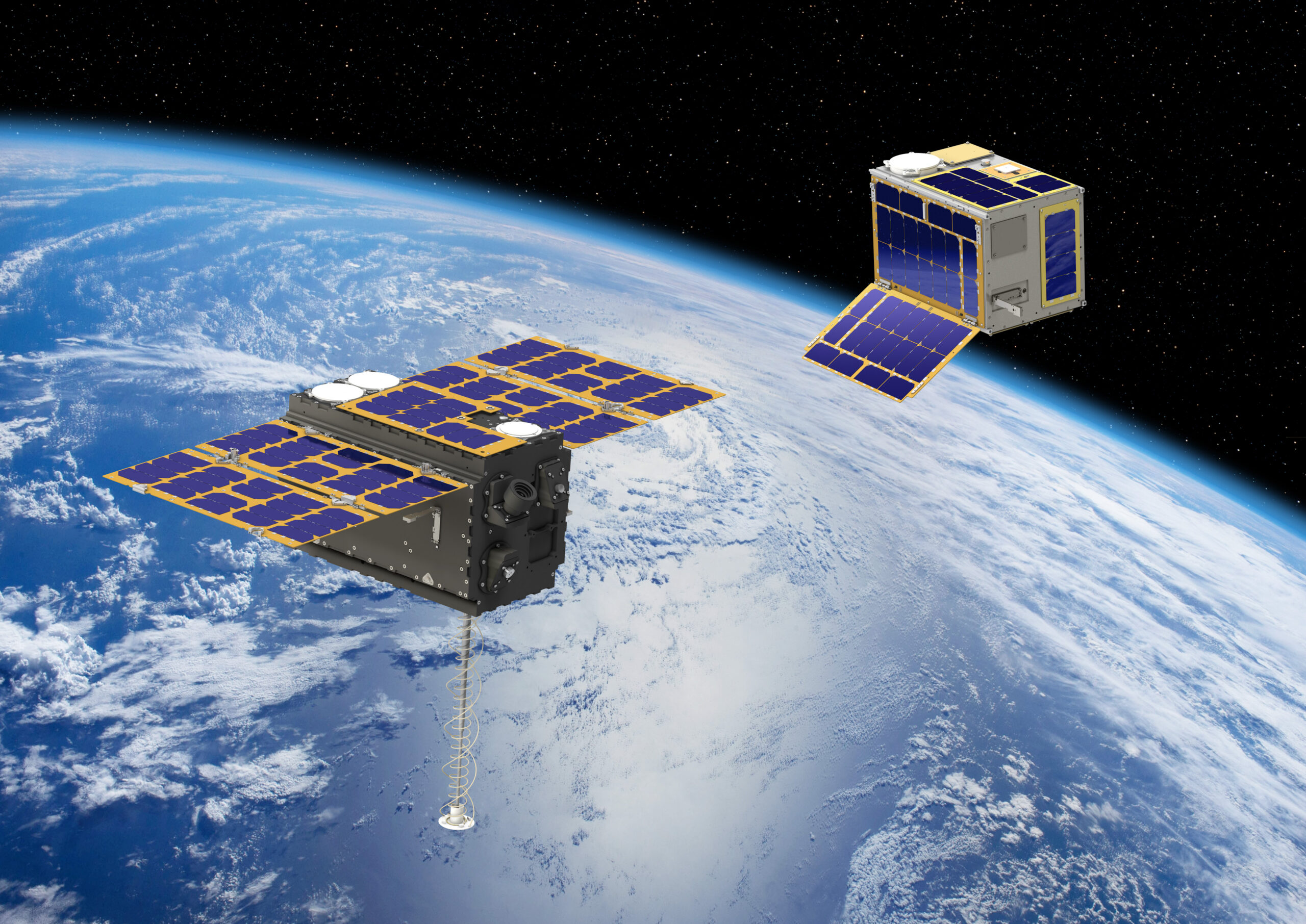
An artist’s rendering of ESA’s Celeste constellation in low Earth orbit (LEO). The 11-satellite mission will test whether navigation signals broadcast from LEO can strengthen Europe’s Galileo system. Credit: ESA – D. Ducros
Mission Highlight: Daughter of the Stars
Rocket Lab is targeting Wednesday, March 25, at 5:14 a.m. EDT for the launch of its 85th Electron mission from Launch Complex 1 on New Zealand’s Māhia Peninsula. The mission, titled Daughter of the Stars, marks the first time Rocket Lab has flown a dedicated mission for the European Space Agency (ESA).
Aboard the Electron are two small satellites for ESA’s Celeste program, the agency’s first satellite navigation initiative in low Earth orbit. Global navigation satellite systems, or GNSS — a category that includes America’s GPS, Europe’s Galileo, Russia’s GLONASS, and China’s BeiDou — operate from medium Earth orbit. Galileo’s satellites, for example, circle at an altitude of 14,429 miles (23,222 kilometers). Signals from that distance are easy to lose between tall buildings, under tree canopies, or inside buildings. Celeste will test whether a complementary layer of satellites in low Earth orbit — just 310 miles (510 km) up — can fill those gaps for Galileo.
The two Pathfinder A satellites, built by Thales Alenia Space and GMV under ESA contracts, are the first of an eventual 11-satellite constellation. The program is named after Maria Celeste, the daughter of Galileo Galilei. ESA hopes to have the full constellation operational by 2027.
Other missions this week
On Tuesday, March 25, SpaceX is targeting 7:03 p.m. EDT for the launch of Starlink Group 17-17 from Vandenberg Space Force Base in California.
Also targeting Wednesday, March 25, Isar Aerospace has moved its Onward and Upward mission to no earlier than March 25 from Andøya Spaceport in northern Norway. The mission, which we covered in detail last week, is the second flight of Germany’s Spectrum rocket and will carry five CubeSats and one experiment through ESA’s Boost! program. If Spectrum reaches orbit, it will be the first orbital launch from the European continent.
On Thursday, China is expected to launch a Long March 2C rocket from the Taiyuan Satellite Launch Center in Shanxi province at approximately 7:22 a.m. EDT, carrying an undisclosed payload.
On Friday, March 28, SpaceX is targeting 12:10 a.m. EDT for Starlink Group 10-44 from Cape Canaveral Space Force Station in Florida. The booster is expected to land on the droneship Just Read the Instructions.
Also on Friday, CAS Space, a commercial launch provider owned by the Chinese Academy of Sciences, is expected to launch a Kinetica 1 rocket from the Jiuquan Satellite Launch Center in northwestern China at approximately 7:00 a.m. EDT. Kinetica 1 is a four-stage solid-fueled vehicle; the payload has not been announced.
On Sunday, March 29, United Launch Alliance is scheduled to launch an Atlas V 551 from Cape Canaveral at 3:53 a.m. EDT carrying the next batch of Amazon Leo (formerly Project Kuiper) broadband satellites. The LA-05 mission is the fifth Atlas V launch for Amazon’s constellation, which must have half of its planned satellites in orbit by mid-2026 to meet an FCC license deadline.
Also targeting late March, Roscosmos is preparing the maiden flight of the Soyuz 5 rocket from the Baikonur Cosmodrome in Kazakhstan. Soyuz 5, also known as Irtysh, is Russia’s first new orbital vehicle in decades, designed to replace the Ukrainian-built Zenit. This demo flight will carry only a mass simulator. An exact date has not been publicly confirmed, though Roscosmos has indicated no earlier than late March.
Last week’s recap
The previous week saw another strong pace of launches, led by SpaceX’s continued Starlink buildout.
On Monday, March 16, SpaceX launched Starlink Group 17-24 from Vandenberg at 1:19 a.m. EDT, with the booster landing on the droneship Of Course I Still Love You. Later that morning, SpaceX launched Starlink Group 10-46 from Cape Canaveral at 9:27 a.m. EDT, with the booster landing on A Shortfall of Gravitas.
On Wednesday, March 19, SpaceX launched Starlink Group 10-33 from Cape Canaveral at 10:20 a.m. EDT, with the booster landing on the droneship Just Read the Instructions.
On Thursday, March 20, Rocket Lab successfully launched its 84th Electron mission, Eight Days A Week, from Māhia Peninsula at 2:10 p.m. EDT, deploying a Synspective StriX synthetic aperture radar satellite. Later that day, SpaceX launched Starlink Group 17-15 from Vandenberg at 5:51 p.m. EDT, with the booster landing on Of Course I Still Love You.
On Saturday, March 22, Roscosmos launched the Progress MS-33 cargo resupply mission to the International Space Station aboard a Soyuz 2.1a rocket from Baikonur at 7:59 a.m. EDT. SpaceX followed with Starlink Group 10-62 from Cape Canaveral at 10:47 a.m. EDT, with the booster landing on A Shortfall of Gravitas. Rounding out the day, Chinarocket launched a Jielong 3 rocket carrying 10 CentiSpace-1 navigation-related satellites from the Haiyang Oriental Spaceport at 11:49 a.m. EDT.
Earlier in the week, on March 16, a Kuaizhou 11 rocket launched eight satellites from the Jiuquan Satellite Launch Center.
Looking ahead
April opens with a possible launch of Artemis 2. On Wednesday, April 1, NASA is targeting 6:24 p.m. EDT for the launch of the SLS rocket and Orion spacecraft from Kennedy Space Center, sending astronauts Reid Wiseman, Victor Glover, Christina Koch, and Canadian Space Agency astronaut Jeremy Hansen on a 10-day flight around the Moon. Artemis 2 will be the first crewed lunar mission since Apollo 17 in 1972. NASA completed its flight readiness review on March 12 and confirmed the April window. Backup dates run through April 6, with an additional window on April 30. NASA rolled the vehicle back out to the launch pad March 20, where teams are now conducting prelaunch operations.
SpaceX also has Starlink missions on the early April schedule, with Starlink Group 17-35 targeting April 1 from Vandenberg and Starlink Group 10-58 targeting April 2 from Cape Canaveral.