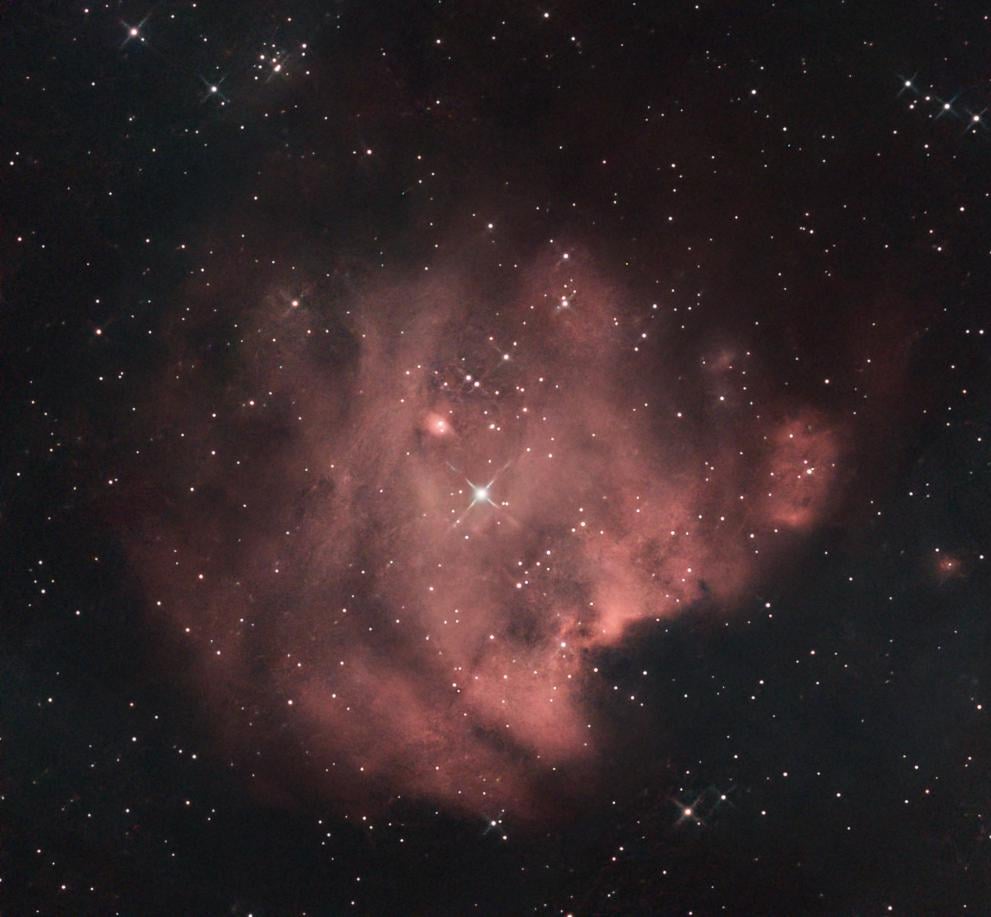
A mosaic* of the Monkey Head Nebula using Seestar S50’s framing feature based on 271x20s subs (= 90.3 mins) from Washington D.C. on Mar. 14, 2026.
Mounted the Seestar on a TH-10 fluid head; put it in equatorial mode; did a polar alignment to less than a degree in polar deviation in both RA and Declination coordinates. Used a Bahtinov mask for manual focus. Replaced the Bahtinov mask with a diffraction spike mask prior to initiating the acquisition of subs. Seestar LP filter** = On.
PixInsight*** (hereafter “PI”) was used to process Seestar’s stacked mosaic file.
Postprocessing was done as follows:
Converted Seestar’s stacked mosaic FIT file to XISF format (preferred by PI) using Script > Batch Format Conversion.
Applied Gradient Correction > Blur Xterminator > Spectrophotometric Color Calibration**** > Blur Xterminator > Delinearization by transferring image data from Screen Transfer Function to Histogram Transformation > Rotation***** > Dynamic Crop.
Created a mask using Range Selection. After masking the background applied Curves Transformation (to adjust saturation and boost intensity), Local Histogram Equalization (to adjust local contrast and visibility), and Noise Xterminator to the target image. Inverted the mask and applied Noise Xterminator and a Histogram Transformation to adjust the background’s shadows and midtones. Reinverted the mask and reapplied Curves transformation, Local Histogram Equalization, and Noise Xterminator to further enhance the target image.
* Seestar’s mosaic, referred to as framing, is constructed from a series of images starting out from the center until they gradually cover the entirety of the framed target. This approach necessitates additional mosaic build-up time, beyond the minimum suggested by Seestar, to even out the quality of the image across the entire mosaic.
** Seestar S50 has a built-in OIII 30nm / Hα 20nm duo-band light pollution filter. (Seestar is a 50 mm f/5, i.e. 250 mm focal length, apochromatic triplet telescope with a built-in camera based on a Sony IMX462 sensor and filters combination.)
*** PixInsight Core Version 1.9.3 Lockhart, build 1646.
**** For SPCC’s R, G, B filter settings when the LP filter is on I used Seestar-LP-(R, G, B).
***** Used the Lanczos-3 interpolation (instead of an auto) algorithm to preserve detail and to minimize aliasing artifacts when applying a rotation.

1 Comment
A mosaic* of the Monkey Head Nebula using Seestar S50’s framing feature based on 271x20s subs (= 90.3 mins) from Washington D.C. on Mar. 14, 2026.
Mounted the Seestar on a TH-10 fluid head; put it in equatorial mode; did a polar alignment to less than a degree in polar deviation in both RA and Declination coordinates. Used a Bahtinov mask for manual focus. Replaced the Bahtinov mask with a diffraction spike mask prior to initiating the acquisition of subs. Seestar LP filter** = On.
PixInsight*** (hereafter “PI”) was used to process Seestar’s stacked mosaic file.
Postprocessing was done as follows:
Converted Seestar’s stacked mosaic FIT file to XISF format (preferred by PI) using Script > Batch Format Conversion.
Applied Gradient Correction > Blur Xterminator > Spectrophotometric Color Calibration**** > Blur Xterminator > Delinearization by transferring image data from Screen Transfer Function to Histogram Transformation > Rotation***** > Dynamic Crop.
Created a mask using Range Selection. After masking the background applied Curves Transformation (to adjust saturation and boost intensity), Local Histogram Equalization (to adjust local contrast and visibility), and Noise Xterminator to the target image. Inverted the mask and applied Noise Xterminator and a Histogram Transformation to adjust the background’s shadows and midtones. Reinverted the mask and reapplied Curves transformation, Local Histogram Equalization, and Noise Xterminator to further enhance the target image.
* Seestar’s mosaic, referred to as framing, is constructed from a series of images starting out from the center until they gradually cover the entirety of the framed target. This approach necessitates additional mosaic build-up time, beyond the minimum suggested by Seestar, to even out the quality of the image across the entire mosaic.
** Seestar S50 has a built-in OIII 30nm / Hα 20nm duo-band light pollution filter. (Seestar is a 50 mm f/5, i.e. 250 mm focal length, apochromatic triplet telescope with a built-in camera based on a Sony IMX462 sensor and filters combination.)
*** PixInsight Core Version 1.9.3 Lockhart, build 1646.
**** For SPCC’s R, G, B filter settings when the LP filter is on I used Seestar-LP-(R, G, B).
***** Used the Lanczos-3 interpolation (instead of an auto) algorithm to preserve detail and to minimize aliasing artifacts when applying a rotation.