
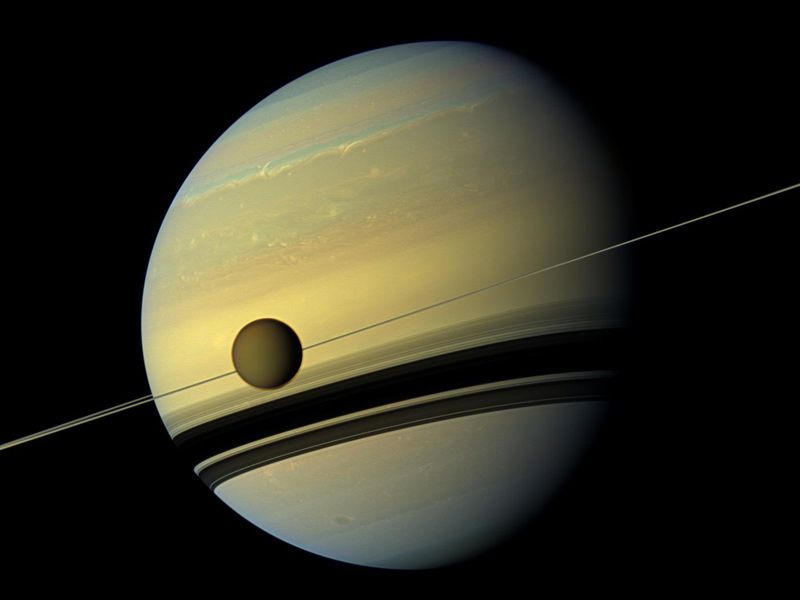
On September 15, 2017, the Cassini spacecraft streaked into Saturn’s atmosphere at 33.5 km/s, concluding a two-decade journey that redefined our understanding of the Solar System.
As it purposely plummeted into the planet, it passed through cobalt-blue skies: a startlingly Earth-like sight on a world so alien.
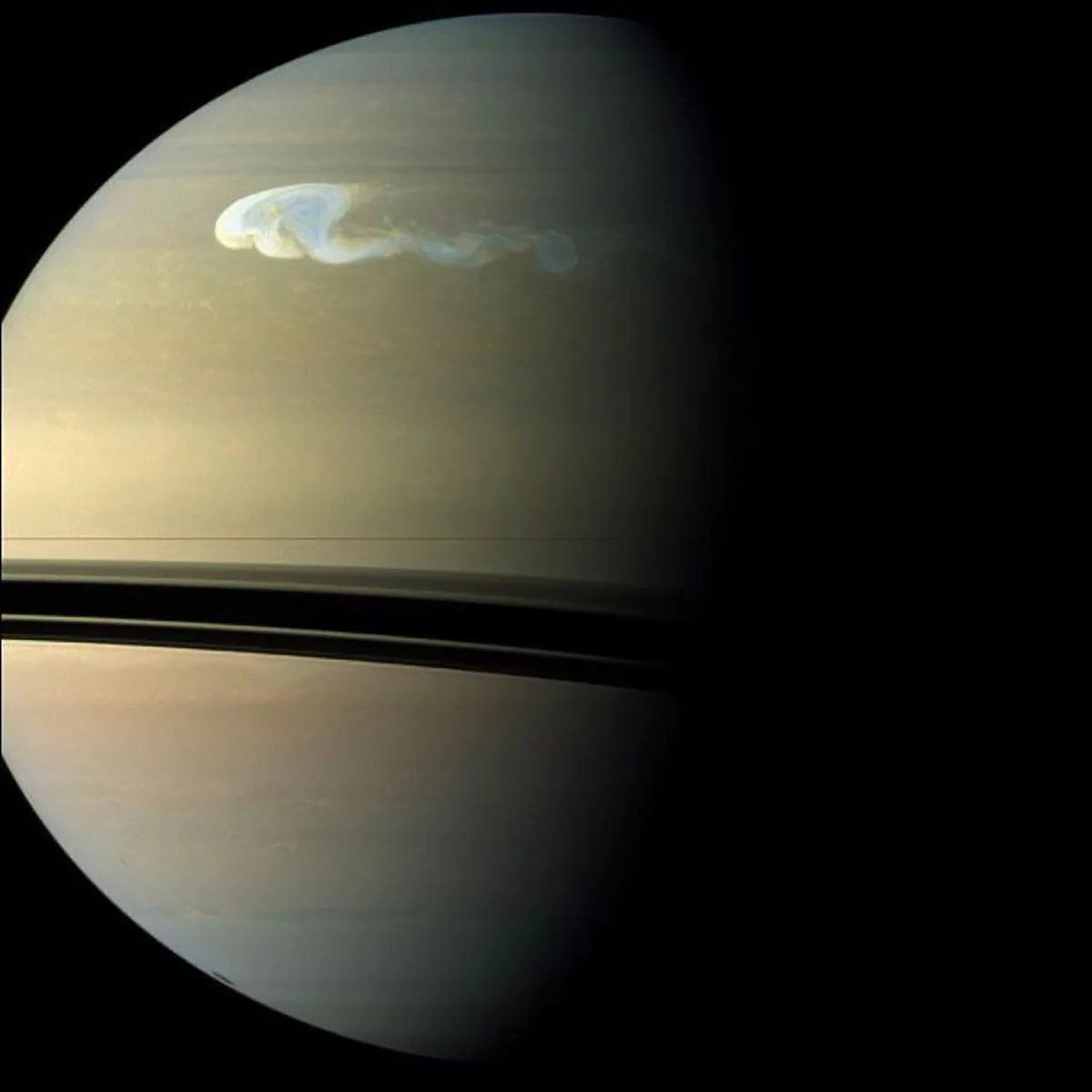 A massive storm – a great white spot – churns across Saturn’s northern hemisphere, captured by NASA’s Cassini spacecraft. Credit: NASA/JPL-Caltech/Space Science Institute
A Grand Arrival
Launched in October 1997, the Cassini-Huygens mission was a joint effort between NASA, the European Space Agency and the Italian Space Agency.
After a 3.5-billion-km trek fueled by gravity assists from Venus, Earth and Jupiter, the bus-sized spacecraft arrived at Saturn in 2004.
It carried the Huygens probe, which successfully landed on the giant moon Titan that December.
Over the next 13 years, Cassini completed over 290 orbits, observing the planet’s shifting seasons from equinox to solstice.
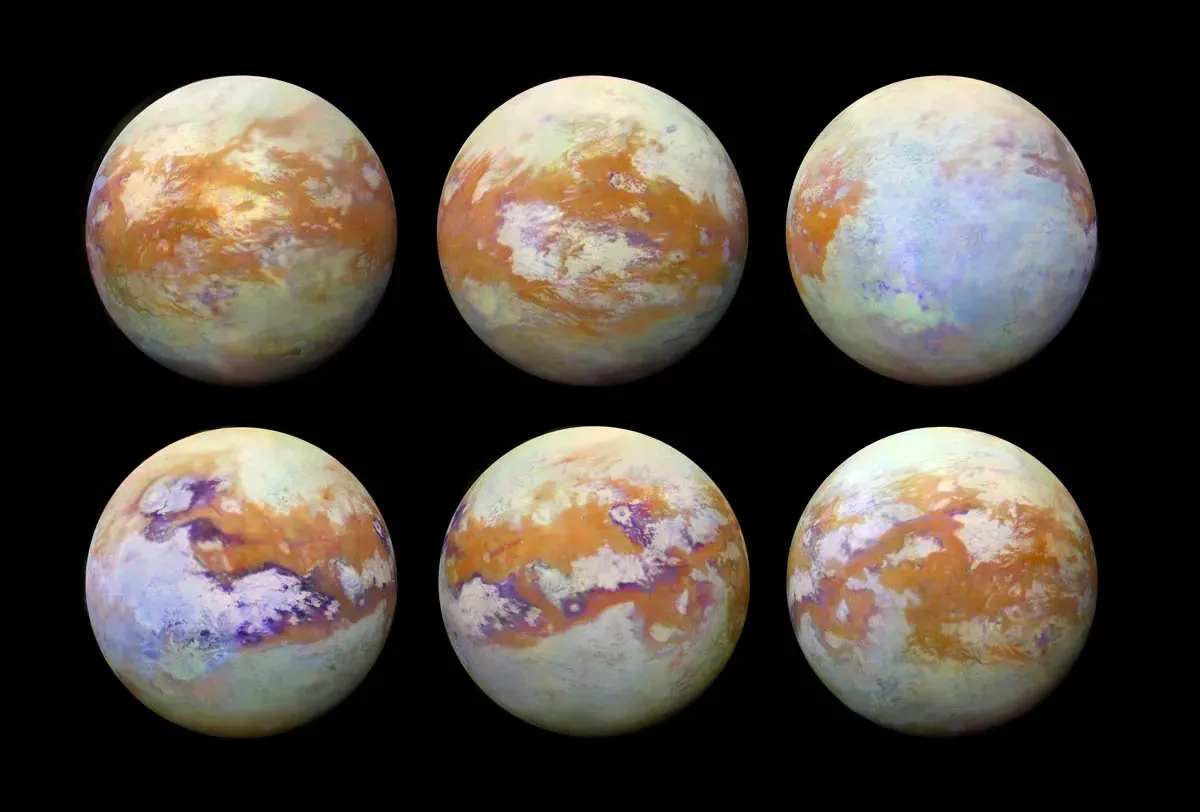 Infrared images of Saturn’s moon Titan, captured by NASA’s Cassini spacecraft. Credit: NASA/JPL-Caltech/Stéphane Le Mouélic, University Of Nantes, Virginia Pasek, University Of Arizona
Transforming our view of Solar System moons
Cassini discovered seven new moons and revealed that Saturn’s satellites are incredibly diverse, ranging from potato-shaped rocks to worlds the size of planets.
Titan: Observations revealed a world where methane mimics Earth’s water cycle, featuring hydrocarbon rivers, lakes and ground fog. Beneath its icy crust, scientists believe a liquid ocean exists – one of the best places to search for signs of life beyond Earth.
Enceladus: Perhaps the mission’s most famous find was the discovery of water-ice geysers erupting from tiger-stripe fissures at the south pole of its icy moon Enceladus. Cassini flew through these plumes, detecting nitrogen, methane and organics, suggesting a salty, hydrothermal ocean that could potentially support microbial life.
More moons: The mission found thin oxygen atmospheres around Rhea and Dione, while the Death Star-like Mimas was identified as another potential ocean-harbouring candidate.
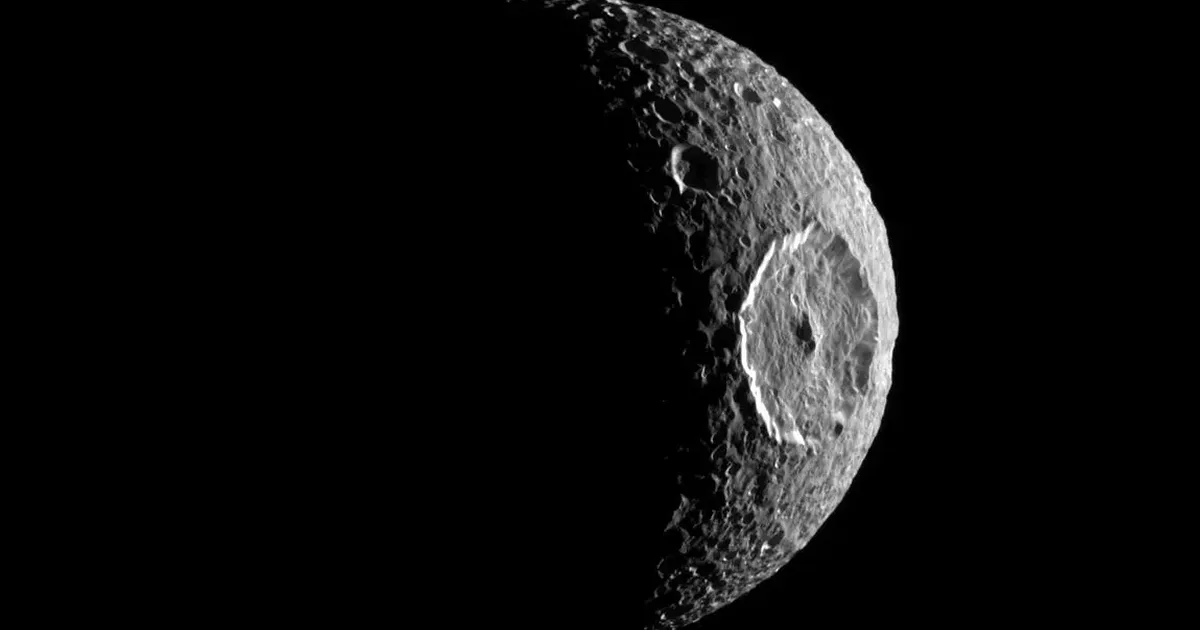 Saturn’s ‘Death Star’ moon Mimas, as seen by the Cassini spacecraft. Credit: NASA/PJL/Space Science Institute
Secrets of Saturn’s rings and atmosphere
Stretching 282,000km – three-quarters the distance from Earth to the Moon – Saturn’s rings are 99.9% water-ice.
Cassini identified particles ranging from sand grains to mountain-sized boulders and observed mysterious, seasonal ‘spokes‘ that appear and vanish in hours due to electrostatic charging.
On the planet itself, Cassini monitored massive lightning storms and the iconic 30,000-km-wide north polar hexagon, a jet stream with winds reaching 320 km/h.
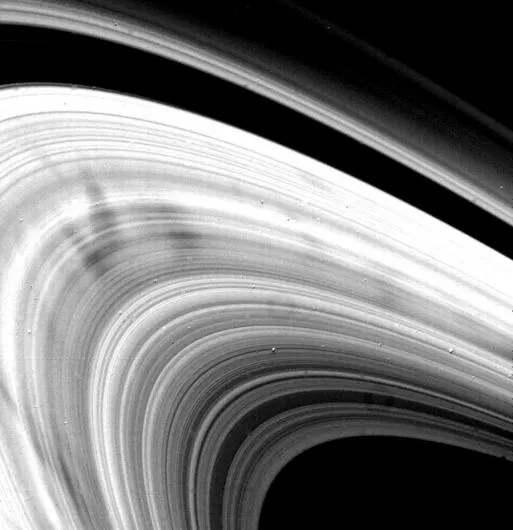 Saturn rings with ‘spoke’ features in the inner B-ring. The spokes are thought to consist of microscopic dust particles suspended by electrostatic repulsion and appear as shadows on the image. (Credit: NASA/JPL)
The Huygens landing
The Huygens probe provided the first look beneath Titan’s orange haze when it successfully landed on the moon.
It found icy ‘sand’ littered with rounded, hydrocarbon-coated pebbles and recorded the first audio of wind from another world.
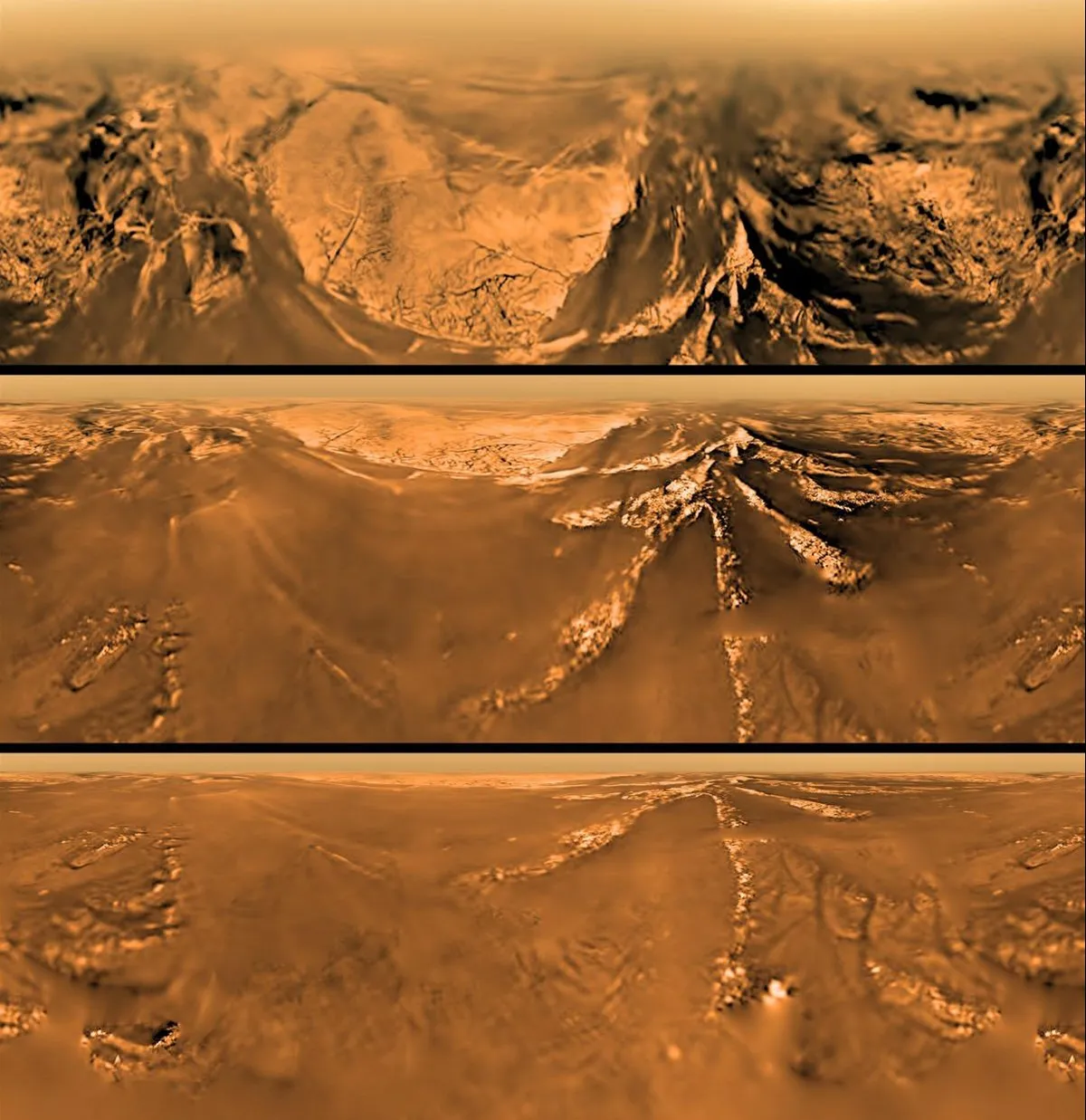 Views of Titan’s surface as seen by the Huygens lander during its descent onto the surface of the icy moon, 14 January 2005. Credit: ESA/NASA/JPL/University of Arizona
The Grand Finale
As fuel ran low, mission controllers faced a dilemma: a dead spacecraft could eventually crash into and contaminate pristine moons like Enceladus.
To protect these potential habitats, they opted for a Grand Finale. In 2017, Cassini performed 22 daring dives between the planet and its rings.
These manoeuvres allowed the craft to sample the atmosphere directly and map Saturn’s gravity and magnetic fields at unprecedented resolutions.
Even as it disintegrated, Cassini sent back data until the very last second, becoming a permanent part of the gas giant it spent a lifetime exploring.
Below are some more amazing images of Saturn and its moons captured by the Cassini spacecraft
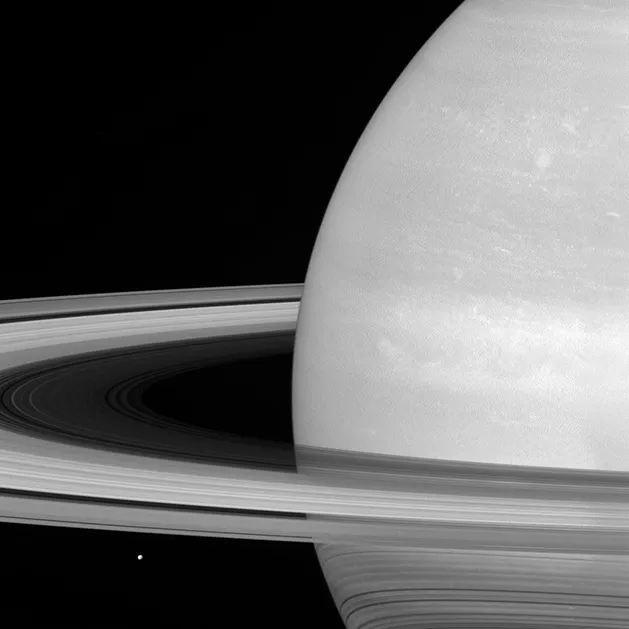 A view of Saturn’s rings captured by the Cassini spacecraft on 21 July 2016. Just below rings can be spotted Saturn’s tiny moon Mimas.
Credit: NASA/JPL-Caltech/Space Science Institute
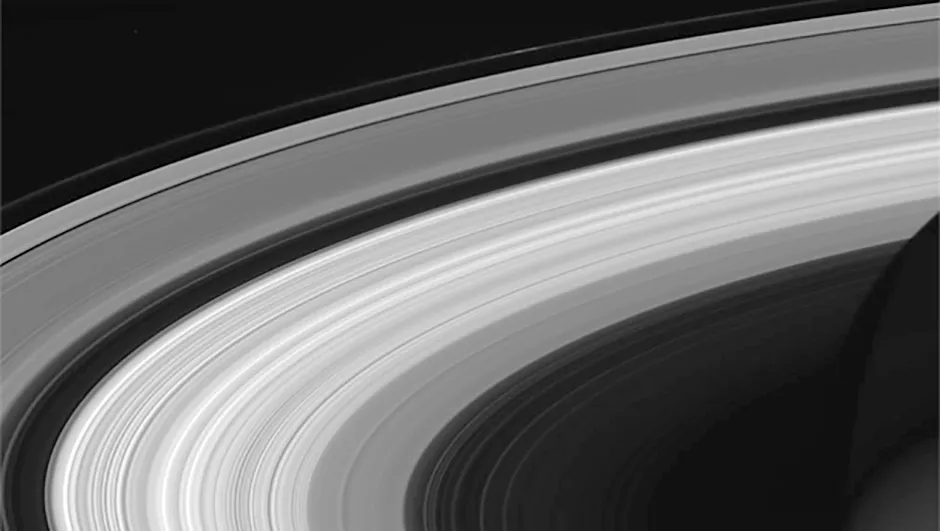 This is one of the last images of Saturn’s rings taken by NASA’s Cassini spacecraft, on 13 September 2017. Data from the mission is enabling scientists to learn more about the planet, its moons and its rings. Image Credit: NASA/JPL-Caltech/Space Science Institute
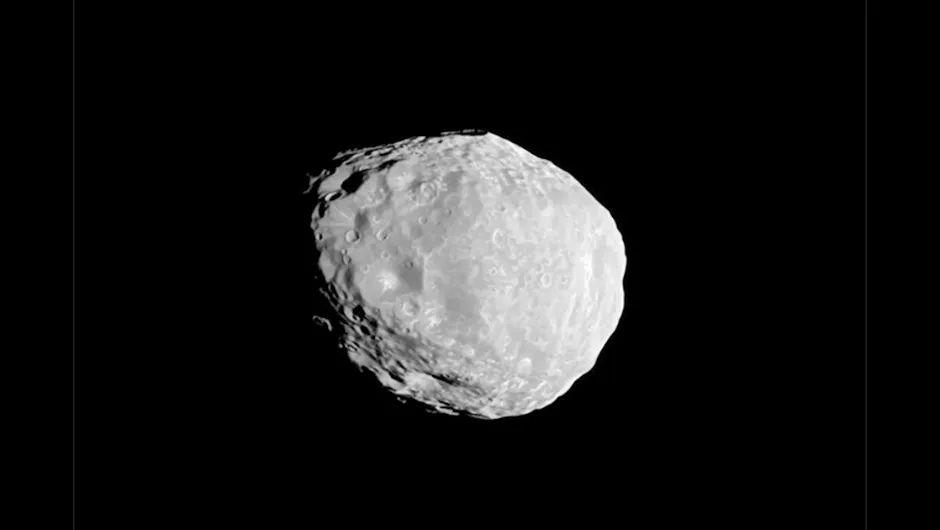 An image of Saturn’s crater-covered moon Janus, taken by the Cassini spacecraft on 7 April 2010.
Credit: NASA/JPL/Space Science Institute
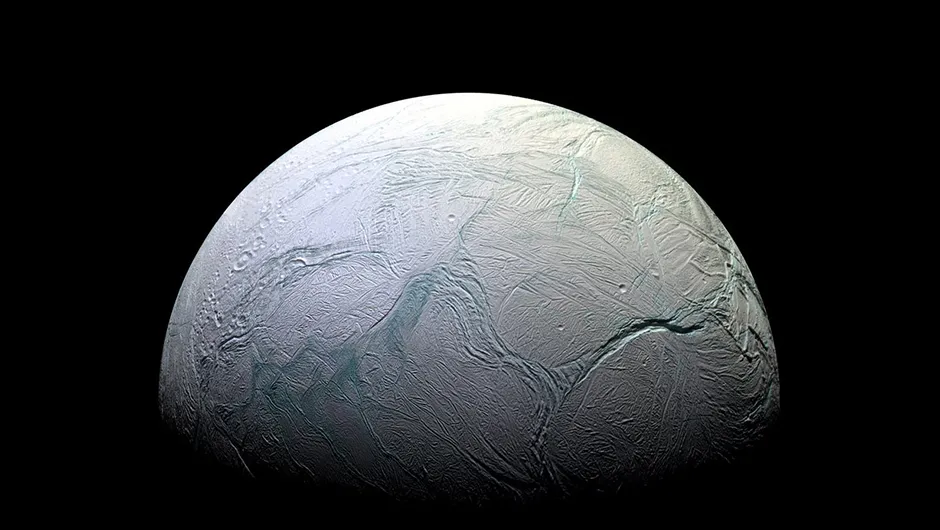 Enceladus’s cratered crust, as seen by the Cassini spacecraft. What lies below, in the moon’s subsurface ocean?
Credit: NASA/JPL-Caltech/Space Science Institute
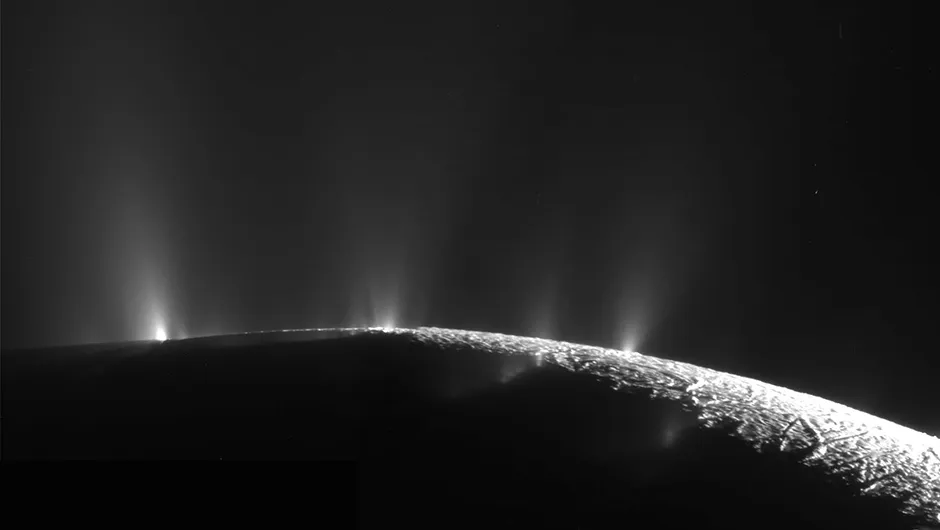 An image of Enceladus captured by Cassini, showing plumes of vapour bursting through Enceladus’s icy crust. Credit: NASA/JPL-Caltech/SSI
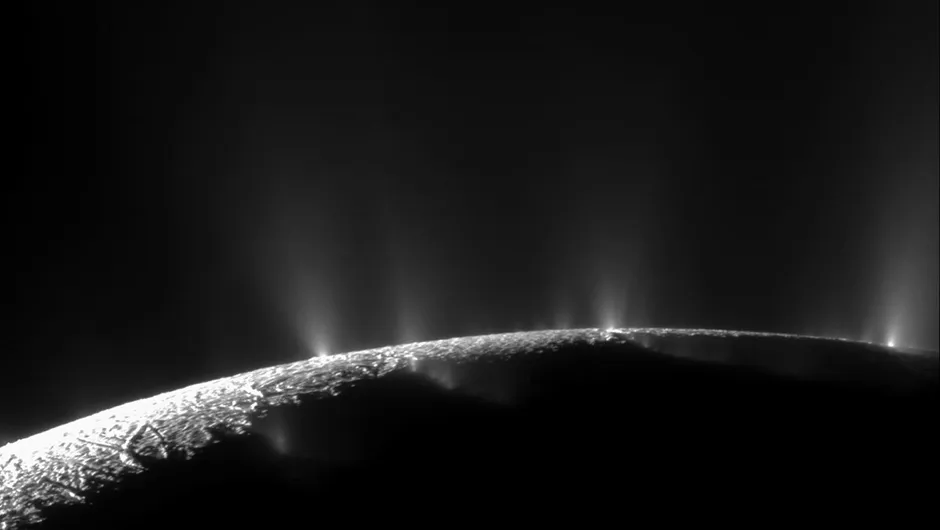 This image captured by the Cassini spacecraft shows plumes of water ice erupting from the surface of Enceladus. Do similar plumes exist on Jupiter’s moon Europa?
Credit: NASA/JPL-Caltech/SSI
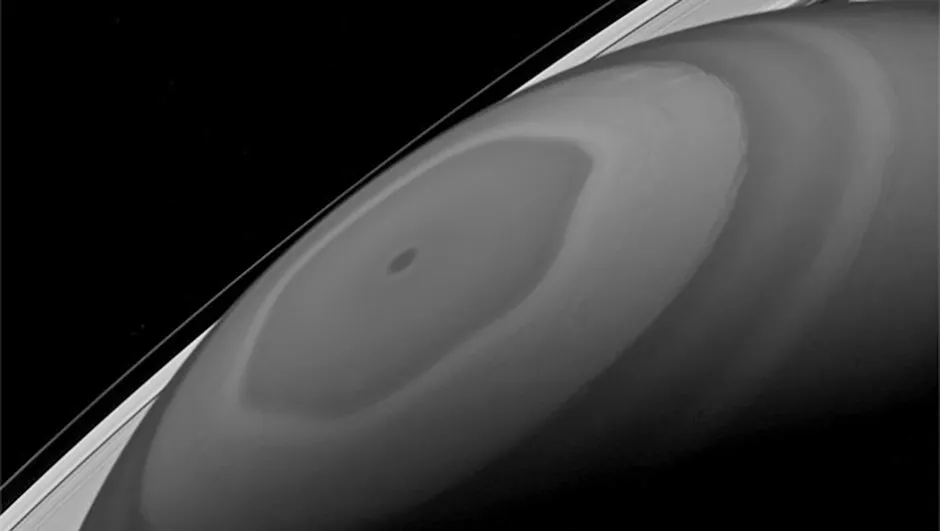 A view of Saturn’s hexagon storm. NASA’s Cassini mission revealed Saturn to us like never before. Scientists will be analysing its data and drawing conclusions for years to come.
Credit: NASA/JPL-Caltech/Space Science Institute
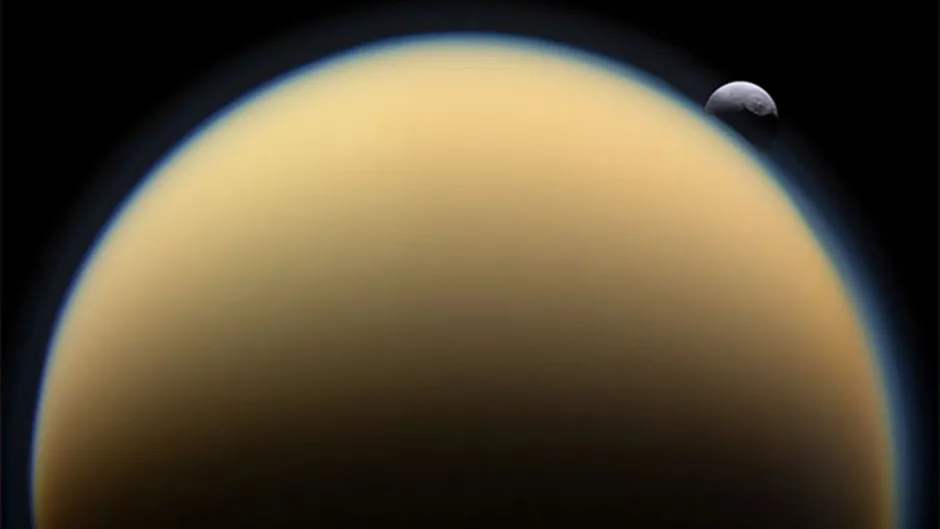 Like Earth, Titan has an atmosphere, seen here as a hazy blue outline around the moon’s limb. But Cassini scientists have discovered another similarity between our planet and Saturn’s largest moon.To the upper left of Titan in this image taken by the Cassini spacecraft is Tethys, another of Saturn’s satellites.Credit: Cassini Imaging Team, ISS, JPL, ESA, NASA
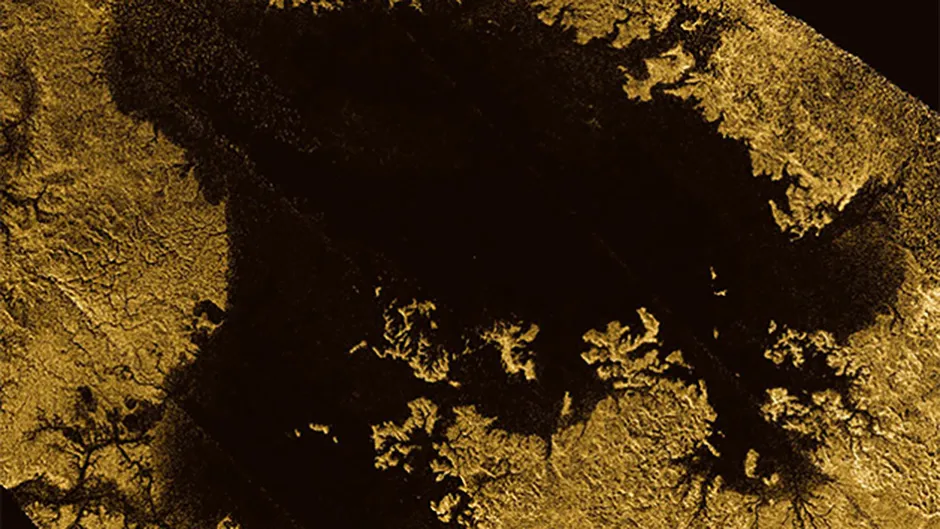 A false-colour image taken by NASA’s Cassini spacecraft of Ligeia Mare, the second largest known body of liquid on Saturn’s moon Titan. It is filled with liquid hydrocarbons such as ethane and methane.
Credit: NASA/JPL-Caltech/ASI/Cornell
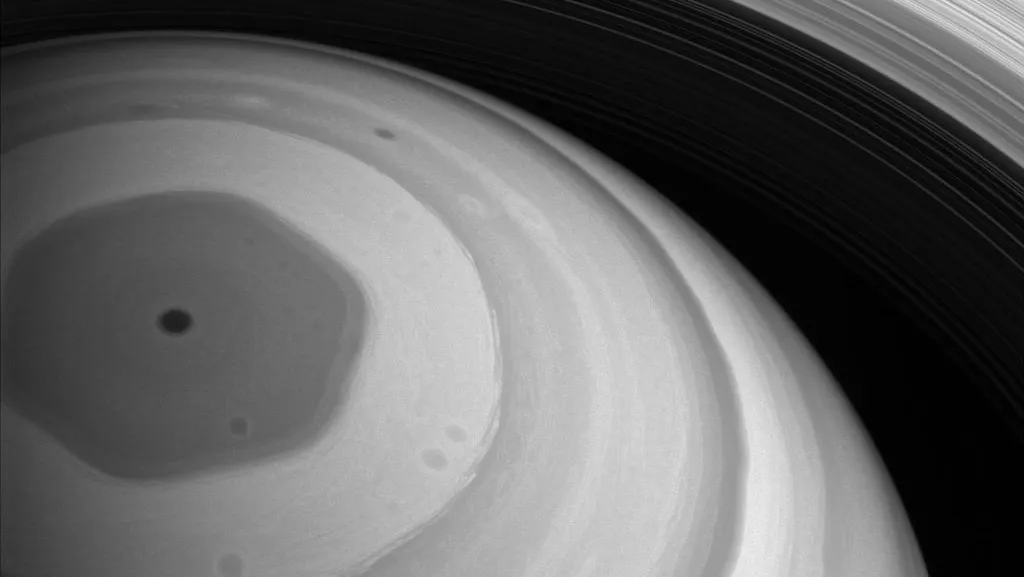 The whole northern region of Saturn is bathed in sunlight in this view from late 2016, takenm by Cassini. Image Credit: NASA
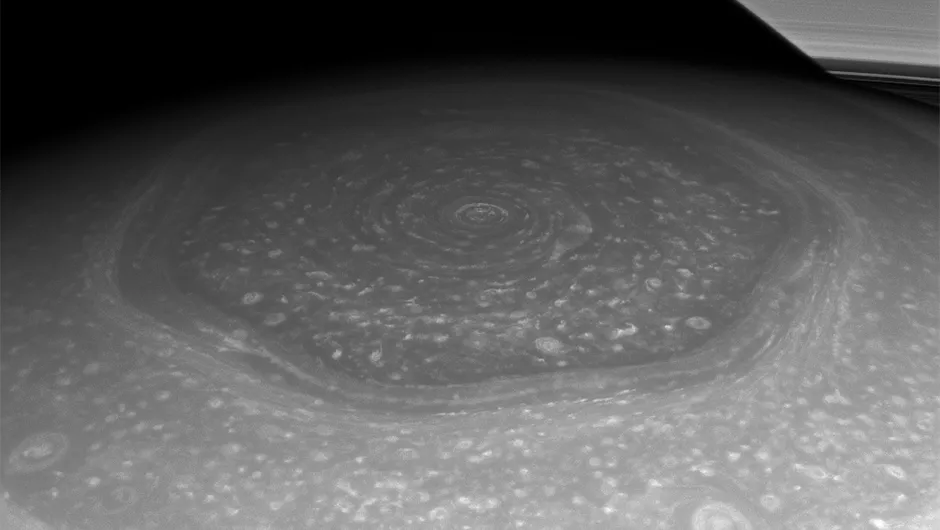 Saturn’s north polar hexagon, as seen by the Cassini spacecraft
Credit: NASA/JPL-Caltech/Space Science Institute
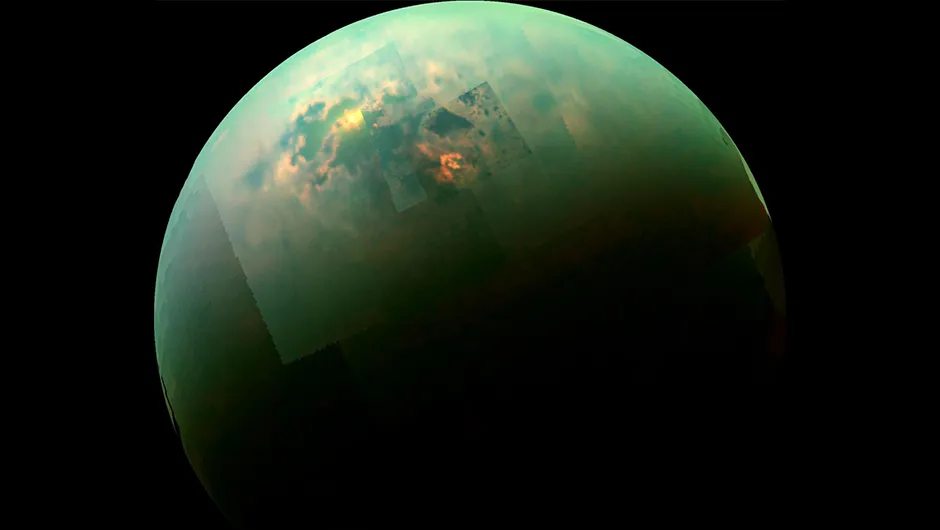 Sunlight reflects off Titan’s northern seas in this image taken by the Cassini spacecraft.
Credits: NASA/JPL/Univ. Arizona/Univ. Idaho
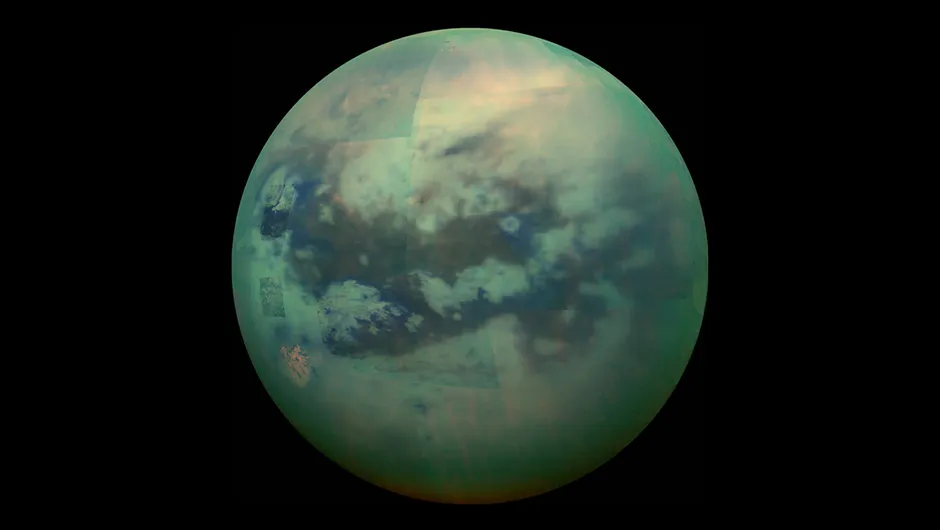 Cassini took many images of Titan over its 13 year mission at Saturn. The mission ended on 15 September 2017, when it plunged into Saturn’s atmosphere, but it’s data is still providing scientific insight. Image Credit: NASA/JPL-Caltech/ASI
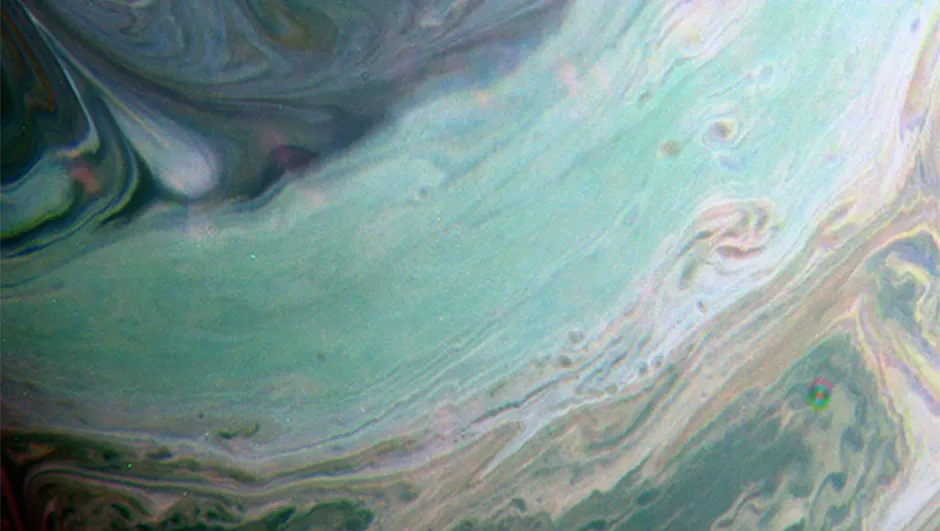 Saturn’s clouds in infrared, by the Cassini spacecraft, 9 August 2016
Credit: NASA/JPL-Caltech/Space Science Institute/Kevin M. Gill
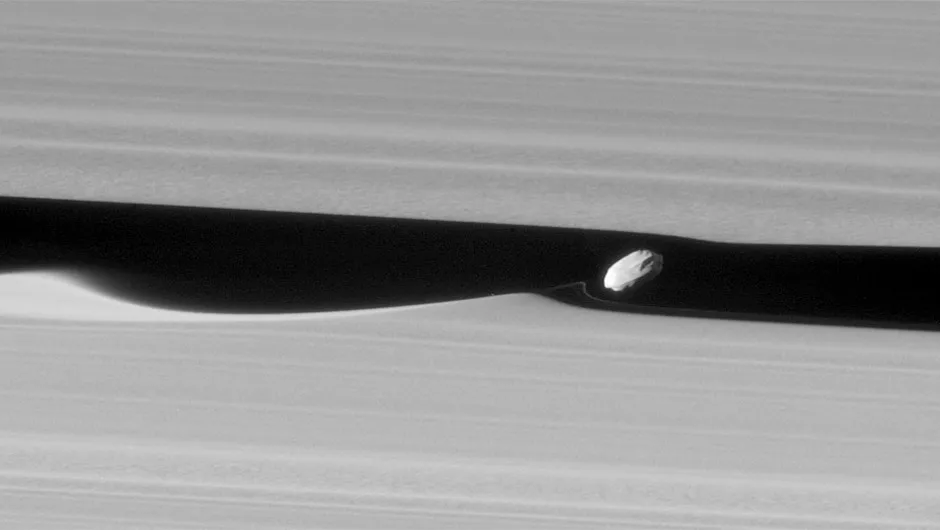 Cassini captured this image of the moon Daphnis orbiting within the 42km Keeler Gap. The waves in the edges of the gap are caused by the moon’s gravitational pull.
Credit: NASA/JPL-Caltech/Space Science Institute
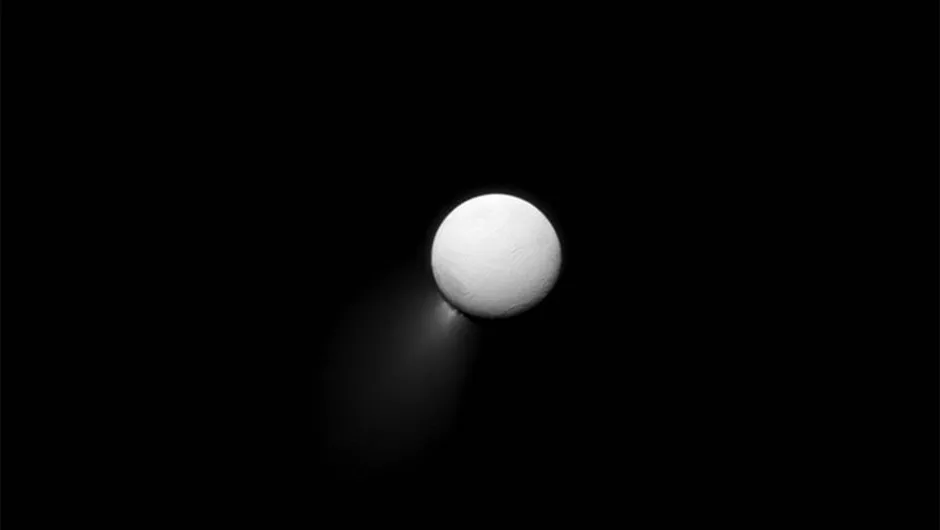 Plumes of water ice and vapour spray from the south polar region of Saturn’s moon Enceladus. The presence of water on the moon means that scientists cannot risk the Cassini orbiter contaminating its surface.
Credits: NASA/JPL/Space Science Institute
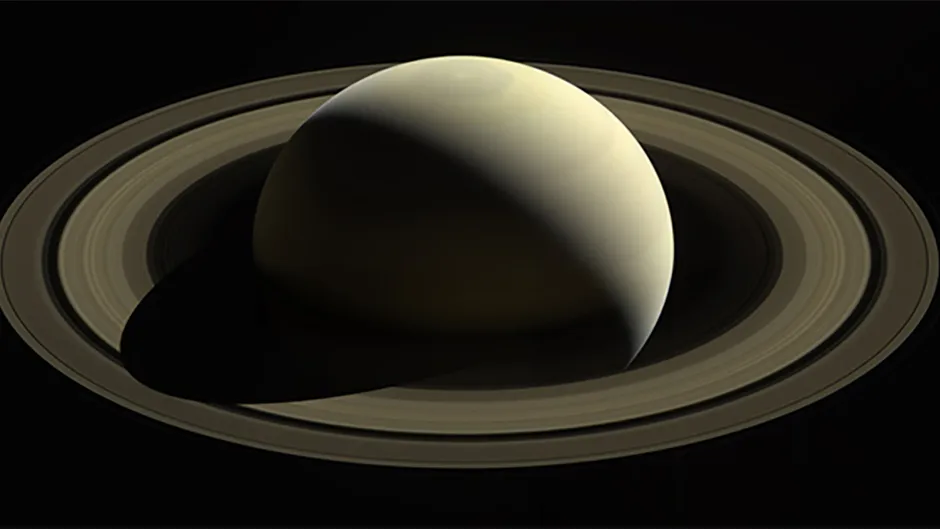 A view of Saturn, captured by the Cassini spacecraft.
Credit: NASA/JPL-Caltech/Space Science Institute
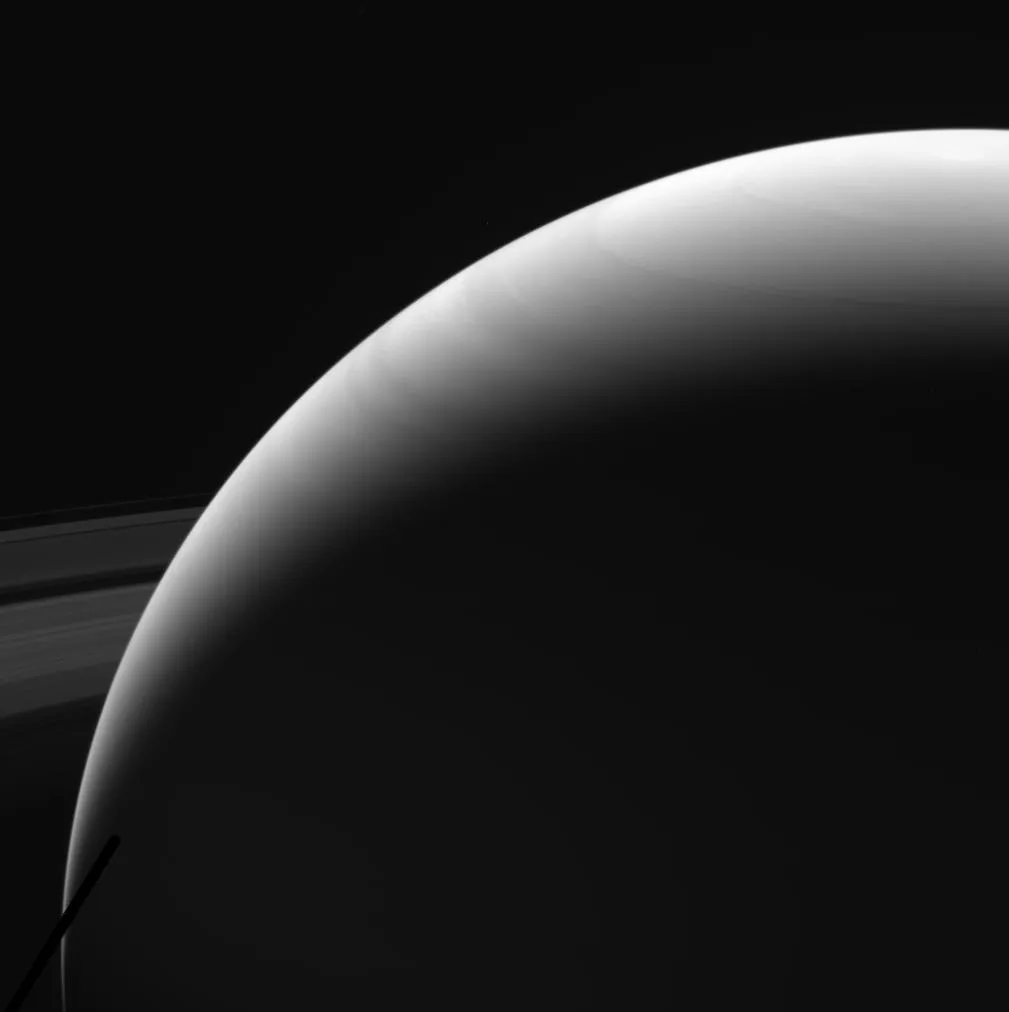 Shadows on Saturn, by the Cassini spacecraft, 13 September 2017 (Credit: NASA/JPL-Caltech/Space Science Institute)
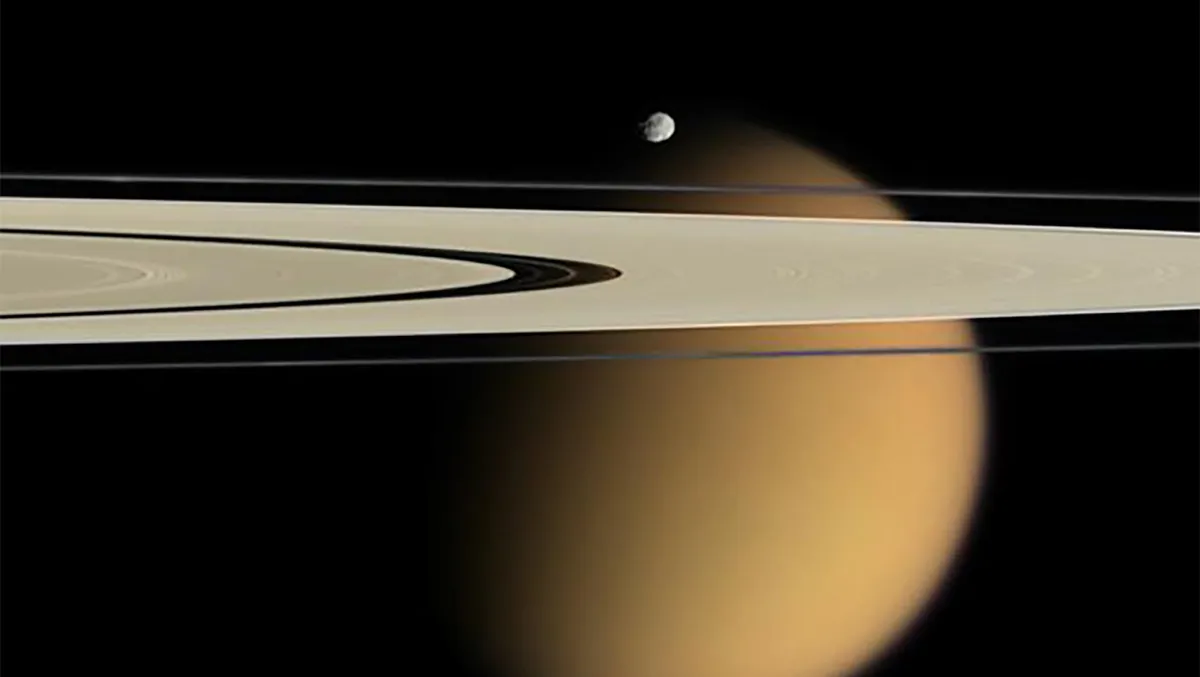 A Cassini image showing Titan, Saturn’s largest moon, behind the planet’s rings. The smaller moon Epimetheus can be seen in the foreground. Image Credit: NASA/JPL/Space Science Institute
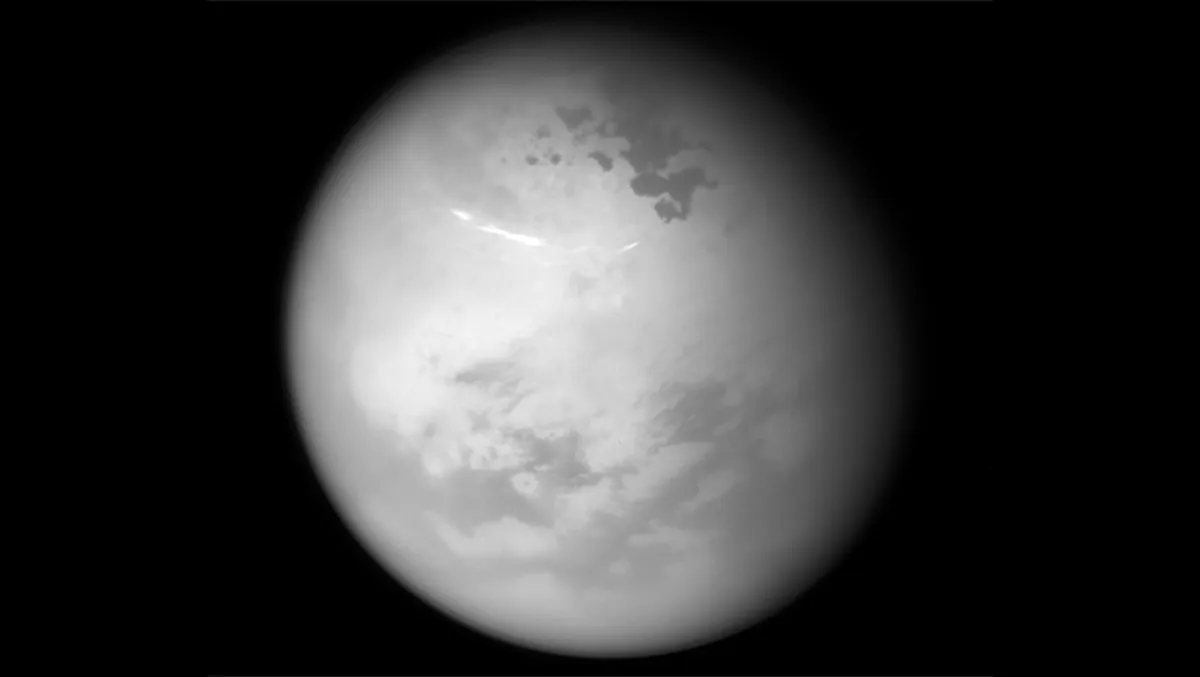 Methane clouds drift across Titan’s summer skies in this Cassini image. The darker patches are hydrocarbon lakes.
Credit: NASA/JPL-Caltech/Space Science Institute
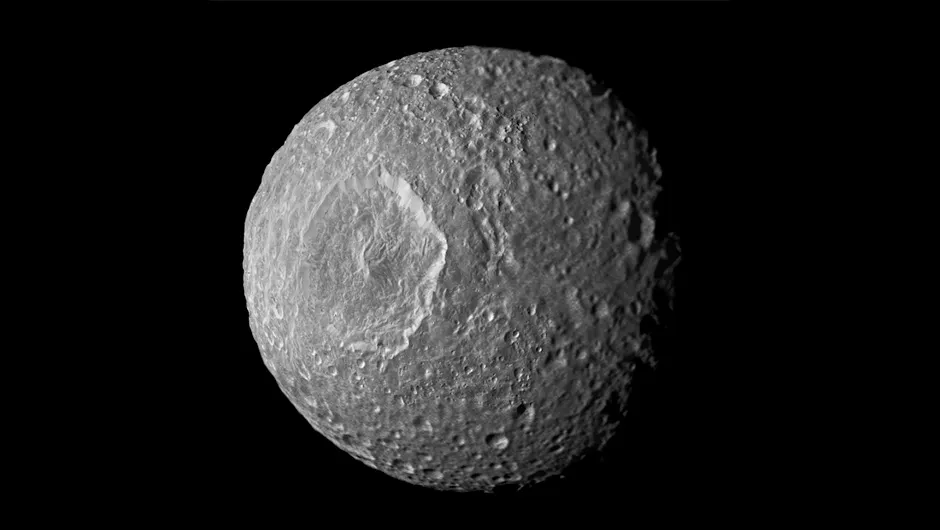 Saturn’s moon Mimas, as seen by the Cassini spacecraft. Credit: NASA
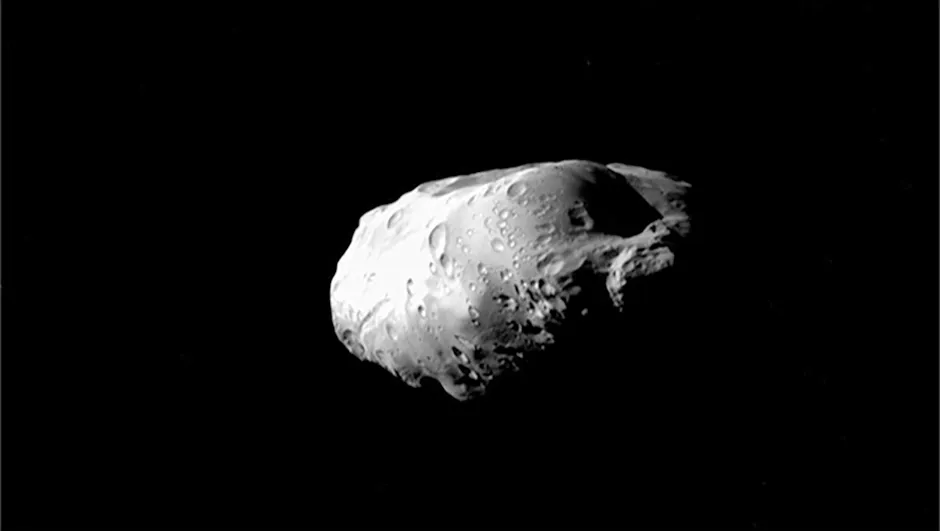 Saturn’s moon Prometheus, as seen by the Cassini spacecraft on 6 December 2015. Credit: NASA/JPL-Caltech/Space Science Institute
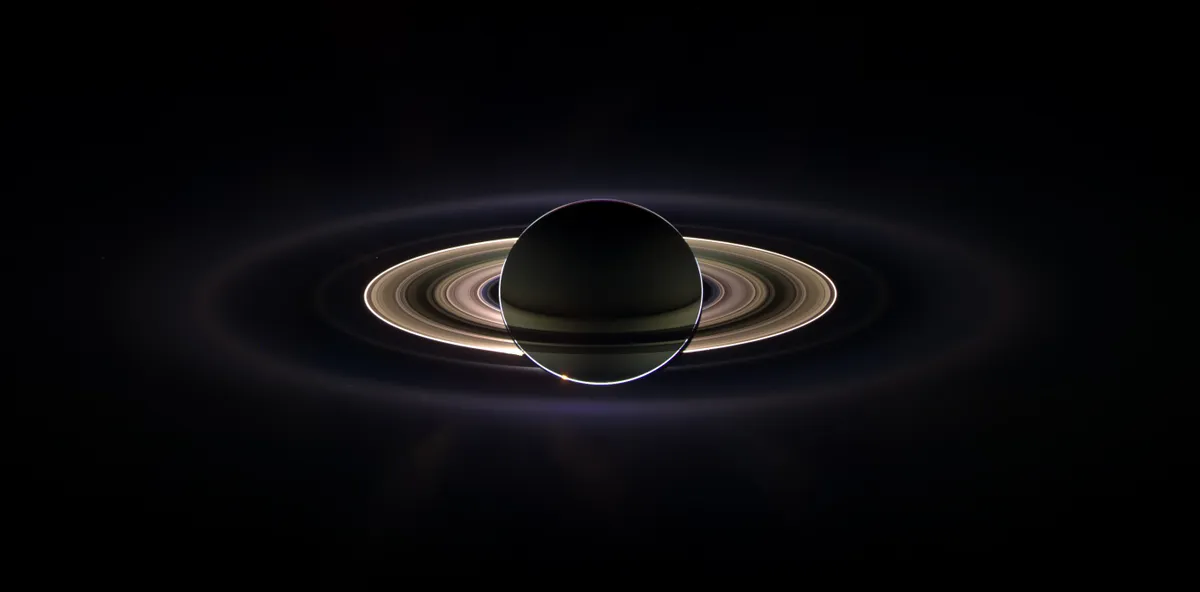 15th September 2006. Saturn sheltering Cassini from the blinding glare of the Sun, brightening microscopic particles and revealing previously unknown faint rings. (Credit: NASA/JPL/Space Science Institute)
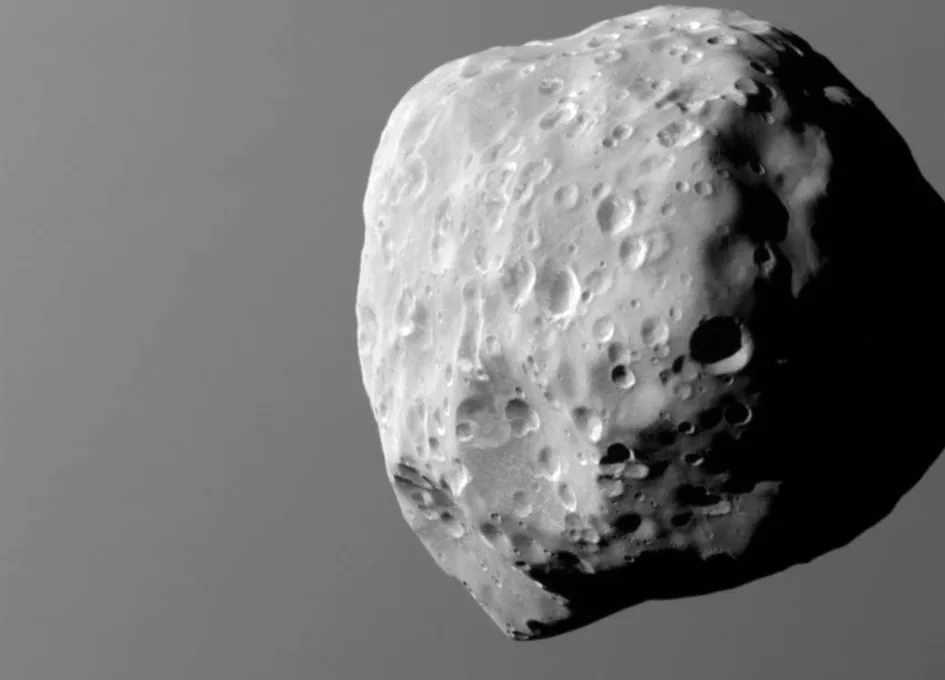 6th December 2015. One of Saturn’s many small moons, Epimetheus has had its surface heavily pitted as a result of eons of bombardment. (Credit: NASA/JPL-Caltech/Space Science Institute)
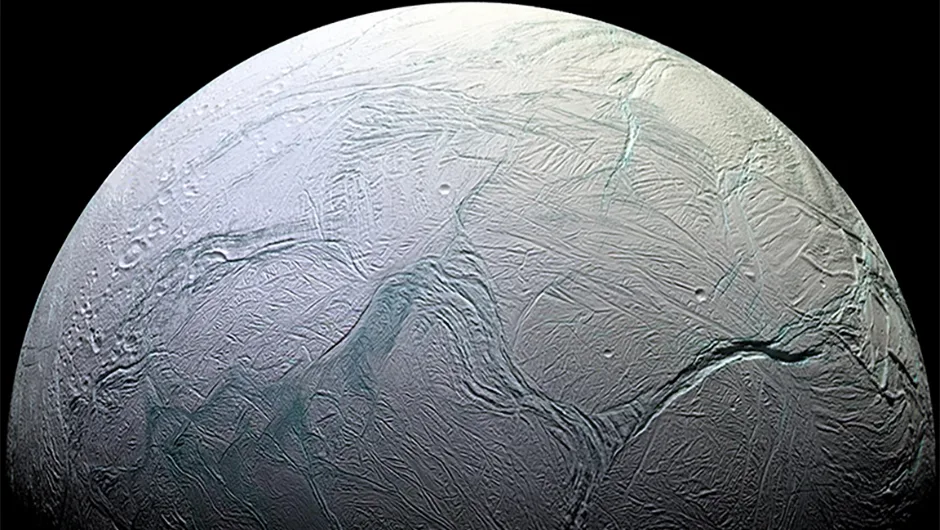 The cratered moon Enceladus. Cassini data has revealed a subsurface ocean beneath its icy crust. Image Credit: NASA/JPL-Caltech/Space Science Institute
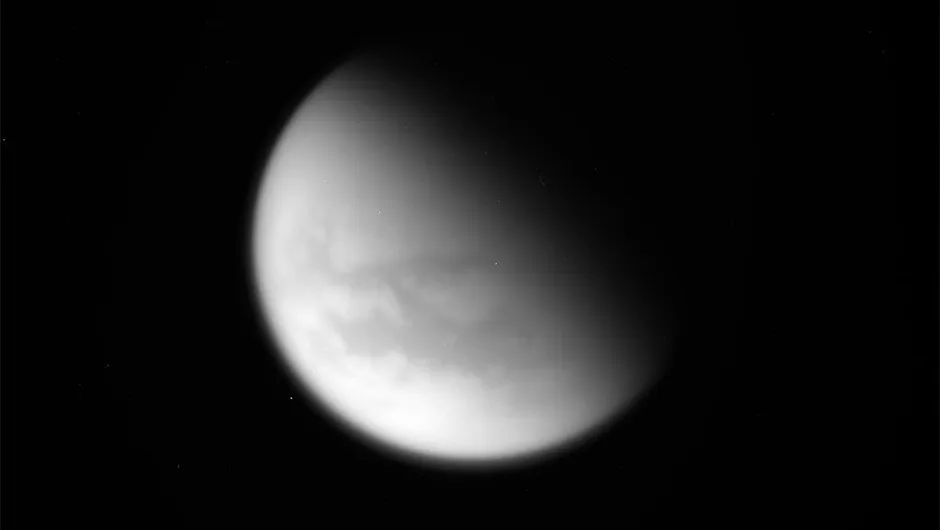 Cassini takes a last look at Saturn’s moon Titan on 21 April, before manoeuvring to begin its series of ring dives on 26 April.
Credit: NASA/JPL-Caltech/Space Science Institute
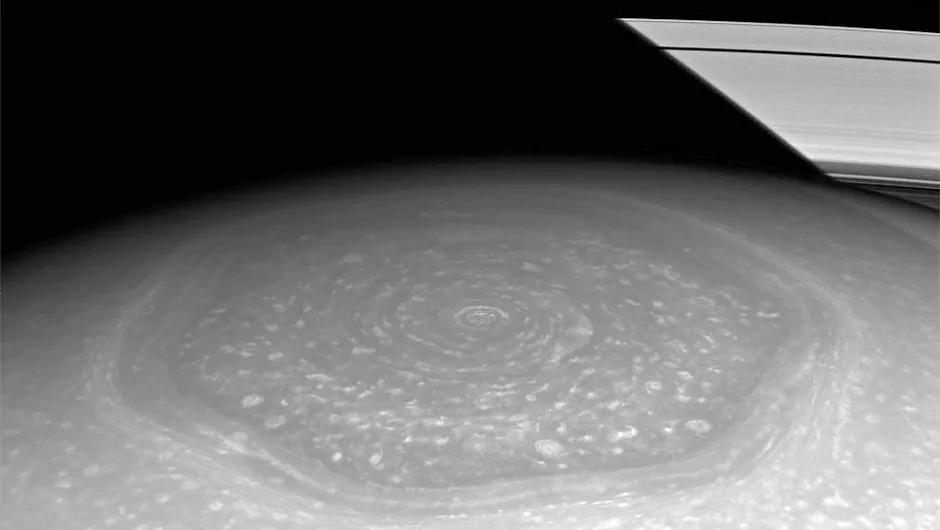 Saturn’s north polar hexagonal storm. Just one of the mysterious features of the Saturnian system that the Cassini mission has revealed in close-up. Credit: NASA/JPL-Caltech/Space Science Institute
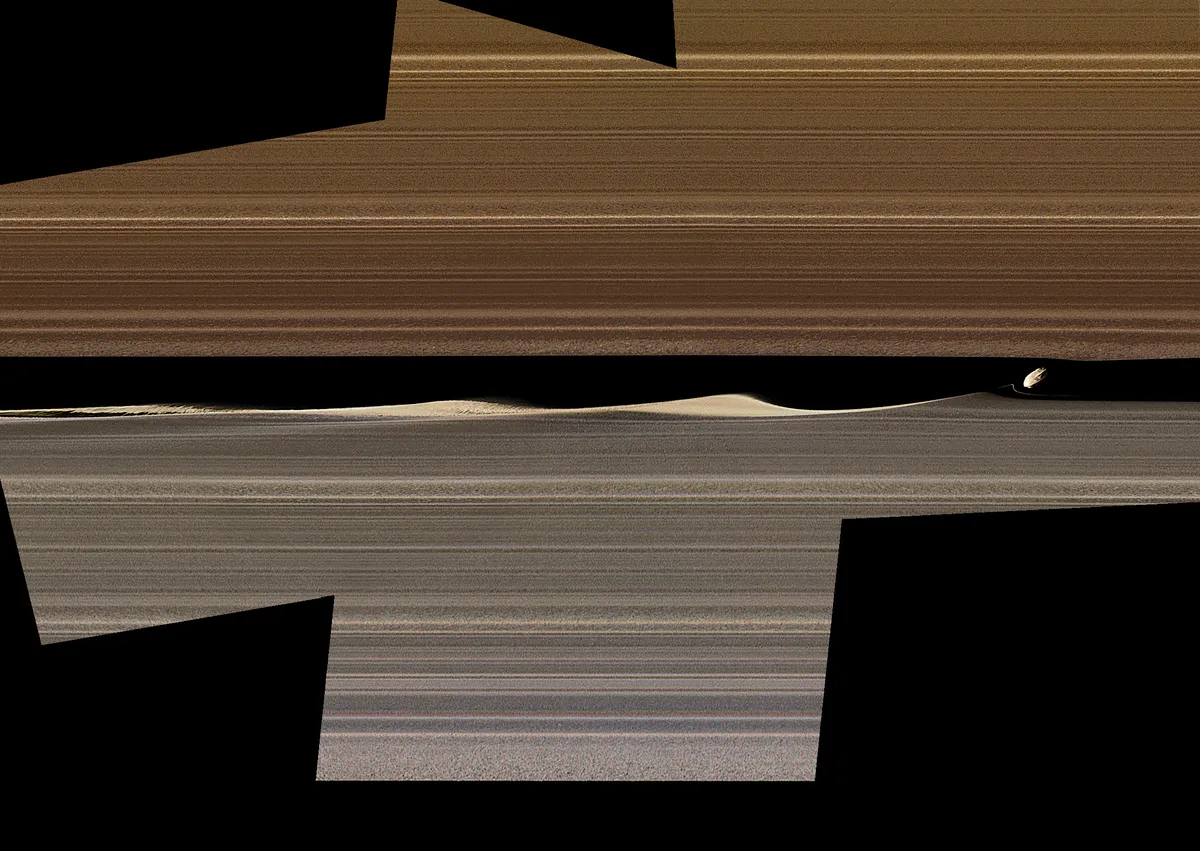 An enhanced colour image of Daphnis embedded in Saturn’s rings, kicking up waves of material. The images in the mosaic were taken in visible light, using the Cassini’s narrow-angle camera at a distance of approximately 28,000km from the ring moon. Image scale is 170m per pixel. Credit: Tilmann Denk at Freie Universität in Berlin.
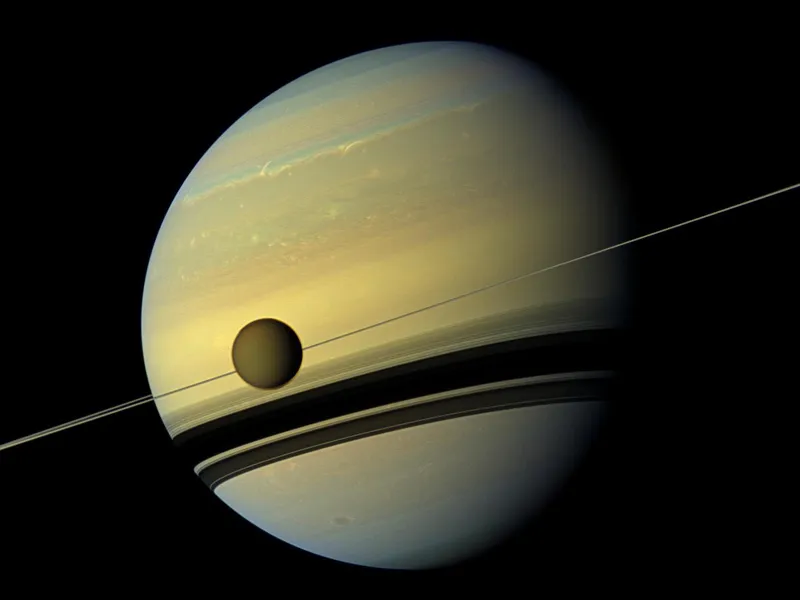 Moon Titan appears in front of Saturn in an image captured by NASA’s Cassini spacecraft. Credit: NASA/JPL-Caltech/Space Science Institute
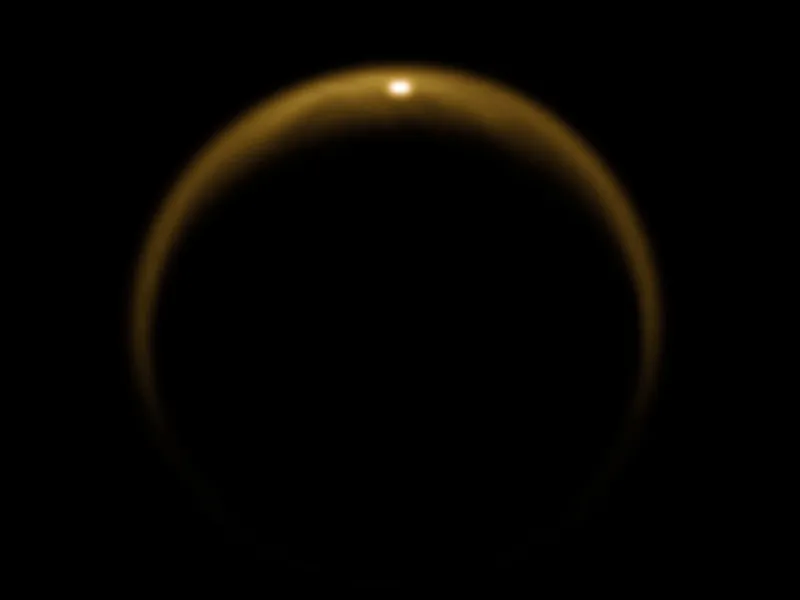 An image of Titan captured by the Cassini spacecraft on July 2009. The bright spot at the top of Titan’s disc is sunlight reflecting off the surface of a hydrocarbon lake. Dragonfly will explore these pools of liquid to search for conditions suitable for the development of life. Credit: NASA/JPL/University of Arizona/DLR
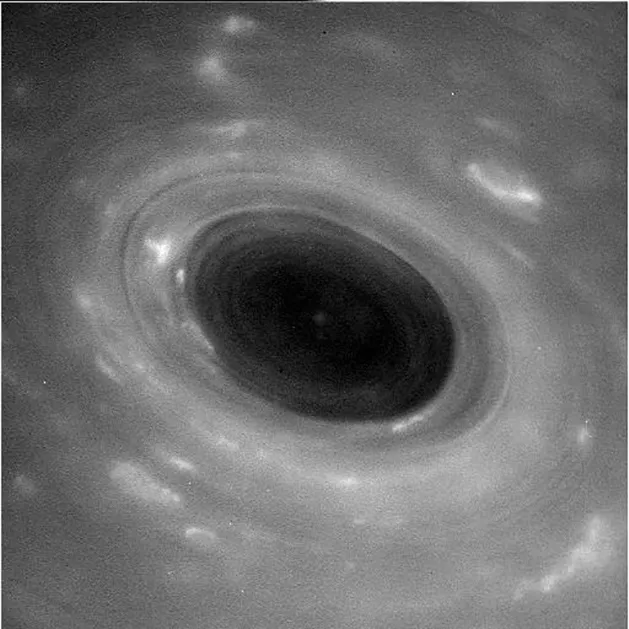 Unprocessed Cassini images show features in Saturn’s atmosphere closer than ever before.
Credit: NASA/JPL-Caltech/Space Science Institute
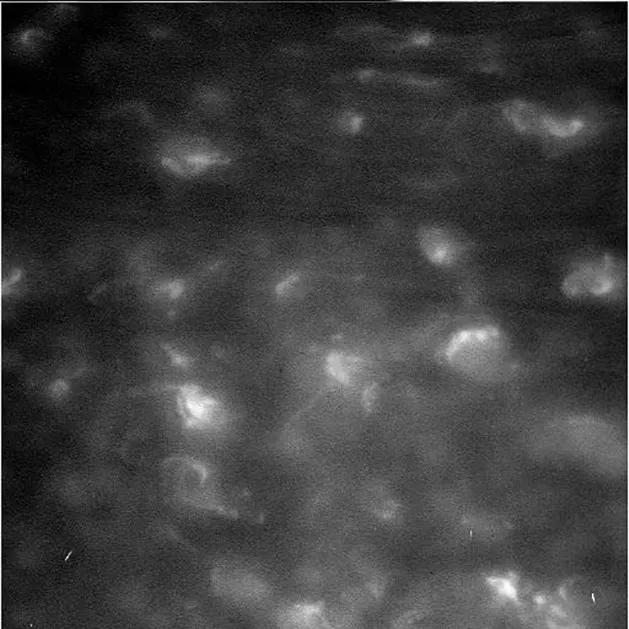 This view of Saturn’s atmosphere was captured by NASA’s Cassini spacecraft during its first Grand Finale dive past the planet on April 26, 2017.
Credit: NASA/JPL-Caltech/Space Science Institute
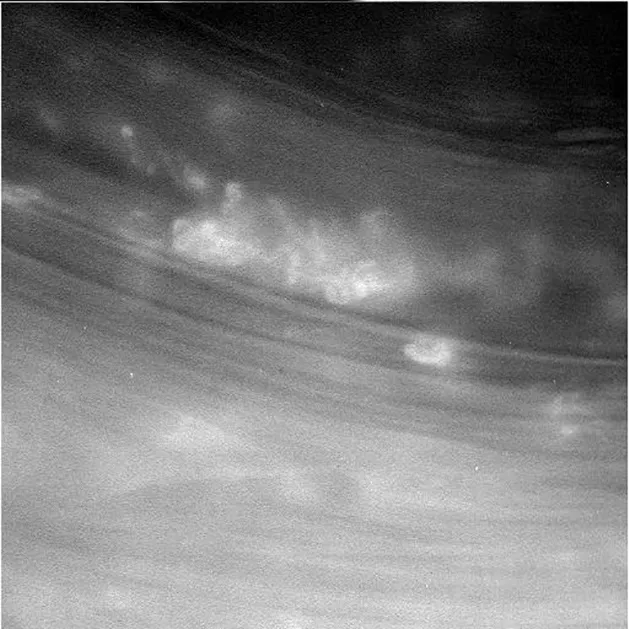 An image of Saturn’s rings captured by the Cassini spacecraft. Credit: NASA/JPL-Caltech/Space Science Institute
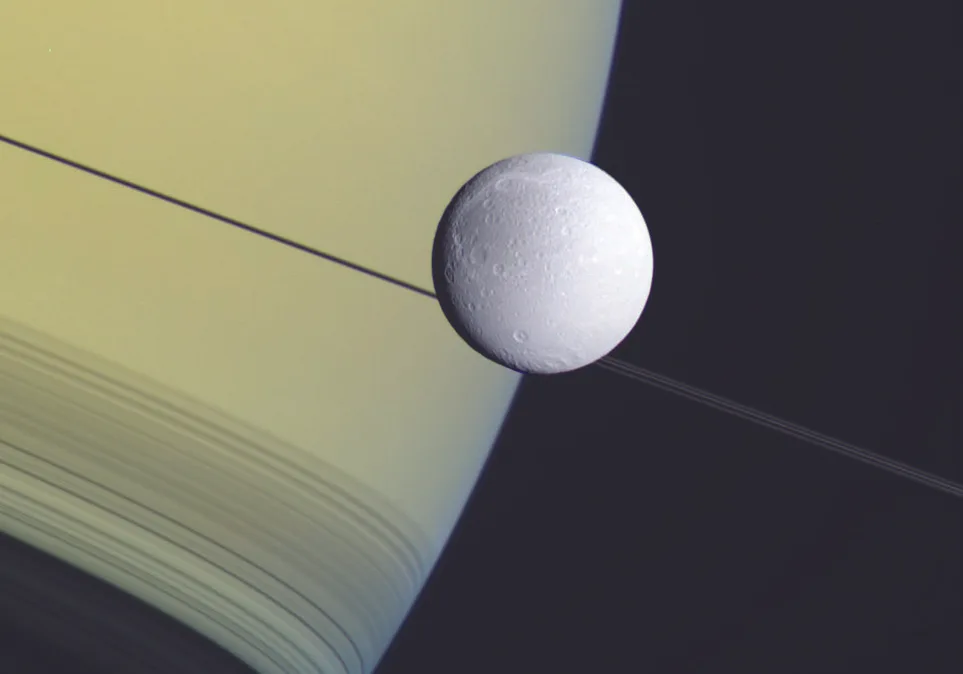 Dione and Saturn in an image captured by the Cassini spacecraft in 2012 and processed by Emily Lakdawalla. Credit: NASA/JPL/SSI/color composite by Emily Lakdawalla
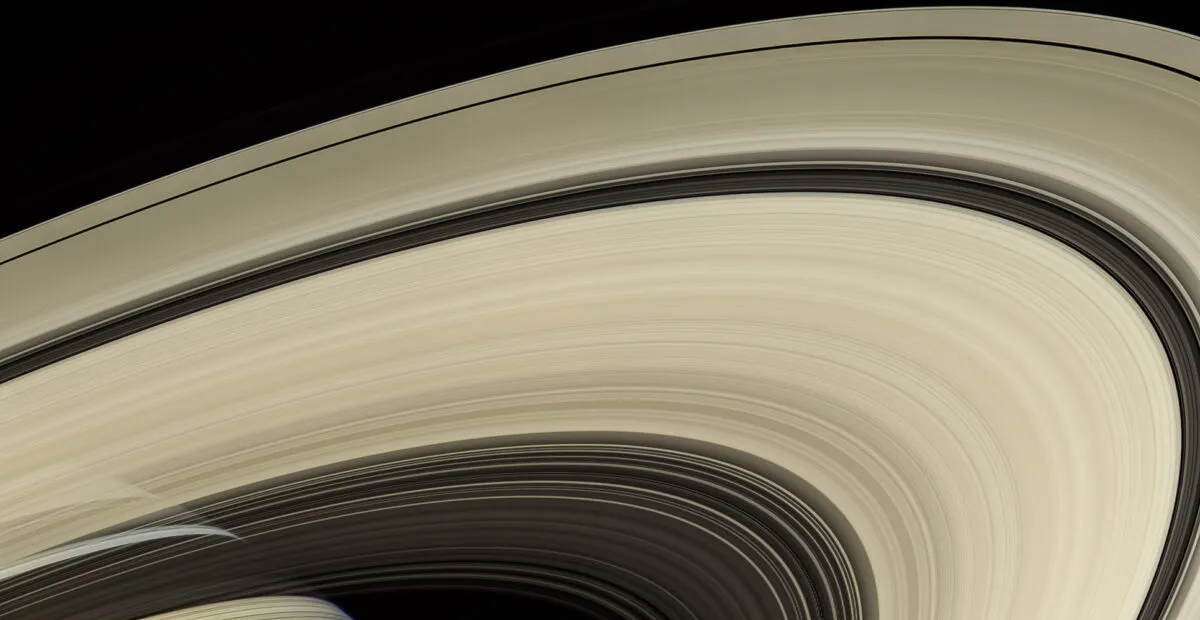 Saturn’s rings, as seen by the Cassini spacecraft. Credit: NASA/JPL-Caltech/Space Science Institute
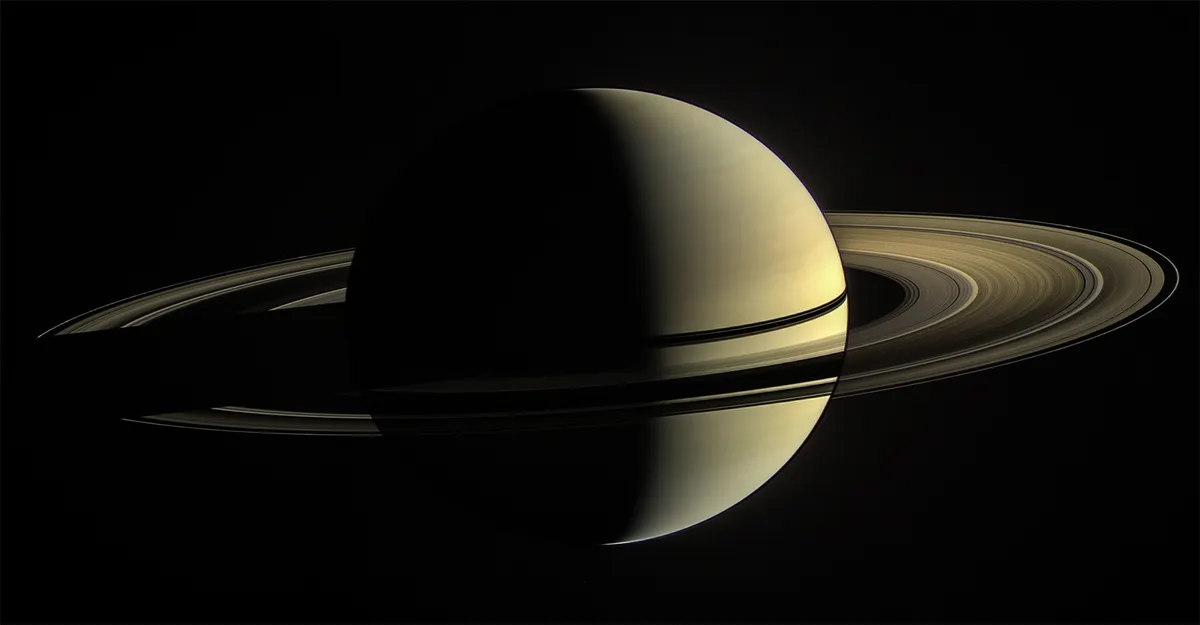 A view of Saturn captured by the Cassini spacecraft on 2 January 2010 from about 2.3 million km away. Credit: NASA/JPL-Caltech/Space Science Institute
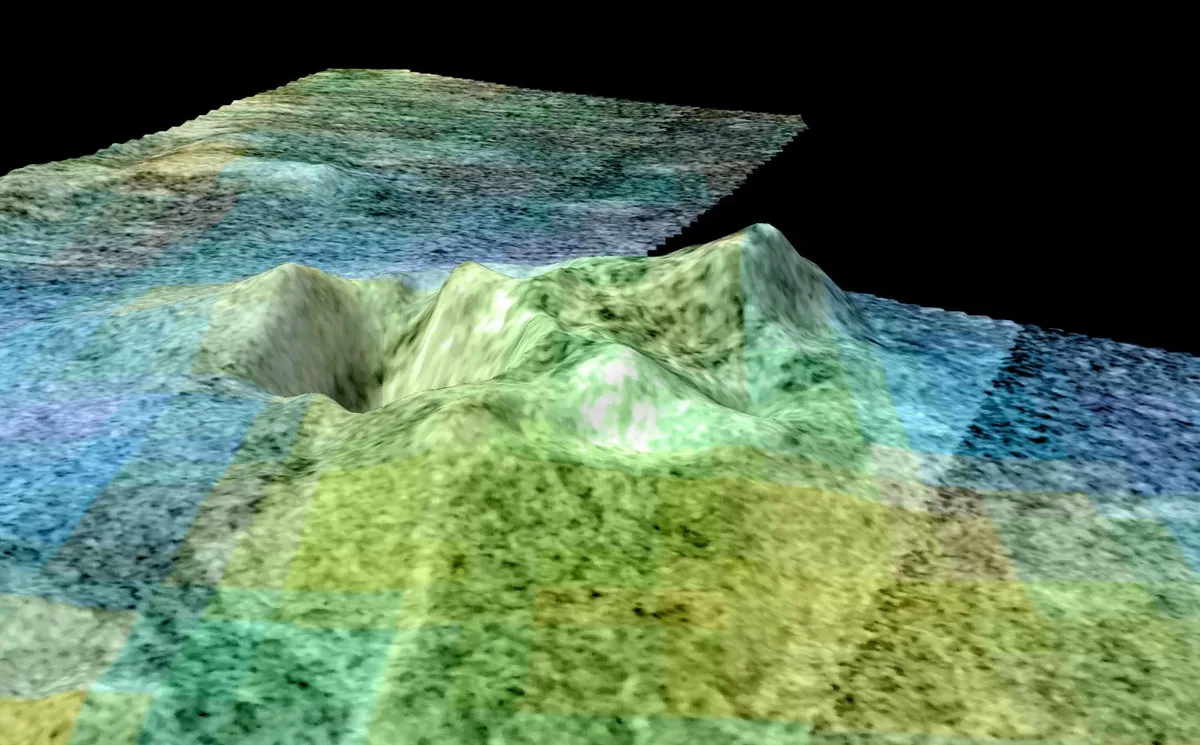 A view of Titan’s Sotra Facula region, whose highest peak is Doom Mons, created using data from the Cassini spacecraft. Credit: NASA/JPL-Caltech/USGS/University of Arizona
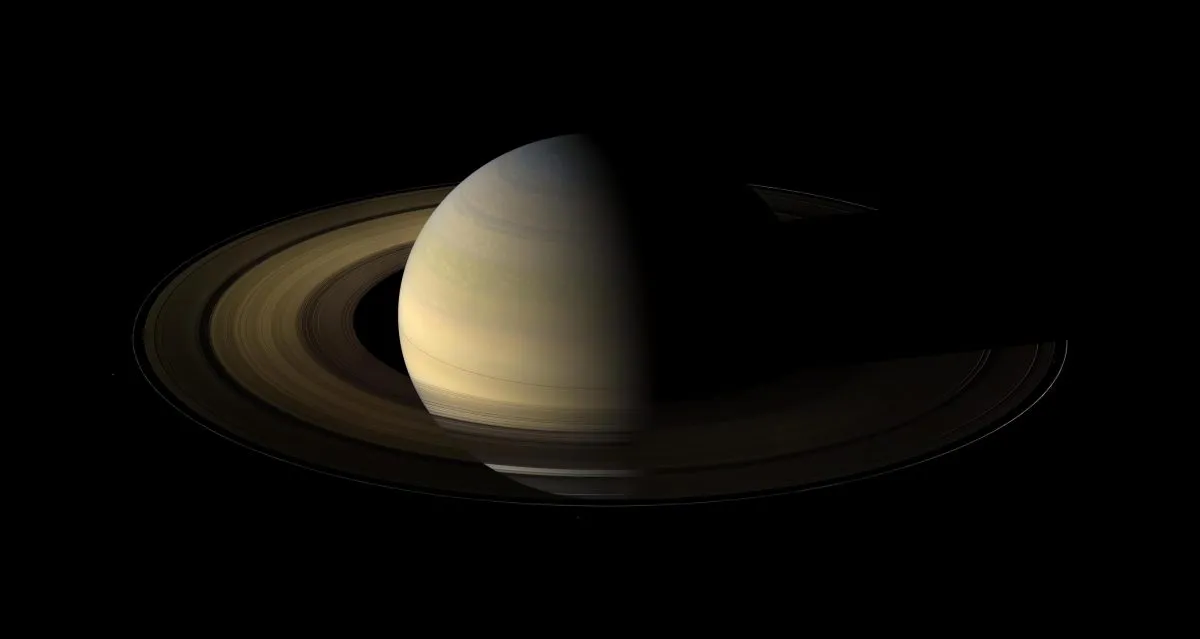 The Cassini spacecraft’s view of Saturn during the planet’s equinox in 2009. Credit: NASA/JPL/Space Science Institute
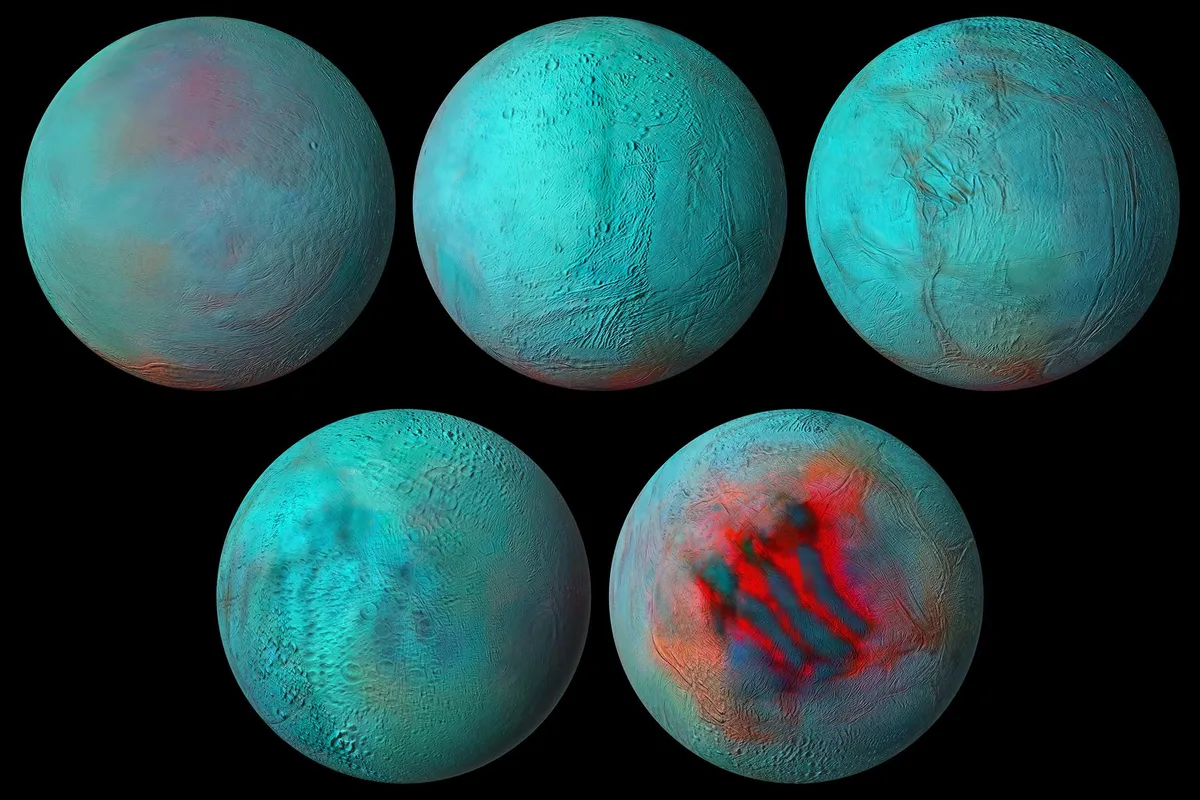 Composite infrared images of Cassini’s moon Enceladus, revealing geologic activity. Credit: NASA/JPL-Caltech/University of Arizona/LPG/CNRS/University of Nantes/Space Science Institute
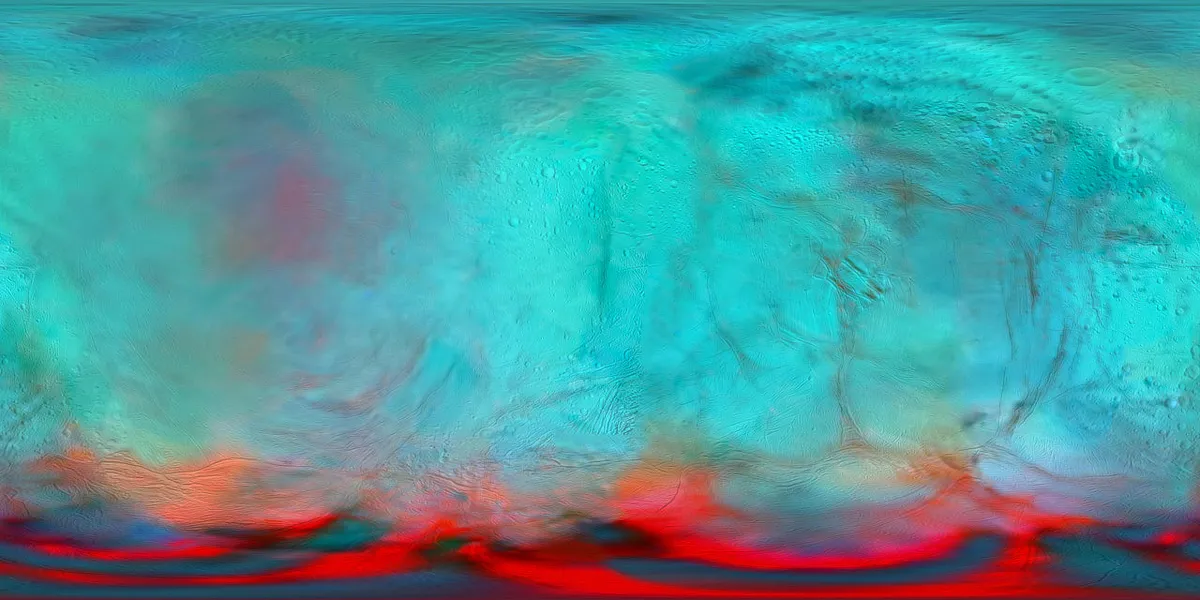 Infrared global map of moon Enceladus by the Cassini spacecraft, 29 September 2020. Credit: NASA/JPL-Caltech/University of Arizona/LPG/CNRS/University of Nantes/Space Science Institute
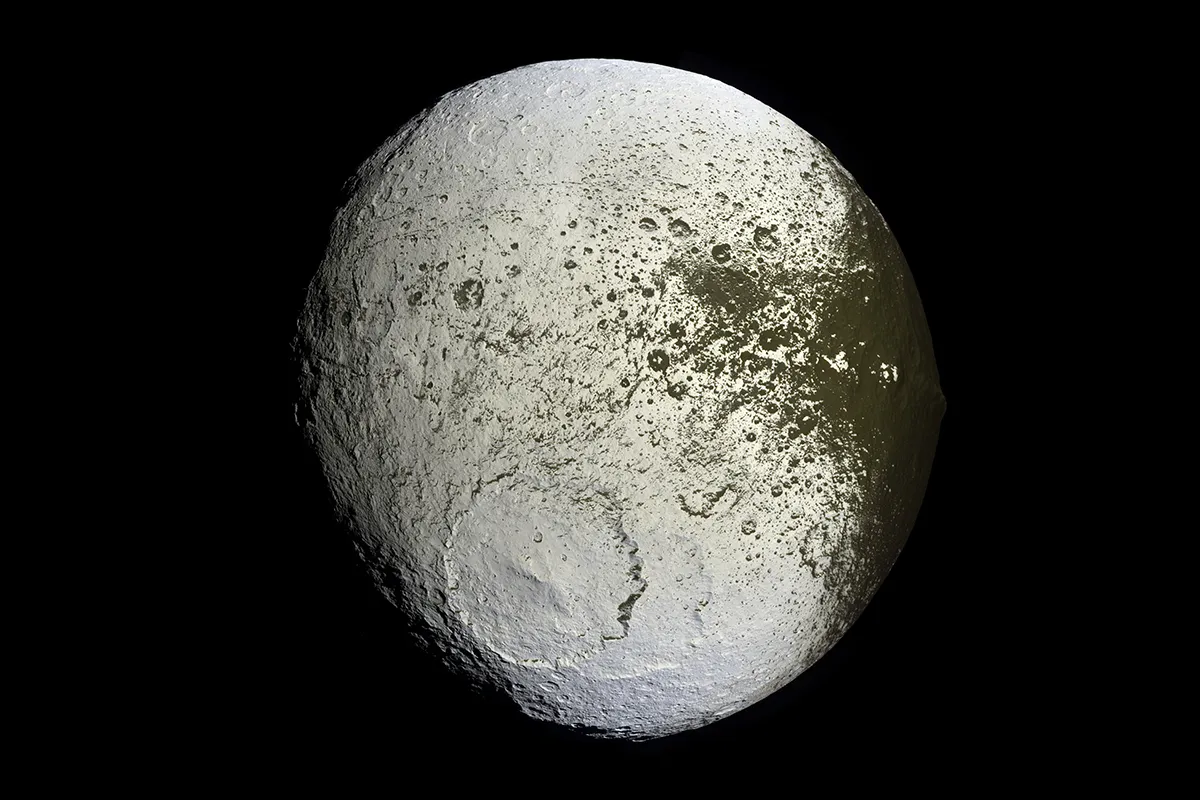 A view of Saturn’s moon Iapetus captured by the Cassini probe. Credit: NASA/JPL/Space Science Institute
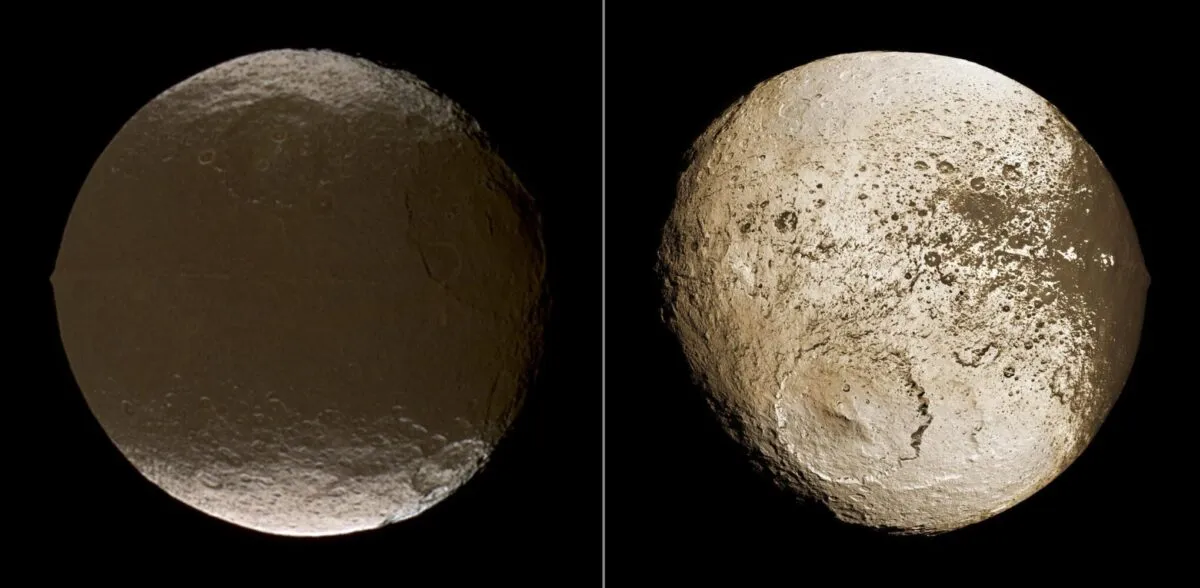 Two global images of Iapetus captured by the Cassini mission show the brightness dichotomy on the surface the moon. The left image shows the moon’s leading hemisphere and the right-hand panel shows the moon’s trailing side. Credit: NASA/JPL-Caltech/Space Science Institute
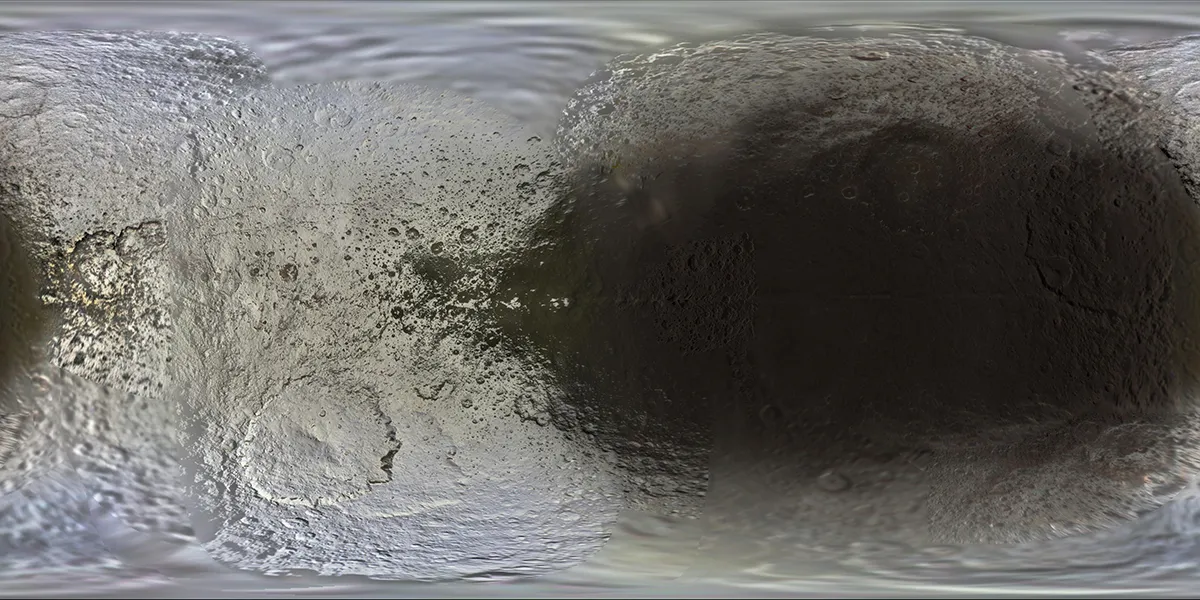 A colour mosaic map of Saturn’s moon Iapetus, created using data collected by the Cassini spacecraft. Credit: NASA/JPL-Caltech/Space Science Institute/Lunar and Planetary Institute
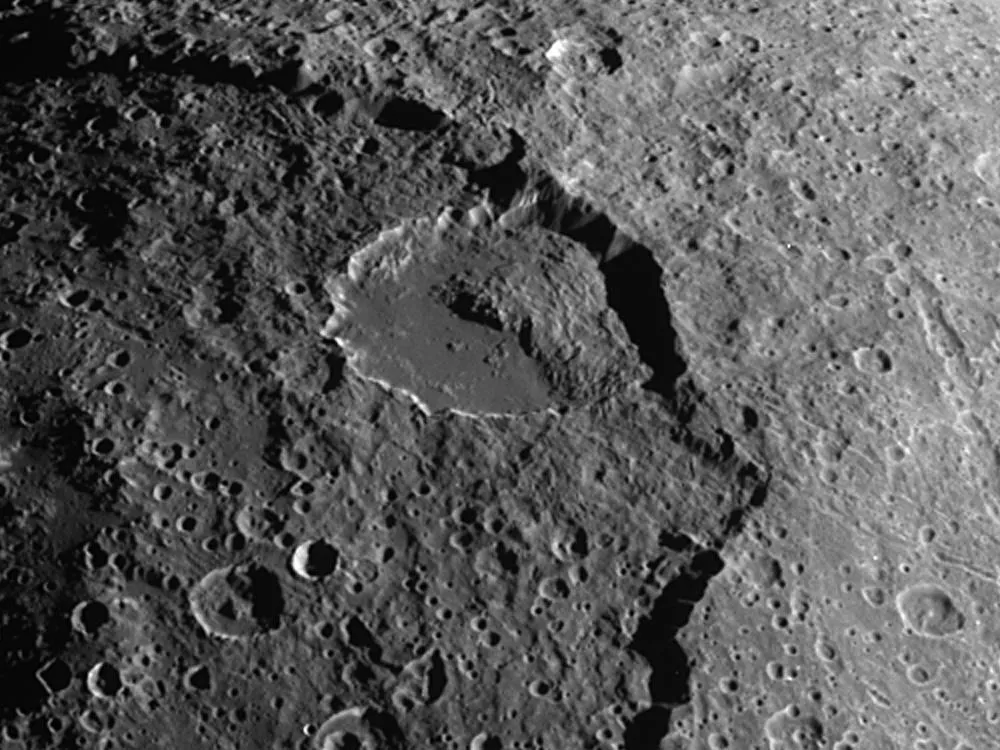 A landslide in the low-brightness region of Iapetus’s surface known as Cassini Regio, as seen in an image captured by the Cassini spacecraft. Credit: NASA/JPL/Space Science Institute
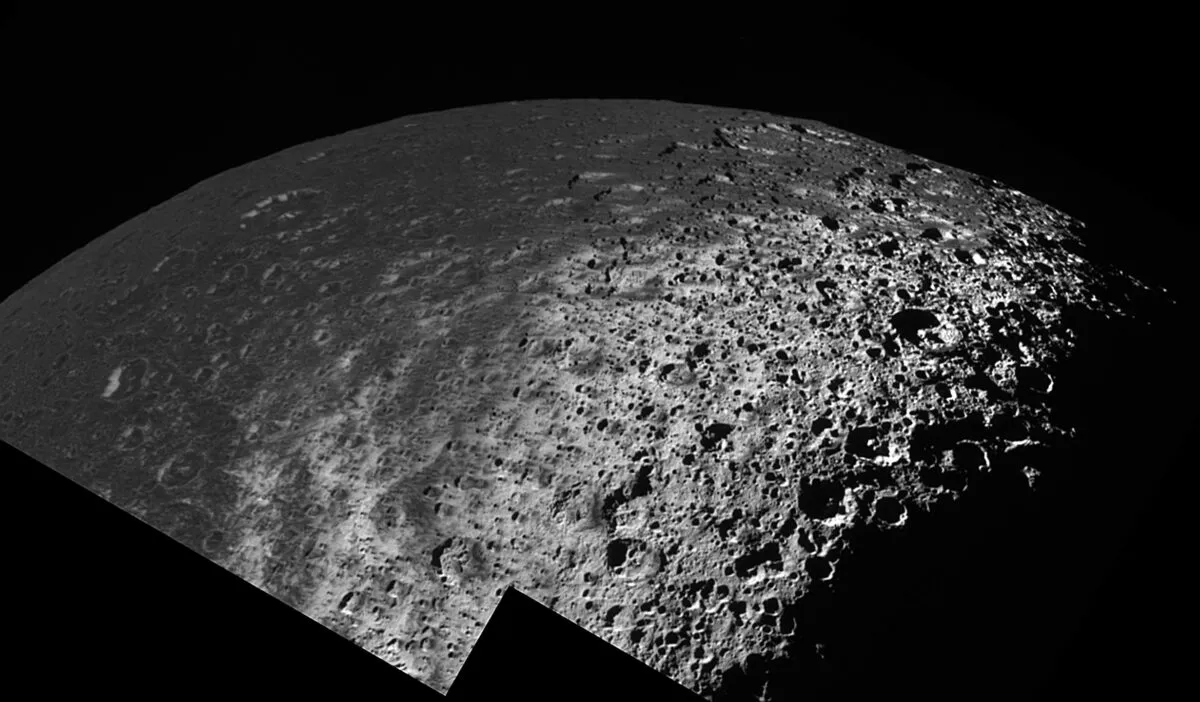 A view of Saturn’s moon Iapetus showing the dark, cratered terrain of Cassini Regio transitioning to a bright, icy terrain at high latitudes. Credit: NASA/JPL/Space Science Institute
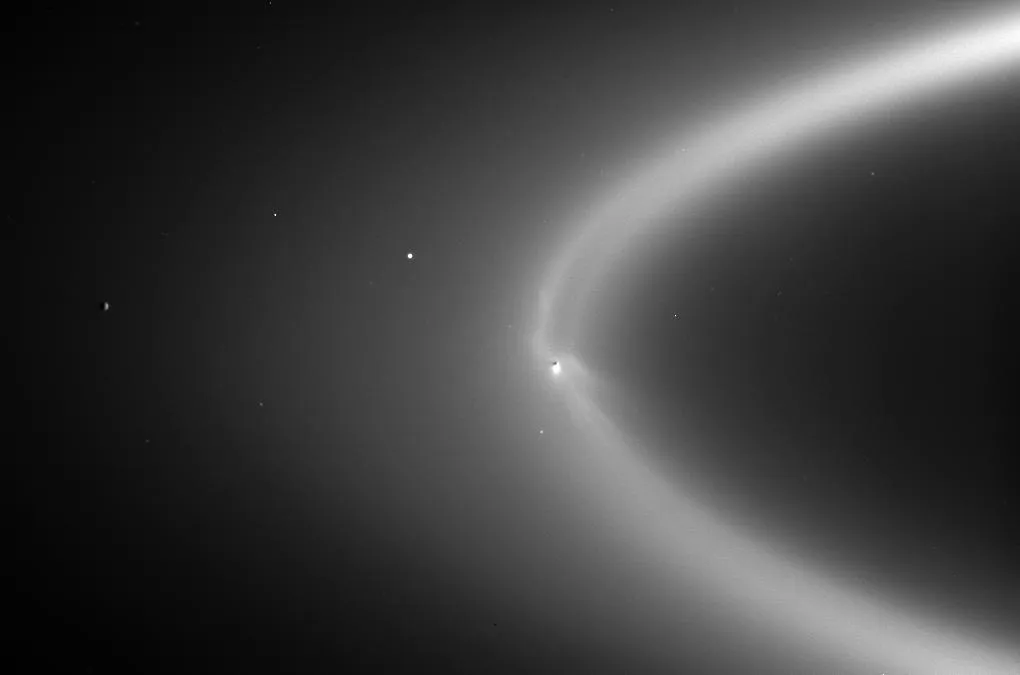 A 2006 observation of Saturn’s E ring by the Cassini spacecraft. The E ring is fed with icy particles via plumes erupting from the subsurface ocean of Saturn’s icy moon Enceladus. The moon’s shadow is seen as a dark dot within the ring. Credit: NASA/JPL/Space Science Institute
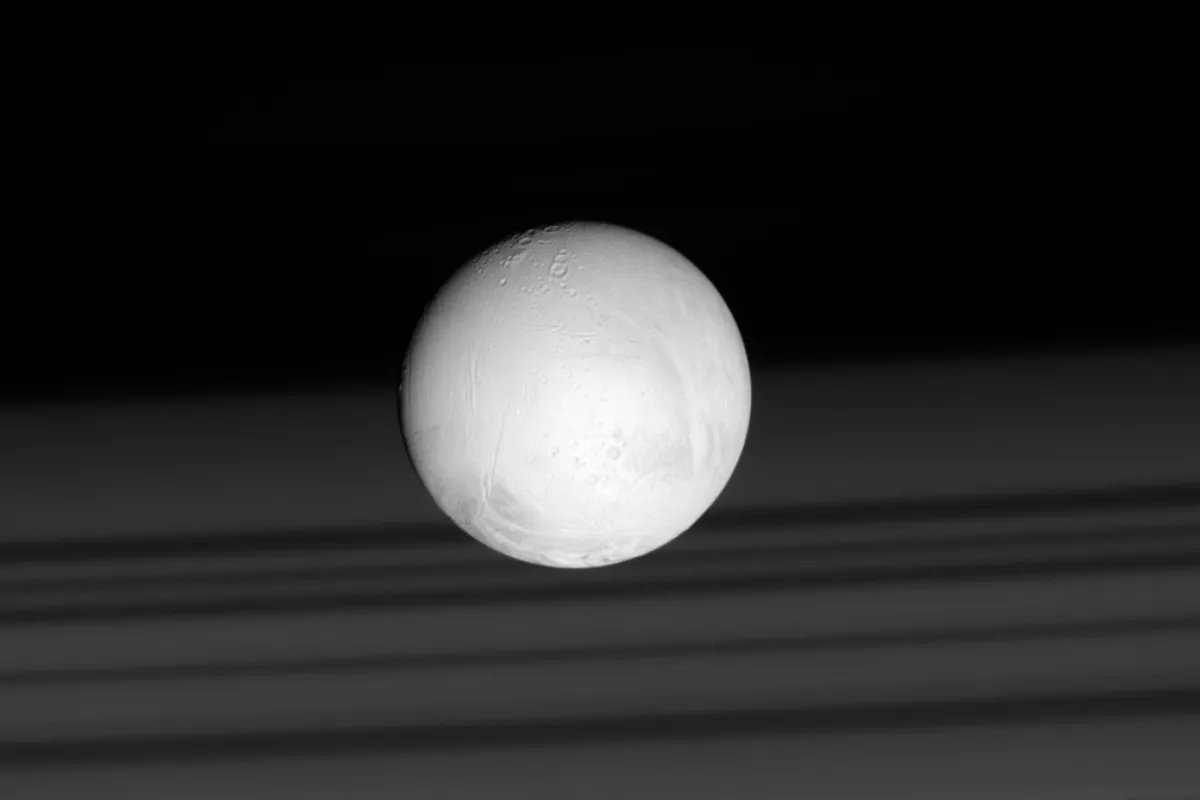 A view of Saturn’s moon Enceladus captured by the Cassini spacecraft on 28 June 2007. In the background can be seen the shadows of Saturn’s rings, cast on the planet’s cloud tops. Credit: NASA/JPL-Caltech/Space Science Institute
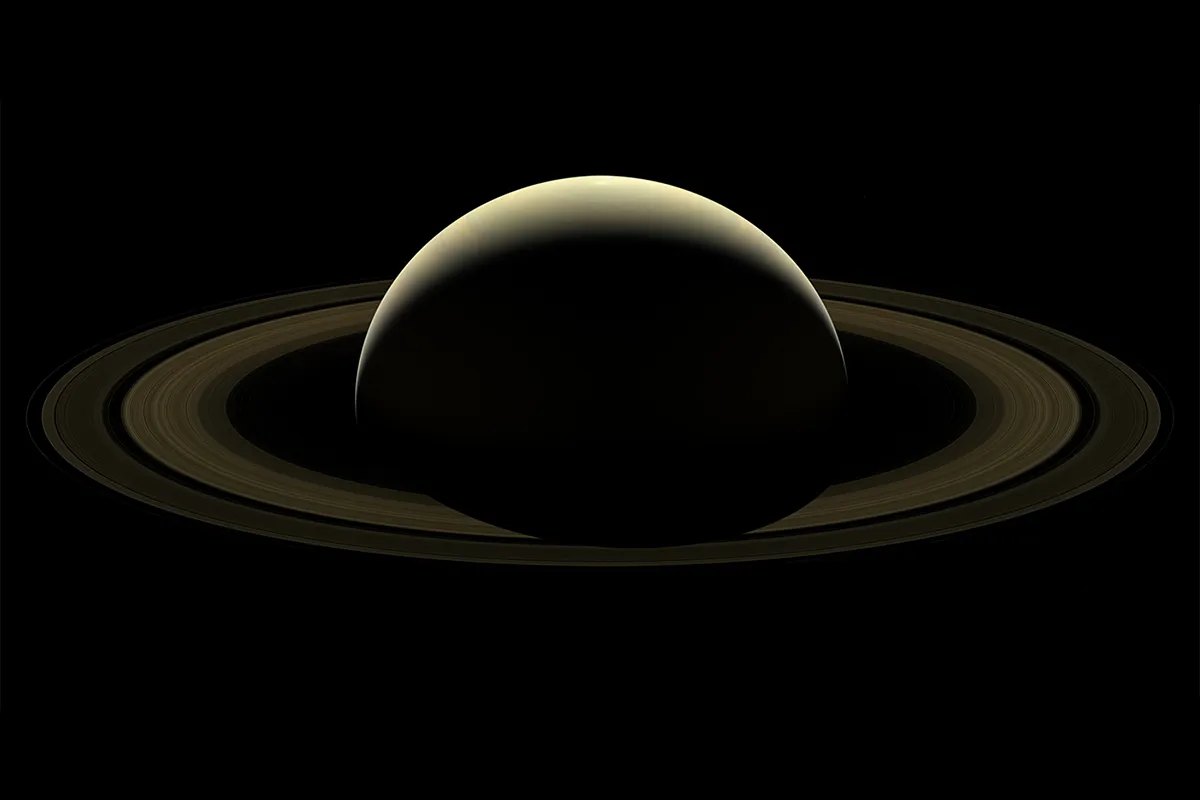 A view of Saturn captured by the Cassini spacecraft, its last full mosaic of the planet and its rings before the mission ended. Credit: NASA/JPL-Caltech/Space Science Institute
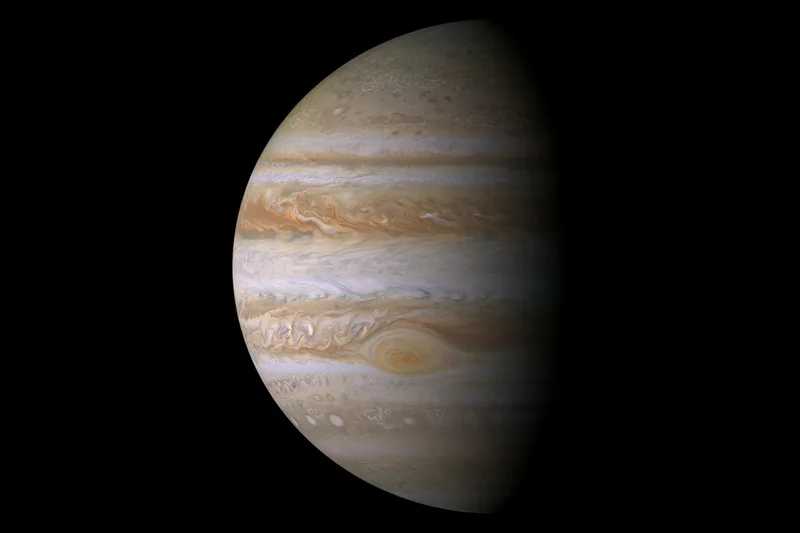 A view of Jupiter, the biggest planet in our Solar System, captured by the Cassini spacecraft. Credit: Source: NASA/JPL/Space Science Institute
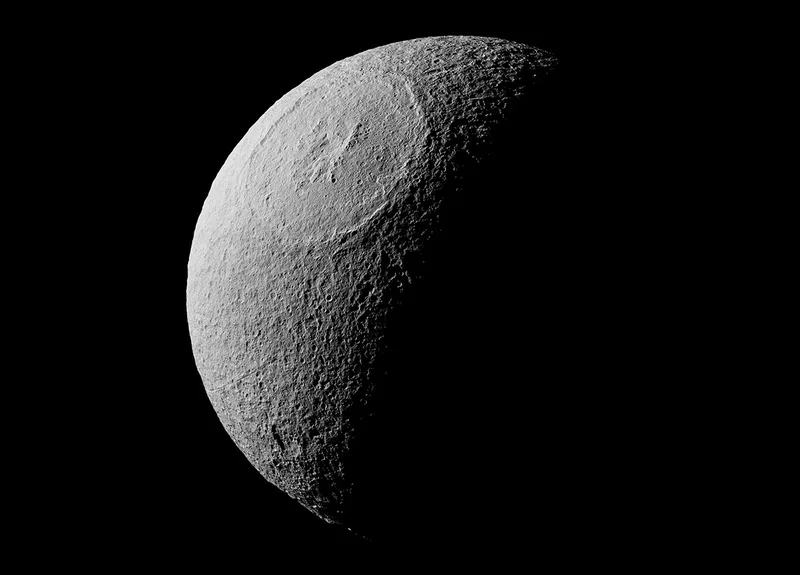 A view of Saturn’s moon Tethys, captured by the NASA Cassini mission. Credit: NASA/JPL-Caltech/Space Science Institute
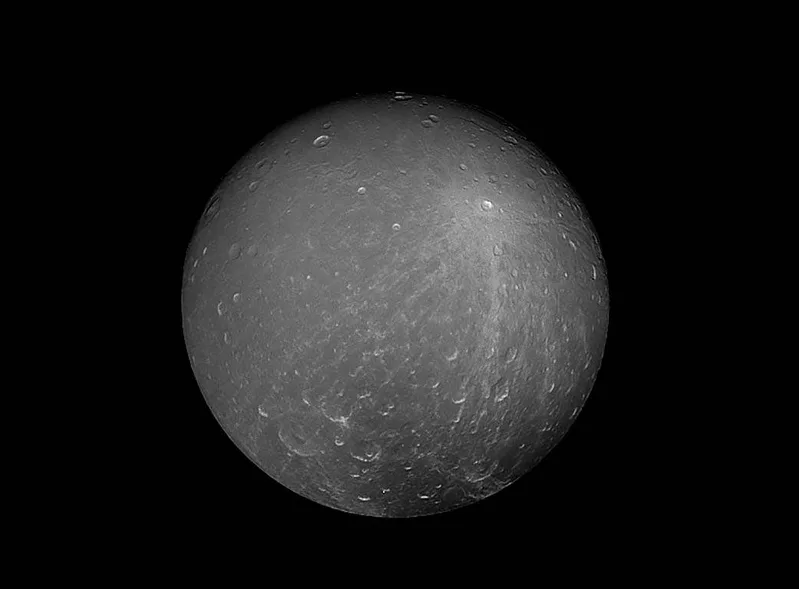 Cassini’s view of Saturn’s moon Dione. Credit: NASA
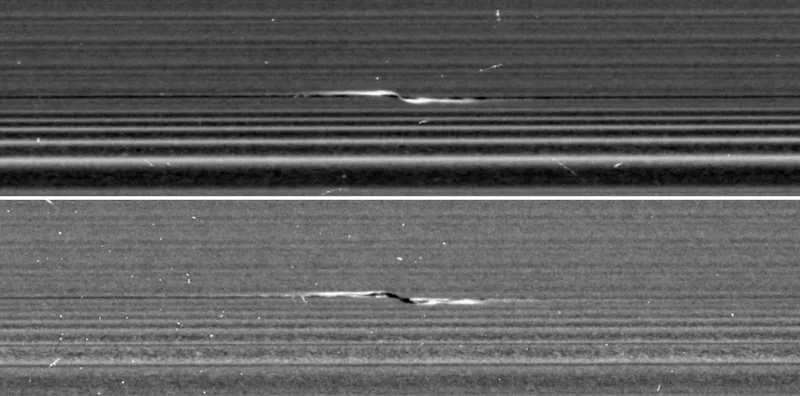 NASA’s Cassini spacecraft captured these views of a propeller feature in Saturn’s A ring on 21 February 2017. Credit: NASA
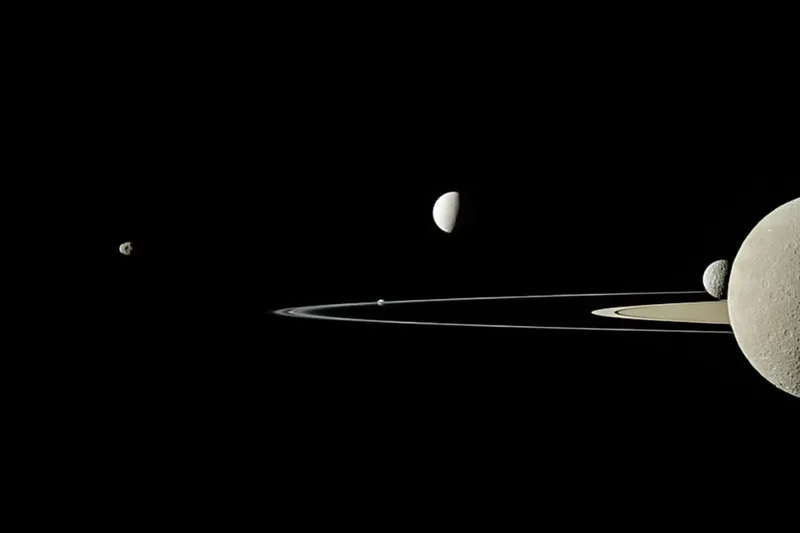 Saturn is king of the moons because it’s the planet in our Solar System with the most moons. This Cassini image shows Saturn’s rings and its moons Pandora, Enceladus, Rhea and Mimas. Credit: NASA/JPL-Caltech/Space Science Institute
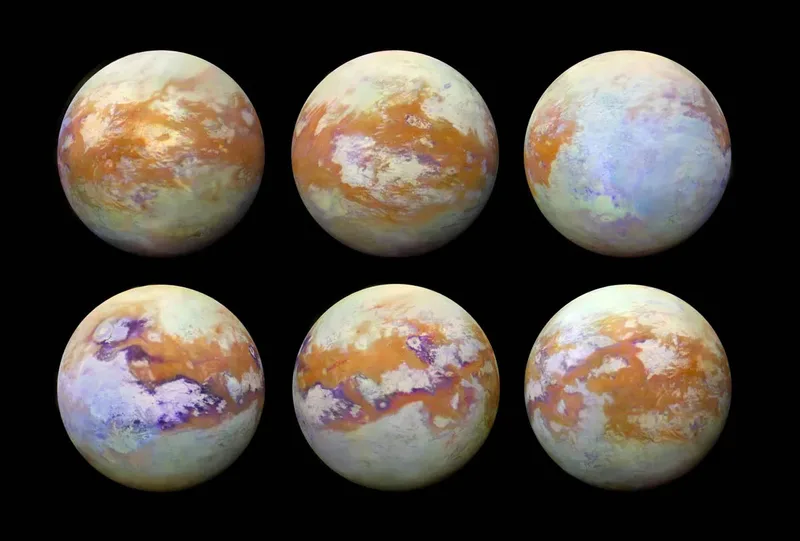 Infrared images of Saturn’s moon Titan, captured by NASA’s Cassini spacecraft. Credit: NASA/JPL-Caltech/Stéphane Le Mouélic, University Of Nantes, Virginia Pasek, University Of Arizona
What are your favourite memories of the Cassini mission? Let us know by emailing contactus@skyatnightmagazine.com