
Back to Article List
Today in the history of astronomy, Comet Hale-Bopp reaches maximum.
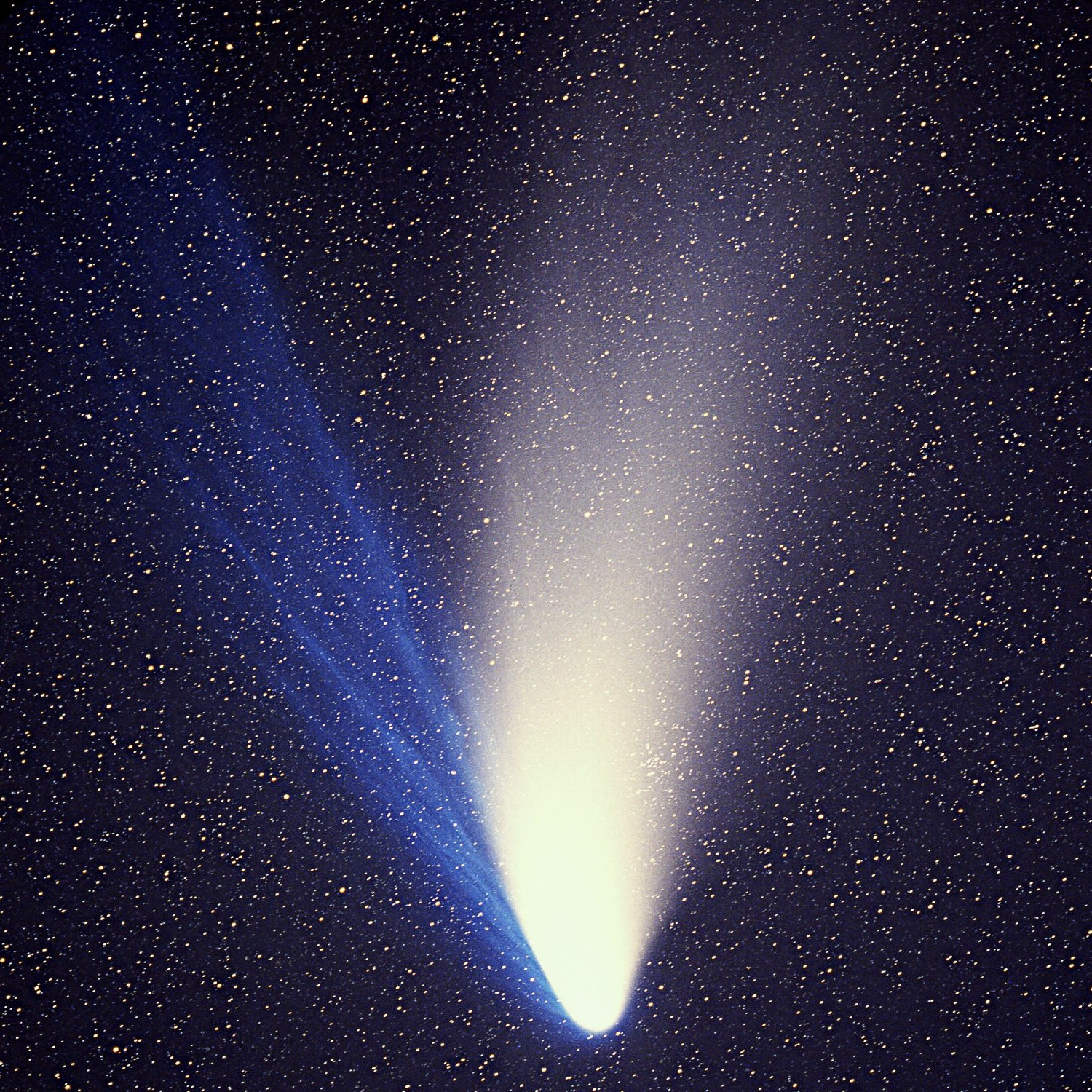
Comet Hale-Bopp was discovered in July 1995, and peaked nearly two years later, breaking records for duration. Credit: E. Kolmhofer, H. Raab; Johannes-Kepler-Observatory, Linz, Austria (https://sternwarte.at), CC BY-SA 3.0, via Wikimedia Commons
American astronomer Alan Hale, observing from Cloudcroft, New Mexico, and American amateur astronomer Thomas Bopp, observing near Stanfield, Arizona, independently discovered Comet Hale-Bopp July 23, 1995. Both observers had been viewing the globular cluster M70 in Sagittarius and spotted the comet nearby. Orbital calculations showed that on the night they found it, Hale-Bopp lay some 7.2 astronomical units from the Sun, nearly twice the usual discovery distance for comets. (One astronomical unit, or AU, is the average distance between Earth and the Sun.)
Luckily, unlike Comet Kohoutek, Comet Hale-Bopp brightened according to predictions. It first became visible to the naked eye from the darkest sites May 17, 1996, and remained so for 18 months, surpassing the old record of nine months set by the Great Comet of 1811. On March 7, 1997, Hale-Bopp reached magnitude 0. Two weeks later, on March 22, it peaked at magnitude –0.8, which is brighter than any star except Sirius (Alpha [α] Canis Majoris), with a tail that extended nearly 20°. It was last seen with the naked eye Dec. 9, 1997.
Stating that Hale-Bopp is a long-period comet seems a bit of an understatement. Its previous perihelion was in July 2215 B.C.E., when it may have been observed in Egypt. It will next reach perihelion in 4385 or later.