
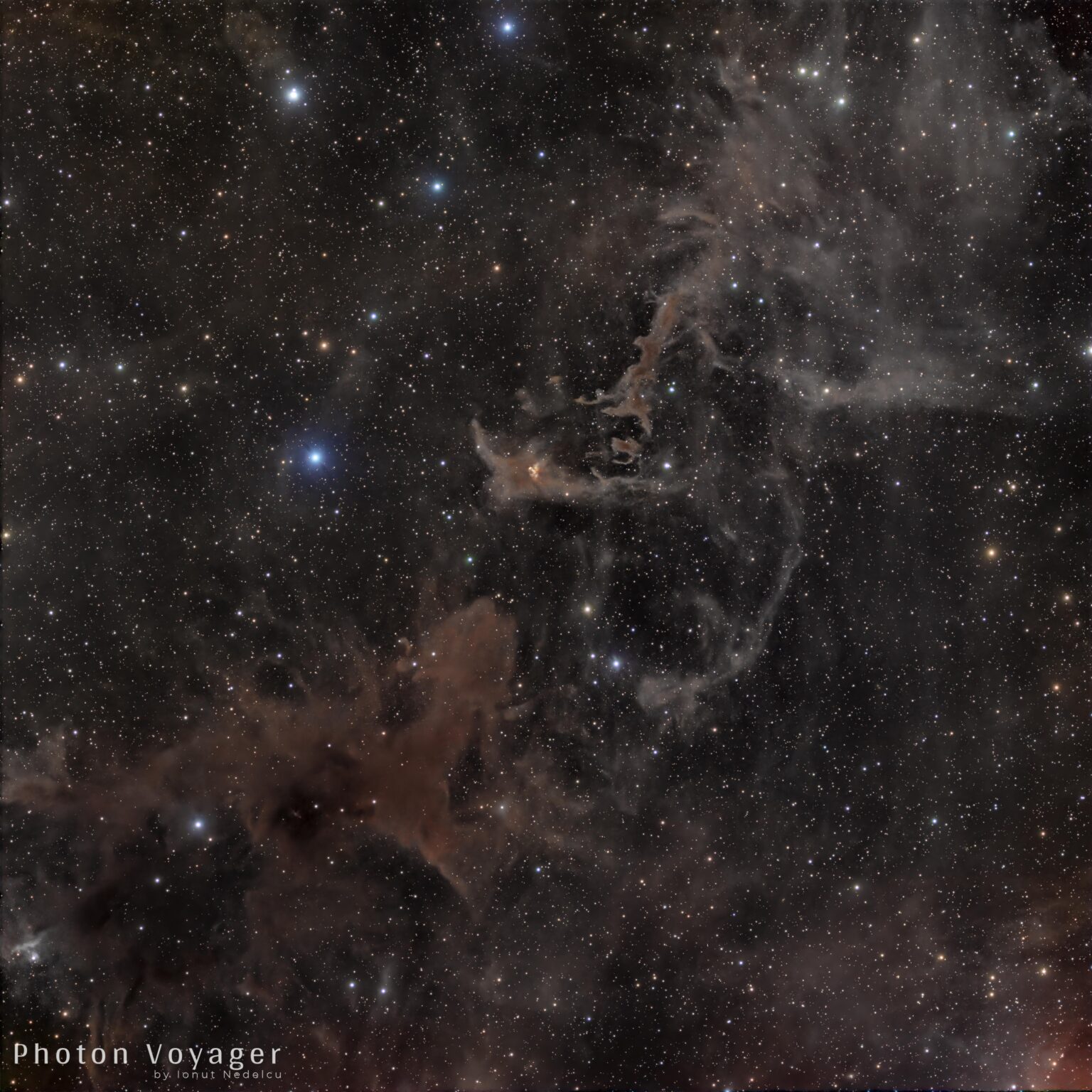
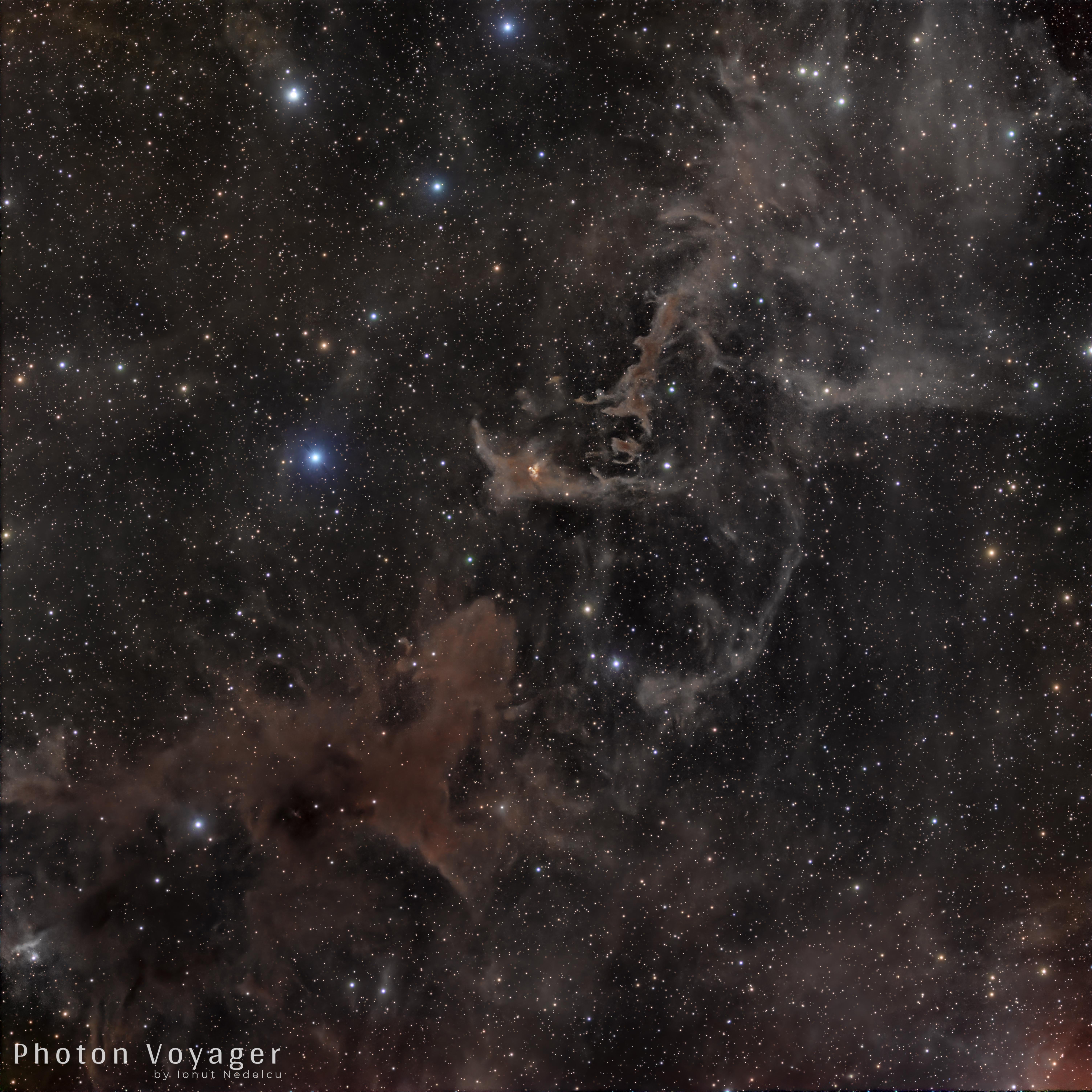
LBN 552 and LDN 1228, or The Fighting Dragons, are part of the Cepheus molecular cloud complex at a distance of around 600 light-years from Earth.
This region consists of cold, dense concentrations of gas and dust where molecular clouds form the environments in which new stars are born. The majority of this material is molecular hydrogen (H₂), which does not radiate efficiently.
LDN 1228 is seen here as a dark nebula, where thicker concentrations of dust obscure the background star field. In contrast, LBN 552 is an extremely faint bright nebula, visible only through scattered starlight reflecting off the surrounding dust, revealing subtle structure within an otherwise diffuse medium. It is considered the faintest object in the Lynds catalogue of nebulae, making it a particularly challenging target to capture from light-polluted UK skies.
The light captured here began its voyage around 600 years ago, around the time when the Magna Carta was being signed in medieval England, and the rise of Genghis Khan was reshaping much of Asia.
This image is the result of 23 hours of total integration collected over four nights from Bortle 4–5 skies. Even with such a long integration time, the structure still lacks finer detail. More integration from a darker region would greatly improve the photo.
Acquisition:
- Shot in Seaford, UK (Bortle 4) and Bedfordshire, UK (Bortle 5)
- 23hr 50min hrs of total integration
- 300s subs + DBF
Equipment:
- ZWO FF65 + 0.75x reducer (f/4.9, 312mm)
- ZWO IR/UV Cut filter
- ZWO ASI533MC-Pro
- SW EQ6R-Pro + NINA & PHD2
- Astromenia 50/200 Guide Scope + ZWO ASI120MM Mini + IR/UV Cut
PixInsight DSO Processing:
- WBPP with 2x Drizzle
- SPCC & SPFC
- GraXpert BE
- BlurX
- NoiseX
- MAS
- GHS
- StarX
- Curves
- ColorSaturation
- PixelMath
- Bill Blanshan's StarReduction
Lightroom Processing:
- Contrast enhancement
- Clarity increase
- Colour Saturation
- Black Level
by JohnNedelcu