
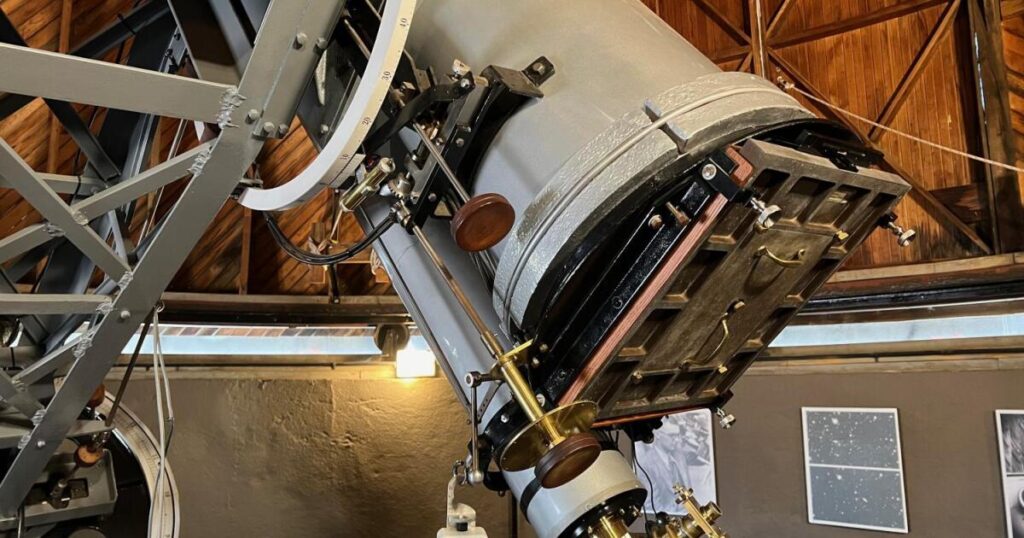
Pluto is so beloved in Flagstaff that the city throws an annual “I Heart Pluto Festival.” In 2024, Gov. Katie Hobbs declared Pluto Arizona’s planet.
That’s because it was discovered in Flagstaff in 1930 by a farm boy without a college degree who built his own telescopes from farm equipment. Clyde Tombaugh came to Flagstaff to work at Lowell Observatory the year before — and quickly proved his worth.
But fast forward to 2006: Pluto was demoted. The International Astronomical Union declared Pluto was not, in fact, our solar system’s ninth planet. It is a dwarf planet. Pluto devotees were devastated.
Democratic Gov. Katie Hobbs signed a law making Pluto Arizona’s official planet. That’s even though an international group of scientists stripped Pluto of its planetary status back in 2006. Delve into the history of Pluto, which was first discovered in Arizona — and the people who never gave up on it.
But the demotion — and Pluto’s status as a planet — has never stopped being hotly debated. And now, President Donald Trump and his NASA administrator are reviving the debate again, apparently at the urging of William Shatner — although Captain Kirk from ‘Star Trek” is not a trained scientist.
They want to reclassify Pluto as a planet and “make Pluto great again.”
Our next guest says she’s all for any attention given to Pluto. Amanda Bosh is the executive director of the Lowell Observatory. She was even part of the research team that first measured the atmosphere of Pluto.
The Show spoke with her more about it.
Full conversation
AMANDA BOSH: I think that what we can say about, you know, all of this, all of the work that’s going on right now to raise Pluto’s visibility with a whole bunch of people, we say thank you for just acknowledging the importance of Pluto in our understanding of our solar system and other planetary systems around in our galaxy and other galaxies as well. … And so I think that, you know, anytime people are talking about Pluto, we love it.
LAUREN GILGER: Do you think it should be reclassified as a planet, not a dwarf planet as it has been reclassified?
BOSH: Well, you know, there was certainly a lot of, a lot of hand wringing when Pluto was declassified. But I want to point out that a dwarf planet is still a planet. It’s just a smaller planet. And that’s unmistakable. I mean, Pluto is smaller.
The reality of it is it doesn’t change how we see Pluto or the fact that we are studying Pluto. If it’s called a dwarf planet or a planet or an English muffin, you know, it does not matter.
GILGER: It doesn’t matter to you. You’re saying this is kind of irrelevant. It’s our planet anyway.
BOSH: It’s our planet. And you know, if you come to Lowell Observatory and join our Pluto tour or if you, if you ever hear me talking to people, to visitors at our astronomy Discovery Center, I would call Pluto a planet because it is. It’s a planet, It’s a dwarf planet, but it’s still a planet, and it’s just terminology.
And so from my perspective, the fact that we are talking about it now is really great because that allows more people to hear about Pluto and to learn about it. I think that a lot of people definitely have an emotional attachment to Pluto being a planet, because it was a planet, you know, for such a long time.
It was called a planet for such a long time. And I can fully understand that, because when I was going through grad school, Pluto was a planet, and it was a key topic of my research, and I always thought of it as a planet.
So if it were to be reclassified, I wouldn’t be sad about that but …
GILGER: Well, so give us a little bit of the science behind this, right? Because, as you say, there was a lot of hand wringing, but this came from, like, the international body that decides these things, right, that said, you know, Pluto does not meet the criteria of a planet. Tell us, why not?
BOSH: So it was an interesting meeting of the International Astronomical Union, because at the time, you have to put it in context, right? At the time, there were other bodies being discovered in the outer edges of our solar system. The sizes weren’t quite known yet, but people, I think people were starting to worry that, you know, with all of these new bodies being discovered, then we’re going to have 20 planets or, you know, some large number.
But that’s OK. I mean, I don’t. I don’t see that that’s a problem.
So then people thought, well, maybe we should reclassify it and make it narrow that definition. It was actually a vote of a small percentage of the full membership of the International Astronomical Union. And the voting members who were there tended to not be planetary scientists. And this whole question of, is it a planet or not, this is within the realm of planetary science.
GILGER: Very interesting.
BOSH: The question, the reason it came up, right, is because Pluto is small and it is very far away from the sun, where there are other bodies. It is in its own orbit, has a very large moon, has a number of moons that orbit it. So that makes it, you know, very similar to some of the other planets that we know.
And it has an atmosphere of its own. And that atmosphere is actually very similar to the Earth’s atmosphere. So there’s a lot of reasons why it looks like a planet. But the definition that was decided on at that time, that made it not a planet. The terminology is it didn’t clear its orbit. And so it’s not large enough to have enough gravity that it kicked everything else out of its orbit.
GILGER: Right. I remember reading a kid’s book to my kids about this, and they say, like, Pluto is out there in the Kuiper Belt with a lot of friends just like it. That’s why it’s not a planet anymore, right?
BOSH: That’s right. It does have a lot of friends.
GILGER: Right. But it is in its own orbit. That’s interesting. There’s such debate.
You were part of the research team that first measured the atmosphere of Pluto, right? Like, tell us a little bit about what you love about this planet.
BOSH: So as you go further out in the solar system, you go past the gas giant planets. Jupiter, Saturn, Uranus and Neptune, and then you get to this smaller planet that is rocky and has a lot of ice on it as well. And so it’s interesting from that perspective because it gives us some insight into how solar systems are formed.
But my love affair with Pluto began when I was in college and I started looking at Pluto and preparing for this special event called a stellar occultation that we ended up doing in 1988, which would tell us whether or not Pluto had an atmosphere.
And the fact that from the Earth we could tell that Pluto has an atmosphere at the time, I just thought was the coolest thing, you know, when the New Horizons spacecraft went past in 2015 …
GILGER: Right.
BOSH: … you can’t ask for anything better than to have pictures of Pluto’s heart, you know? Yeah. That was just so beautiful. So from the, from the aesthetic and the artistic perspective, Pluto is sort of reaching out to you, saying, come love me. So lovable.
GILGER: It’s so lovable.
BOSH: It is so lovable. Absolutely. And it’s got mountains, and it’s got great fields of ice, and it’s just things are moving. It is just such a dynamic planet and so interesting scientifically, as well as sort of that romantic story of what is happening with Pluto, how is it out there on the edge of the solar system, and then how we know about it.
GILGER: Yeah, yeah. How we know about it.
BOSH: Right.
GILGER: So, I mean, let’s end on that note, right? Like, Pluto is, as you say, your planet, our planet here in Arizona. I mean, how important is Pluto to Lowell, to Flagstaff? I mean, to this place? It sounds like it’s a real identity piece to you, whether it’s a dwarf planet or a real planet and will become the ninth again.
BOSH: Exactly. I think that what we hear from our visitors, you know, the public just loves Pluto. And the fact that it was discovered here, and they can go and see the tele, and touch the telescope that was used to discover it, that really connects people with this history. And so for the observatory, you know, there have been a number of important discoveries at Lowell Observatory over the, you know, the 130-plus years that we have existed. And Pluto is one of the big ones.
So, you know, that’s something that we tout along with the expansion of the universe and a whole number of other ones as well. But it’s part of our identity. And the fact that this is part of our history is big for Lowell Observatory and also Flagstaff.
And also, I don’t know if you know this, but Pluto has a real Flagstaff connection beyond Lowell Observatory because its largest moon, Charon, was discovered down the road at the U.S. Naval Observatory. We have astronomers here who are continuing to study Pluto and its atmosphere. And it’s just a big part of who we are and what we do here.