
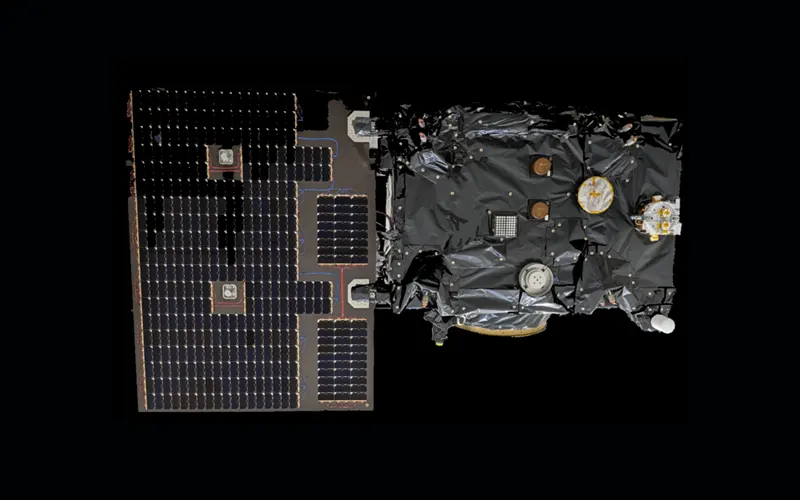
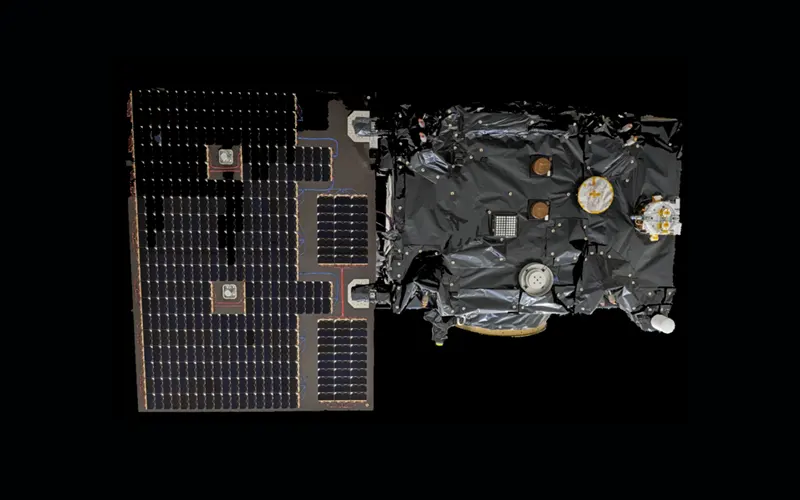
 Credit: ESA
The European Space Agency has regained contact with the Coronagraph spacecraft of its Proba-3 mission after more than a month of silence.
Launched aboard an ISRO PSLV-XL rocket in December 2024, the Proba-3 mission’s Coronagraph and Occulter spacecraft work in tandem to create and observe an artificial solar eclipse that enables observations of the Sun’s outer corona. When making observations, the satellites fly in a precise formation approximately 150 metres apart.
On 6 March, ESA announced that between 14 and 25 February, the Coronagraph spacecraft suffered an anomaly that triggered a chain reaction leading to a loss of attitude control. With the spacecraft’s solar array no longer facing the Sun, it quickly depleted its onboard battery, triggering entry into “survival mode,” in which only minimal electronics remain active, and communication with ground stations on Earth is interrupted.
The agency explained that teams planned to use the Occulter to locate and examine the Coronagraph spacecraft to better understand its condition. However, at the time of the incident, the two satellites were not flying in formation and were approximately 4 kilometres apart, making it more difficult to locate the spacecraft.
In addition to the spacecraft’s in-orbit partner, teams used the agency’s ground station network to continue attempts to contact the spacecraft, as well as optical observation data from ground-based telescope networks operated by its commercial partners Neuraspace and Sybilla Technologies, and radar data from the TIRA system operated by Fraunhofer FHR. This data was used to determine the spacecraft’s orbit and attitude motion to ascertain whether it was stable or tumbling.
On 19 March, ESA announced that it had successfully re-established contact with the spacecraft via its ground station in Villafranca, Spain. It added that the spacecraft was now in safe mode as operators conducted health checks to better understand its current condition and identify any damage.
“When we got the call from the operators at Villafranca, the excitement in the team was palpable,” said Proba-3 mission manager Damien Galano. “But the hard work is not over yet. We need to carefully look at the data before we take any further steps.”
According to ESA, the spacecraft’s solar panels are now facing the Sun, powering essential onboard electronics and charging the battery with the remaining power. After a month of exposure to extreme cold, the onboard systems will need time to warm up before operations can resume.
Keep European Spaceflight Independent
Your donation will help European Spaceflight to continue digging into the stories others miss. Every euro keeps our reporting alive.