
A new study published in Monthly Notices of the Royal Astronomical Society has pinpointed the best planets for the search for extraterrestrial life. By focusing on specific characteristics of exoplanets, astronomers have identified which ones are the most likely to harbor life beyond Earth. This critical discovery could drastically change the trajectory of future space exploration, with researchers narrowing down the thousands of known exoplanets to a handful of prime targets. The study offers insights into what makes a planet truly habitable and how we can go about looking for life in the universe.
The Critical Targets for Alien Life Discovery
The research team behind this discovery examined a variety of factors that make a planet suitable for life. These factors include a planet’s location within the habitable zone, its orbital eccentricity, and its energy levels. Planets that sit at the inner and outer edges of the habitable zone, where liquid water might be present, are key targets. The research also explored eccentric planets, which may have irregular orbits but could still maintain the necessary conditions for life.
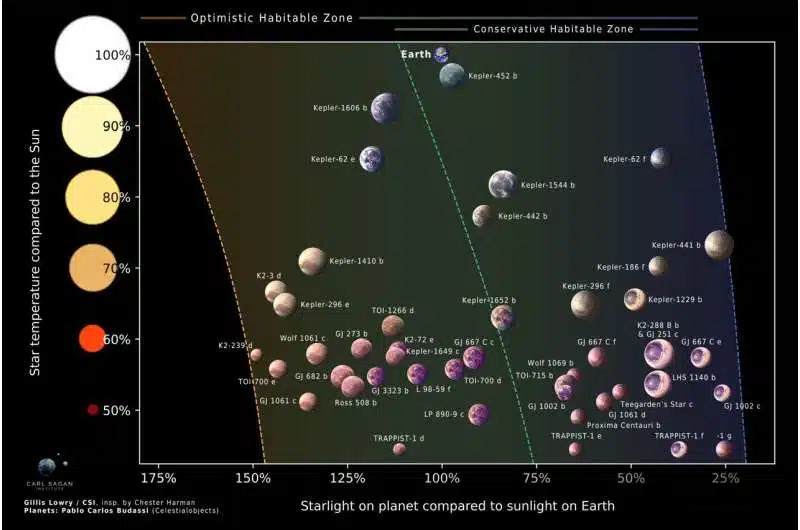 A diagram depicting habitable zone boundaries across star type with rocky exoplanets from Bohl et al. (2026). The boundaries of the habitable zone shift based on star color, since different wavelengths of light will heat a planet’s atmosphere differently. Credit: Gillis Lowry / Pablo Carlos Budassi
As Gillis Lowry, a graduate student at San Francisco State University and co-author of the paper, explained,
“While it’s hard to say what makes something more likely to have life, identifying where to look is the first key step—so the goal of our project was to say ‘here are the best targets for observation.’”
These findings, published in Monthly Notices of the Royal Astronomical Society, highlight the importance of specific characteristics, like the planet’s energy balance and its distance from its star, that can help us predict where life may exist. By focusing on these targets, scientists hope to narrow down their search for extraterrestrial life and potentially make groundbreaking discoveries.
What Makes a Planet Habitable?
The study doesn’t just focus on where life may be; it also addresses how habitability can change over time. With planets located at the edges of the habitable zone, the research shows how energy levels affect the likelihood of life. Too much or too little energy can make a planet uninhabitable, and understanding these factors is essential for future exploration.
“Observing these planets can help us understand when habitability is lost, how much energy is too much, and which planets remain habitable—or maybe never were,” said Lowry.
By identifying these planets, scientists can gain a deeper understanding of what conditions are necessary to sustain life.
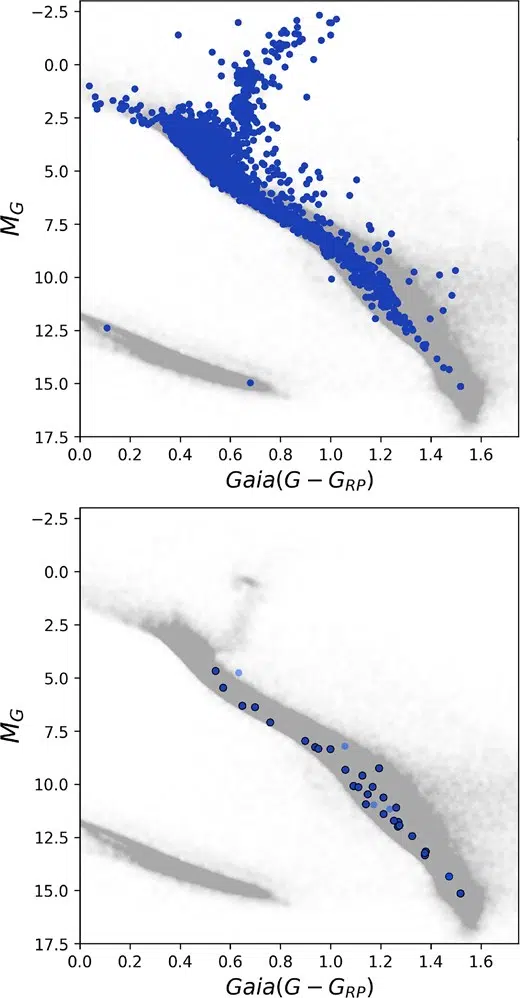 Colour–magnitude diagram of all exoplanet host stars (top) and rocky HZ exoplanet host stars (bottom) compared to all stars with Gaia DR3 data within 100 pc. Planets that do not require uncertainties in stellar flux to overlap the HZ are shown as dark circles, while planets that require flux uncertainties to overlap the HZ are shown as slightly lighter circles.
Credit: Monthly Notices of the Royal Astronomical Society
The Role of the James Webb Space Telescope
The study also emphasizes the importance of advanced telescopes, like the James Webb Space Telescope (JWST), in observing these planets. With the ability to detect exoplanet atmospheres and analyze their compositions, the JWST and other telescopes are poised to play a crucial role in this ongoing research. These telescopes will enable us to study planets in greater detail, potentially revealing signs of life or the conditions that could support it.
“As Project Hail Mary so beautifully illustrates, life might be much more versatile than we currently imagine, so figuring out which of the 6,000 known exoplanets would be most likely to host extraterrestrials such as Astrophage and Taumoeba—or Rocky—could prove critical, and not just to Ryan Gosling,” Professor Kaltenegger said.
The reference to Project Hail Mary, a popular science fiction novel, underscores the importance of pushing the boundaries of our imagination in the search for life beyond Earth.
A Step Toward Intergalactic Exploration
The findings of this study don’t just represent a leap in understanding where to look for life, they also highlight the bigger picture of space exploration. If we one day build a spacecraft capable of traveling to these distant worlds, this research will guide the mission, making it a vital resource for any future intergalactic explorers.
“We identified the targets that are most observable with the James Webb Space Telescope (JWST) and other telescopes,” said Professor Kaltenegger. “Our paper reveals where you should travel to find life if we ever built a ‘Hail Mary’ spacecraft.”
This strategic approach could make space missions more efficient, focusing resources on planets that are more likely to yield significant discoveries.