
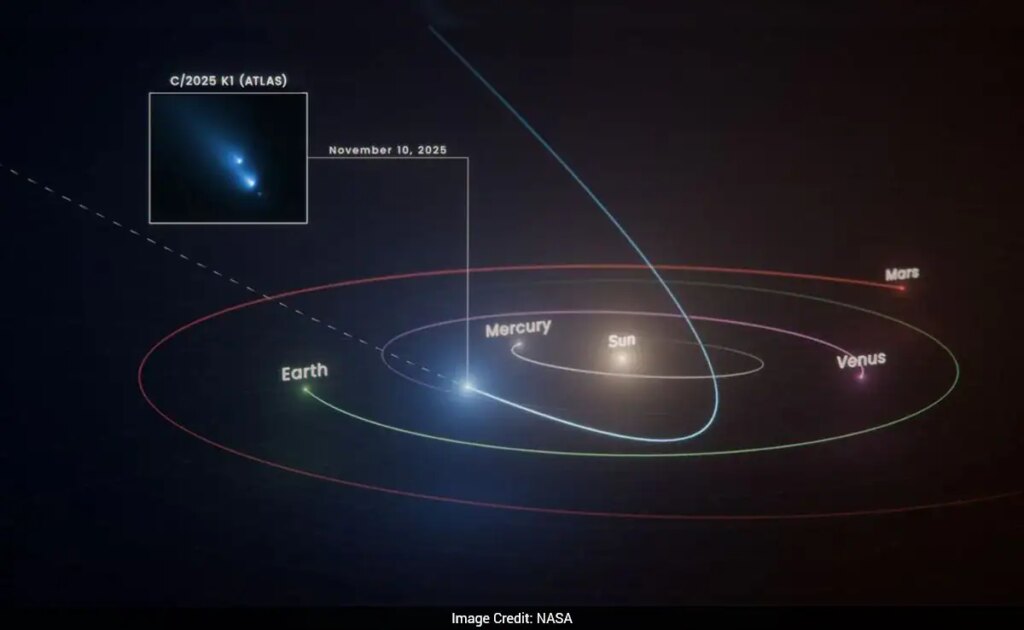
In a rare and exciting moment for space science, a powerful telescope captured a comet breaking apart almost as it happened. This unexpected observation has given scientists a closer look at how comets behave during one of their most dramatic phases, reported NASA.
NASA’s Hubble Space Telescope captured the disintegration of a comet in space, designated as K1 or C/2025 K1 (ATLAS). Witnessing such an event in real-time is considered extremely rare. The findings of this research were published on Wednesday in the journal Icarus. Notably, this comet was not the primary target of the study, making the discovery all the more surprising.
Co-investigator John Noonan, a research professor in the Department of Physics at Auburn University in Alabama, noted that significant scientific discoveries often occur by chance. He explained that this particular comet came into view because their originally selected target was obscured due to unforeseen technical issues, consequently, they had to choose a new target. As soon as they began observing it, the comet started to disintegrate.
Noonan recounted that he realised K1 was breaking apart only after reviewing the images the following day. He noted that during his initial examination of the data, he observed that the images appeared to show four comets instead of just one, leading him to recognise that he was witnessing an extraordinary phenomenon.
Scientists have long sought to capture such an event. They had previously planned on multiple occasions to use Hubble to observe a comet’s fragmentation, but they were unsuccessful because predicting the exact timing of such an event proved too difficult.
Lead investigator Denis Bodewits, a professor at Auburn University, remarked on the irony of the situation. They were studying an ordinary comet, only to have it break apart right before their eyes.
Bodewits explained that comets are remnants from the formation of the solar system and are composed of primordial matter. However, they no longer remain in a pristine state, as they have undergone changes due to the influence of the Sun and cosmic rays. Consequently, when scientists study their composition, the question arises as to whether the observed properties are intrinsic to the original material or have been altered over time.
The fragmentation of a comet, however, offers a unique opportunity to observe such primordial matter-material that has remained untouched by external influences. Hubble recorded K1 fragmenting into at least four pieces, with a cloud of gas and dust surrounding each fragment. While Hubble observed these fragments with great clarity, when viewed from Earth, they appeared merely as faint, glowing spots.
These images were captured approximately one month after the comet had reached its closest approach to the Sun, a point known as perihelion. During this phase, the comet is subjected to maximum heat and stress, consequently, as was the case with K1-comets often begin to disintegrate shortly thereafter.
Prior to its fragmentation, K1 was slightly larger than an average comet, measuring approximately 5 miles across. Scientists believe that the breakup began roughly eight days before Hubble captured these images, which were taken between November 8 and November 10, 2025. During this period, an additional, smaller fragment also broke away.
Leveraging Hubble’s high-resolution images, scientists were able to piece the fragments back together to reconstruct the comet’s original form, thereby establishing a complete timeline of the fragmentation process. However, this investigation also presented them with a new puzzle: explaining the time lag between the actual breakup and the subsequent brightening observed from Earth.
The research team posits that a comet’s brightness stems primarily from sunlight reflecting off its dust particles. Therefore, newly exposed ice may require time to accumulate a fresh layer of dust, or for internal pressure to build beneath the surface, before the underlying material is finally expelled.
Noonan noted that Hubble had never before observed a disintegrating comet at such close proximity to the actual moment of fragmentation. He explained that, typically, such events become visually apparent only weeks after they occur, in this instance, however, the phenomenon was observed within just a few days. This unprecedented observation is aiding scientists in deciphering the physical processes occurring on a comet’s surface, and may also help determine the precise duration required for a dust layer to form and for material to be subsequently ejected.