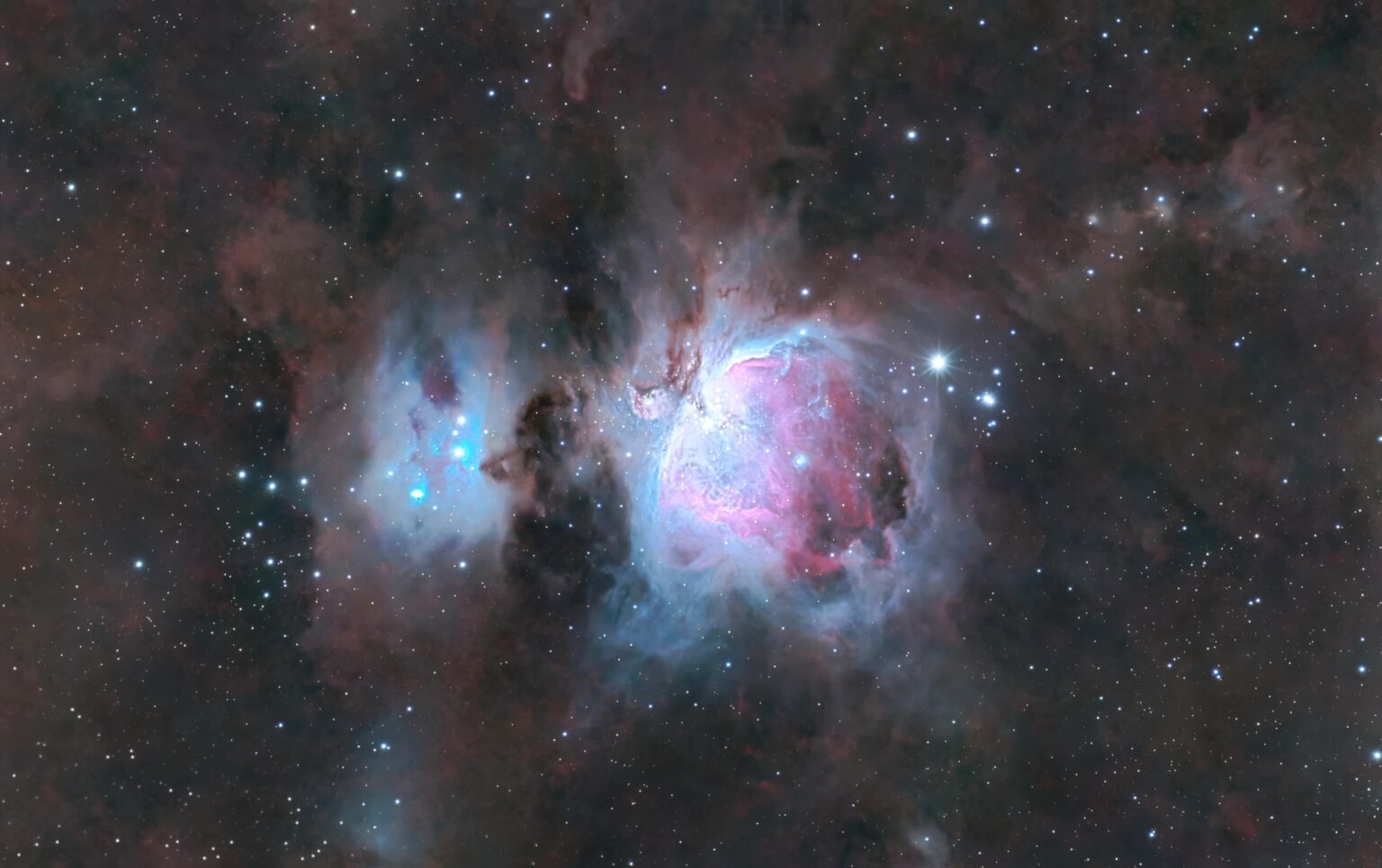
The Orion Nebula and its sister the Running Man Nebula. One of my favorite deep sky objects, its been my pleasure to spend my clear nights this winter trying to capture the Orion Nebula the best I can. Hopefully I might be able to get a little bit more data, but most likely this will be my final image for this season. I would have collected much more data on the target, but almost every night this winter has been nothing but clouds! The horror our hobby faces.
The processing of this image has been fairly complex and I’ve tried a variety of new to me techniques. One of my biggest issues has been with my star shapes. My lens suffers from extreme coma, and so it took many iterations to get the stars where I’ve wanted. I experimented with mixing full re-synthesis stars with real stars using masks, however this still felt unnatural to me. In the end, I decided to collect data specifically with only stars in mind. Using a very high F-Value results in better star shapes in variable aperture lenses. The final star layer uses roughly 40 minutes of 20 second sub-exposures at f11. Siril’s Aberration Remover script was then used to further fix the remaining star bloating/coma. I have found this has provided real looking yet round/pleasing star shapes, and I will probably try to use it for my future images.
Another issue has been the core, which the Siril VeraLux HyperMetric Stretch and HDR Multiscale scripts have seriously made easy to process. I further used the starless version of the 40 minutes of f11 data as a masked layer in Gimp at very low opacity to help further enhance the clarity of the core.
The main nebulosity was done with fairly standard stretches and the HDR Multiscale script.
The background dust was a separate stretch overlaid as a layer in Gimp. By using a separate layer for the background, I could stretch it out to the extreme without worrying about the nebulosity. GraXpert AI Denoise also helped severely in getting the faint data out. The layer was also processed in RawTherapee for extra denoising.
Then many many image adjustments in Gimp and RawTherapee until I felt it was acceptable. With such little data on the background dust and a non-astro modified camera, it was hard to get the dust to look good.
Overall, I am very happy with how the image has turned out, and I have learned a ton. But I am excited to try higher focal lengths for more detail in the core next season. For those still reading, clear and dark skies to you!
Acquisition:
* Camera: Nikon D5300
* Lens: Nikon AFP 70-300mm DX (at 300mm f6.3 and f11)
* Tracking Mount: IOptron SkyGuider Pro (No Guiding)
* ISO: 4000 (High ISOs help with the Nikon Concentric Rings)
* Sub-Exposure Time: 20 and 60 seconds
* Total Exposure Time: 5 Hours for main image (40 minutes for core and stars)
* Bortle 6-7

1 Comment
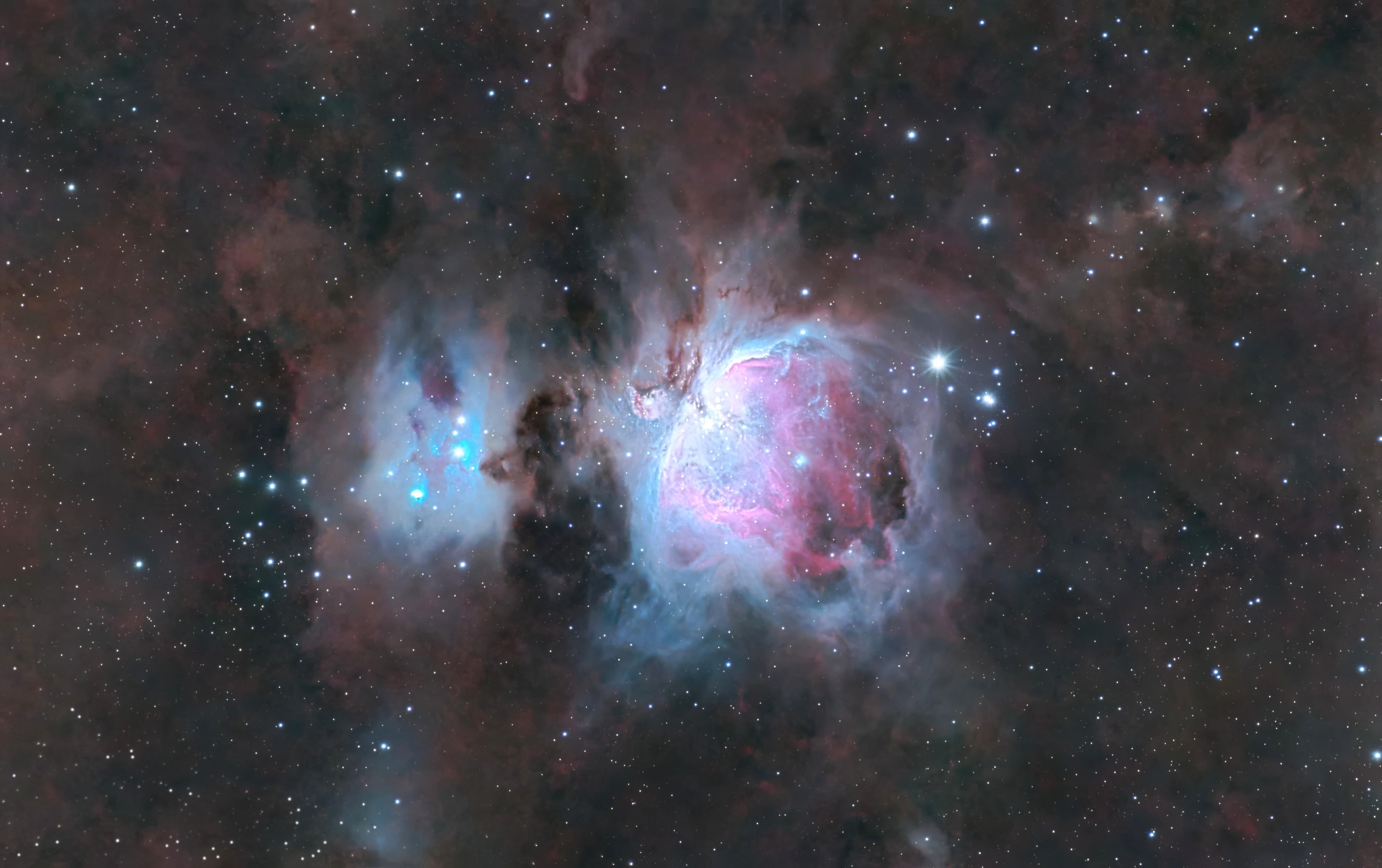
The Orion Nebula and its sister the Running Man Nebula. One of my favorite deep sky objects, its been my pleasure to spend my clear nights this winter trying to capture the Orion Nebula the best I can. Hopefully I might be able to get a little bit more data, but most likely this will be my final image for this season. I would have collected much more data on the target, but almost every night this winter has been nothing but clouds! The horror our hobby faces.
The processing of this image has been fairly complex and I’ve tried a variety of new to me techniques. One of my biggest issues has been with my star shapes. My lens suffers from extreme coma, and so it took many iterations to get the stars where I’ve wanted. I experimented with mixing full re-synthesis stars with real stars using masks, however this still felt unnatural to me. In the end, I decided to collect data specifically with only stars in mind. Using a very high F-Value results in better star shapes in variable aperture lenses. The final star layer uses roughly 40 minutes of 20 second sub-exposures at f11. Siril’s Aberration Remover script was then used to further fix the remaining star bloating/coma. I have found this has provided real looking yet round/pleasing star shapes, and I will probably try to use it for my future images.
Another issue has been the core, which the Siril VeraLux HyperMetric Stretch and HDR Multiscale scripts have seriously made easy to process. I further used the starless version of the 40 minutes of f11 data as a masked layer in Gimp at very low opacity to help further enhance the clarity of the core.
The main nebulosity was done with fairly standard stretches and the HDR Multiscale script.
The background dust was a separate stretch overlaid as a layer in Gimp. By using a separate layer for the background, I could stretch it out to the extreme without worrying about the nebulosity. GraXpert AI Denoise also helped severely in getting the faint data out. The layer was also processed in RawTherapee for extra denoising.
Then many many image adjustments in Gimp and RawTherapee until I felt it was acceptable. With such little data on the background dust and a non-astro modified camera, it was hard to get the dust to look good.
Overall, I am very happy with how the image has turned out, and I have learned a ton. But I am excited to try higher focal lengths for more detail in the core next season. For those still reading, clear and dark skies to you!
Acquisition:
* Camera: Nikon D5300
* Lens: Nikon AFP 70-300mm DX (at 300mm f6.3 and f11)
* Tracking Mount: IOptron SkyGuider Pro (No Guiding)
* ISO: 4000 (High ISOs help with the Nikon Concentric Rings)
* Sub-Exposure Time: 20 and 60 seconds
* Total Exposure Time: 5 Hours for main image (40 minutes for core and stars)
* Bortle 6-7