
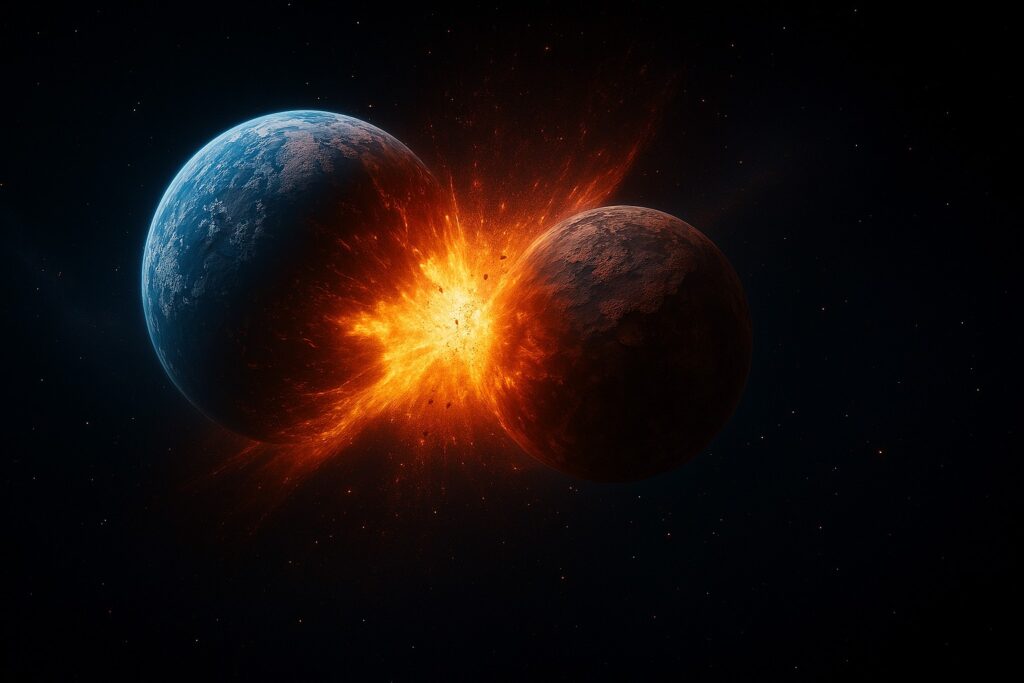
For a long time, the star Gaia20ehk (Gaia-GIC-1), located 11,000 light-years away in the constellation Puppis, was the very embodiment of stability. An ordinary star that no one had ever noticed. However, in 2016, its “behavior” changed dramatically: first, three strange dips in brightness appeared, and in 2021, according to scientists, it “went haywire,” beginning to flicker irregularly and intensely.
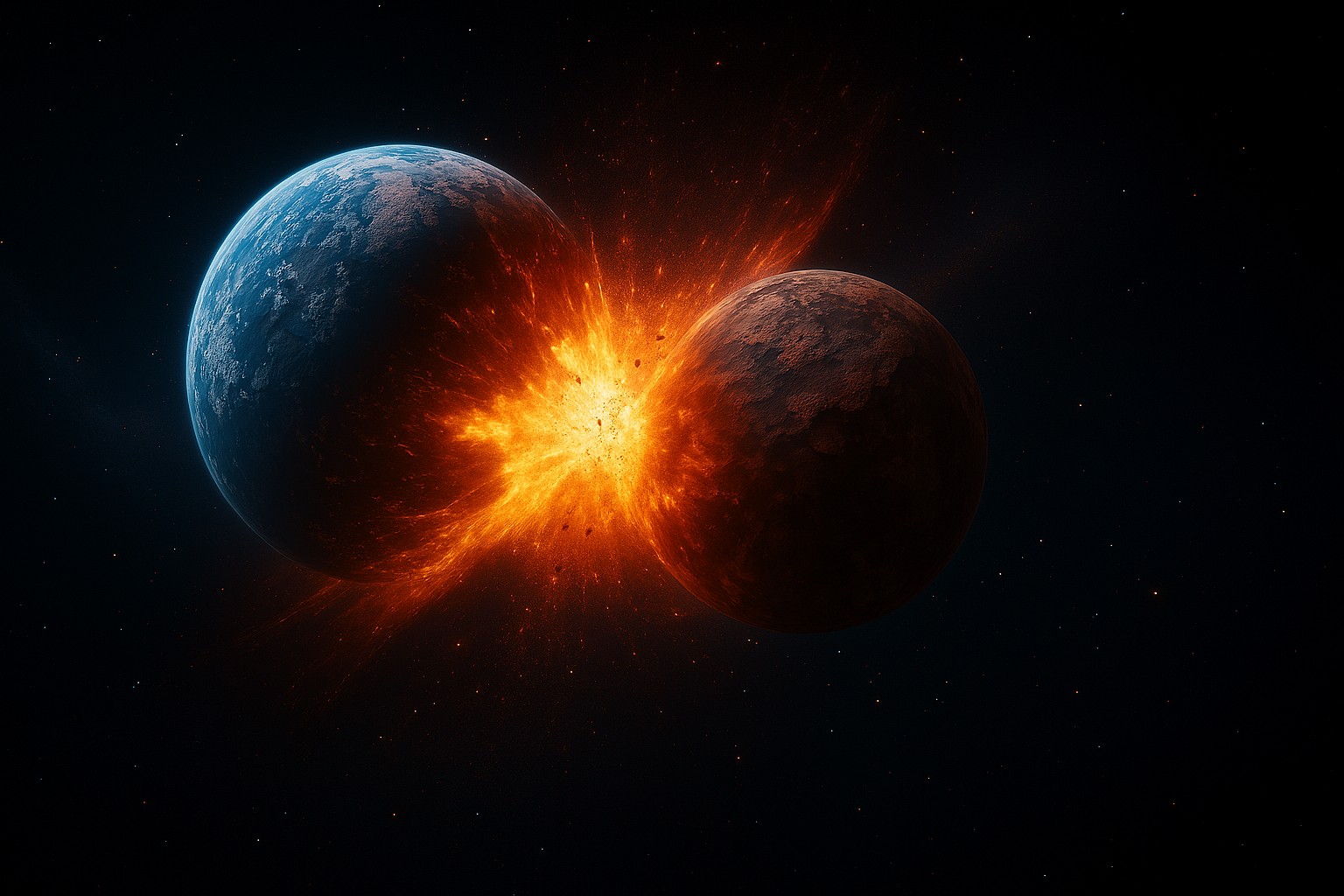 Illustration of a collision between two planets orbiting the star Gaia20ehk, created by the Gemini AI
While reviewing the archives, University of Washington graduate student Anastasios Tzanidakis realized that this was not just a technical glitch, but rare evidence of a genuine planetary catastrophe. The scientist published an article about his discovery in The Astrophysical Journal Letters.
Infrared evidence
The main mystery was what exactly was obscuring the star. They found the answer by comparing the visible light with the infrared radiation. It turned out that just as the star was fading from view, it was becoming incredibly bright in the infrared spectrum.
The material blocking the star’s light turned out to be hot, with a temperature of about 627 °C. This is a clear sign of the “afterglow” from the collision of two celestial bodies, which have turned into a glowing, clumpy cloud of debris.
A deadly rendezvous
Using data on the mass of the star—which is 1.3 times more massive than the Sun—and the frequency of its flickering, astronomers calculated the orbit of this cloud.
Distance: The debris orbits at a distance of 1.1 AU from the star. This is almost identical to the distance between Earth and the Sun.
The mass of the dust that has formed is equivalent to that of a small icy moon, such as Enceladus.
The scale of the event: since we can only see fine dust, the colliding planets had to be much larger.
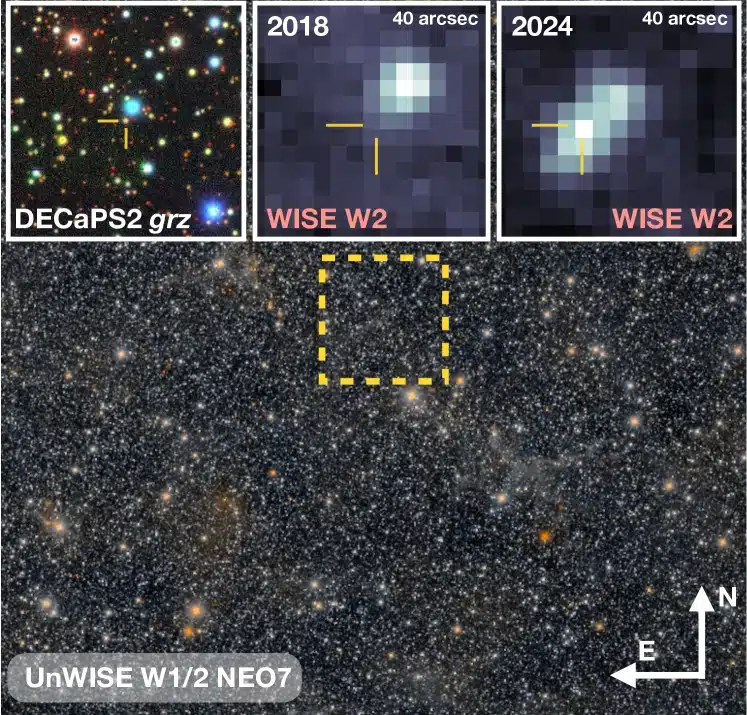 Optical and infrared images of Gaia20ehk. In visible light, the star appears normal, but infrared images from WISE show a sharp increase in its brightness between 2018 and 2024, which is consistent with the presence of hot dust formed as a result of a recent planetary collision.
Scientists believe the collision occurred in stages. First, the planets spiraled toward each other, undergoing a series of “glancing” impacts—the very same three dips in brightness observed in 2016—and then a final head-on collision occurred, creating a massive cloud of debris.
A mirror of our past
Why is Gaia20ehk so important to science? It serves as a “living” illustration of how our Solar System formed. According to the prevailing theory, our Moon was formed exactly this way: as a result of a collision between the young Earth and another planet the size of Mars.
Today, we are witnessing this chaotic process unfold in real time in another part of the galaxy. This is a rare opportunity to test the models that explain how rocky planets like ours are formed.
Astronomers plan to use the James Webb Space Telescope to closely monitor the cooling of the debris. In addition, scientists have high hopes for the Vera Rubin Observatory, which could detect about a hundred such “cosmic collisions” over the next decade.
This will help answer a fundamental question in astrobiology: How rare was the event that created the Earth-Moon system, and how often do habitable worlds form in the universe?
According to Daily Galaxy