
When you buy through links on our articles, Future and its syndication partners may earn a commission.
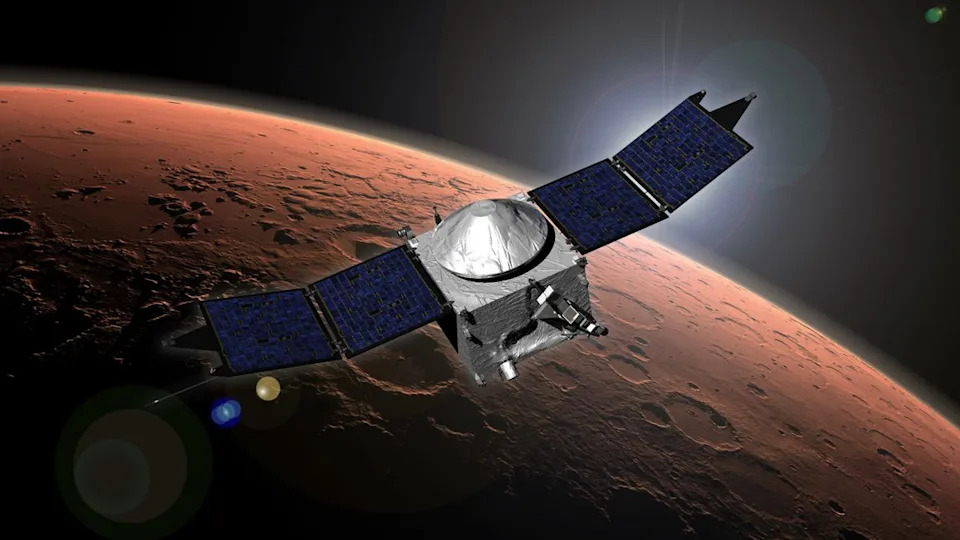
Artist’s conception of the MAVEN spacecraft orbiting Mars. . | Credit: NASA/GSFC
NASA has yet to reestablish contact with its MAVEN Mars spacecraft despite ongoing efforts, agency officials said Monday (March 16).
NASA lost contact with MAVEN on Dec. 6, 2025, after the spacecraft was expected to emerge from Mars’ far side. Communications received two days earlier showed the spacecraft was operating normally — with “no indications of problems whatsoever,” Louise Prockter, director of NASA’s planetary science division, said during a town hall at this year’s Lunar and Planetary Science Conference in The Woodlands, Texas. However, analysis of a fragment of tracking data from the day contact was lost suggests MAVEN was rotating in an unexpected manner as it emerged from behind Mars and was no longer in its planned orbit, according to NASA.
Prockter said no signal has been detected by NASA’s Deep Space Network since a planned two-week communication blackout ended on Jan. 16. The scheduled pause in communications, caused by a solar conjunction — when the sun aligns between Earth and Mars — prevents signal interference and avoids sending partial or distorted commands that could trigger unintended behavior in the spacecraft. NASA resumed attempts to contact MAVEN after the solar conjunction ended, but those efforts have so far been unsuccessful, Prockter said. “We haven’t officially said MAVEN is lost yet. We’re still looking for it.”
NASA has deployed additional assets to locate the spacecraft, including the National Science Foundation’s Green Bank Observatory. The agency also attempted to detect MAVEN from the Martian surface by directing the Curiosity rover to point its camera skyward, but no sign of the spacecraft was found.
At a separate meeting in January, Prockter had said recovery was “very unlikely” after the spacecraft had been out of contact for more than a month. NASA has since convened an anomaly review board to evaluate potential recovery efforts, assess the spacecraft’s condition and determine any likelihood of recovery.
But it remains unclear how long those efforts will continue before the mission is officially declared over.
Launched in 2013, MAVEN — short for Mars Atmosphere and Volatile Evolution — spent a dozen years studying how Mars lost its atmosphere, helping scientists understand how the planet transformed from a warmer, wetter world into the cold desert seen today. Originally built for a one-year mission, MAVEN marked its 10th anniversary in September 2024.
Beyond science, MAVEN also supports operations by relaying about 20% of communications between Earth and surface missions, including NASA’s Curiosity and Perseverance rovers.
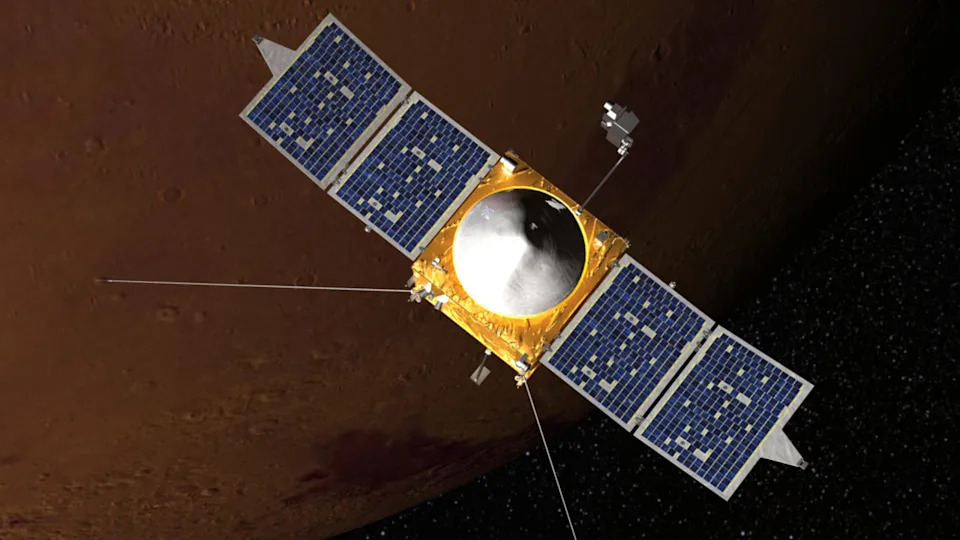
Artist’s conception of NASA’s MAVEN Mars orbiter. | Credit: NASA/GSFC
“I did want to take a moment just to celebrate the entire MAVEN team for all they’ve achieved,” Prockter said during Monday’s town hall, “and for their absolutely heroic efforts during the recent spacecraft recovery efforts.”
With MAVEN now silent, other spacecraft — including NASA’s Mars Reconnaissance Orbiter and Mars Odyssey, and the European Space Agency’s Trace Gas Orbiter — are taking on a greater share of relay duties. NASA said it has scheduled additional communication passes and modified daily plans for the Curiosity and Perseverance rovers to maintain science operations.
In parallel, NASA is considering options to support its aging Mars relay infrastructure and potentially replace MAVEN if it is ultimately declared lost, though Prockter declined to provide further details. A budget reconciliation bill passed last year allocates $700 million for a “high-performance Mars telecommunications orbiter,” and Blue Origin has proposed its own Mars telecom orbiter that it says could launch by 2028.
“We know that they’re not all going to last forever,” Prockter said. “The agency is thinking about what is next for Mars.”