
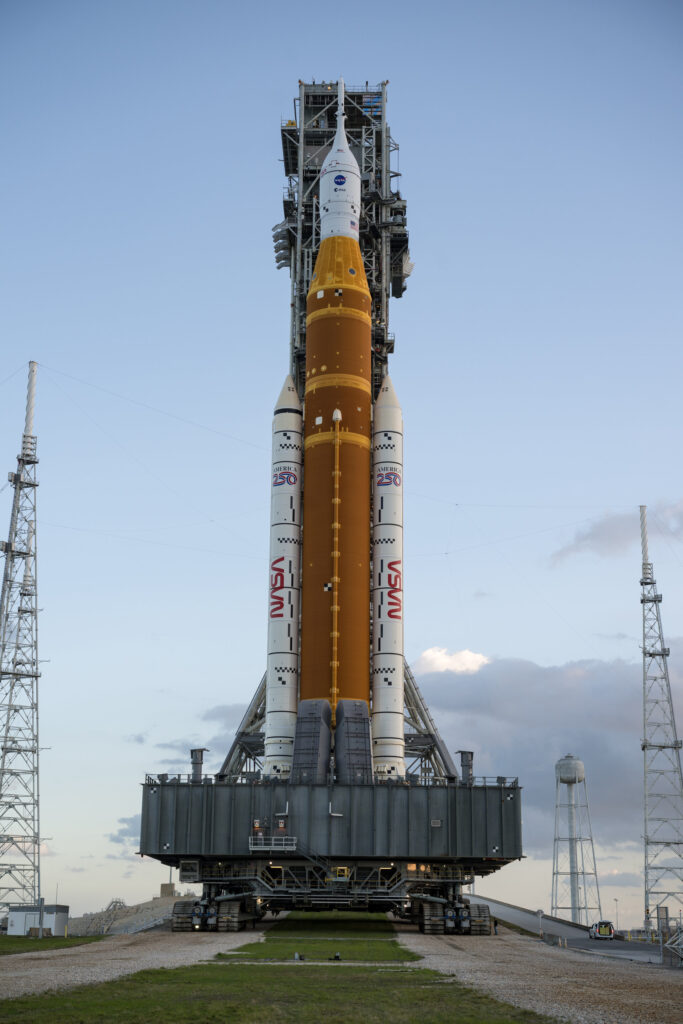
Earlier today, NASA’s Artemis II rocket once more began rolling out from the Vehicle Assembly Building at the Kennedy Space Center in Florida, US, and has now arrived at its launch pad ahead of the first crewed flight towards the Moon in over 50 years.
Riding atop its mobile launcher, the Space Launch System rocket and Orion spacecraft travelled slowly but surely at a crawl, covering 6.5 km in about 12 hours, with teams monitoring every step.
This is the rocket’s second trip to the pad – it first made the journey in January. Since then, teams rehearsed key launch operations, including fuelling the rocket and running through the final countdown to liftoff. A wet dress rehearsal was successfully completed in February, with the rocket fully loaded with its cryogenic propellants.
However, following this test, engineers identified an issue in the rocket upper stage helium system, used to pressurise the propellant tanks. The rocket was subsequently rolled back to the Vehicle Assembly Building for inspection and repairs. The safety of the crew remains the top priority, with teams working carefully to ensure all systems perform as expected ahead of launch.
In recent weeks, teams have resolved the issue, carried out additional checks, and replaced batteries across key systems. In mid-March, after a flight readiness review with programme partners including ESA, NASA confirmed all teams had polled ‘go’ for launch in early April.
The mission is targeting the following launch opportunities (CEST):
2 April – 00:24 (1 April 18:24 local time)
3 April – 01:22 (2 April 19:22 local time)
4 April – 02:00 (3 April 20:00 local time)
5 April – 02:53 (4 April 20:53 local time)
6 April – 03:40 (5 April 21:40 local time)
7 April – 04:36 (6 April 22:36 local time)
Powering Orion on this historic voyage is ESA’s second European Service Module. This crucial part of the spacecraft will power and propel Orion through deep space, provide air and water and control the temperature inside for the four astronauts. Built by over 20 companies across 10 ESA Member States led by prime contractor Airbus, the module reflects nearly a decade of work.
Europe’s contribution continues throughout the mission, where the engineers who know the module the best will be supporting around the clock from ESA centres in the Netherlands and Germany, as well as from NASA’s Johnson Space Center in Houston.