
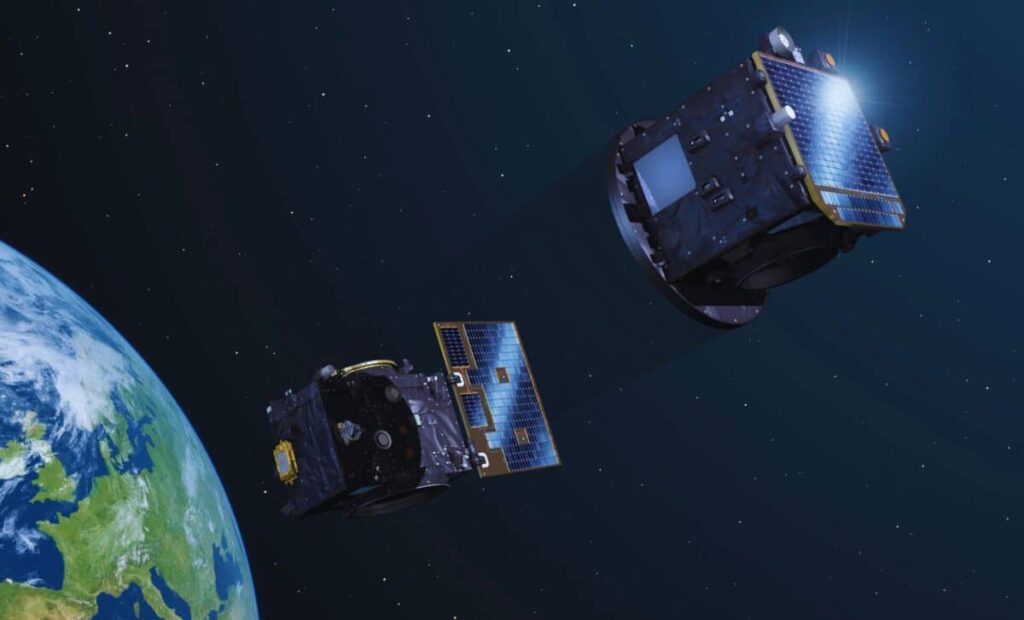
A silent spacecraft drifting in space has been brought back into contact, restoring momentum to one of Europe’s most intricate solar missions. After nearly a month without communication, engineers managed to reconnect during a brief and unexpected window. The recovery keeps the European Space Agency (ESA)’s Proba-3 mission alive.
Launched in 2024, Proba–3 relies on two spacecraft flying in precise formation to simulate a solar eclipse at an altitude of more than 60,000 kilometers. One satellite blocks the Sun using a 1.4-meter disk, while the other observes the faint solar corona, a region still difficult to study directly.
A Chain Reaction Led To Loss Of Contact
As explained by an ESA statement, the incident began on February 14, when the spacecraft carrying the coronagraph lost its orientation after a series of failures. Its solar panels turned away from the Sun, cutting off its power supply.
As its batteries drained, the spacecraft entered a survival mode and stopped communicating. It remained in this state, tumbling through space, for several weeks. The loss of orientation triggered the entire sequence that led to the blackout.
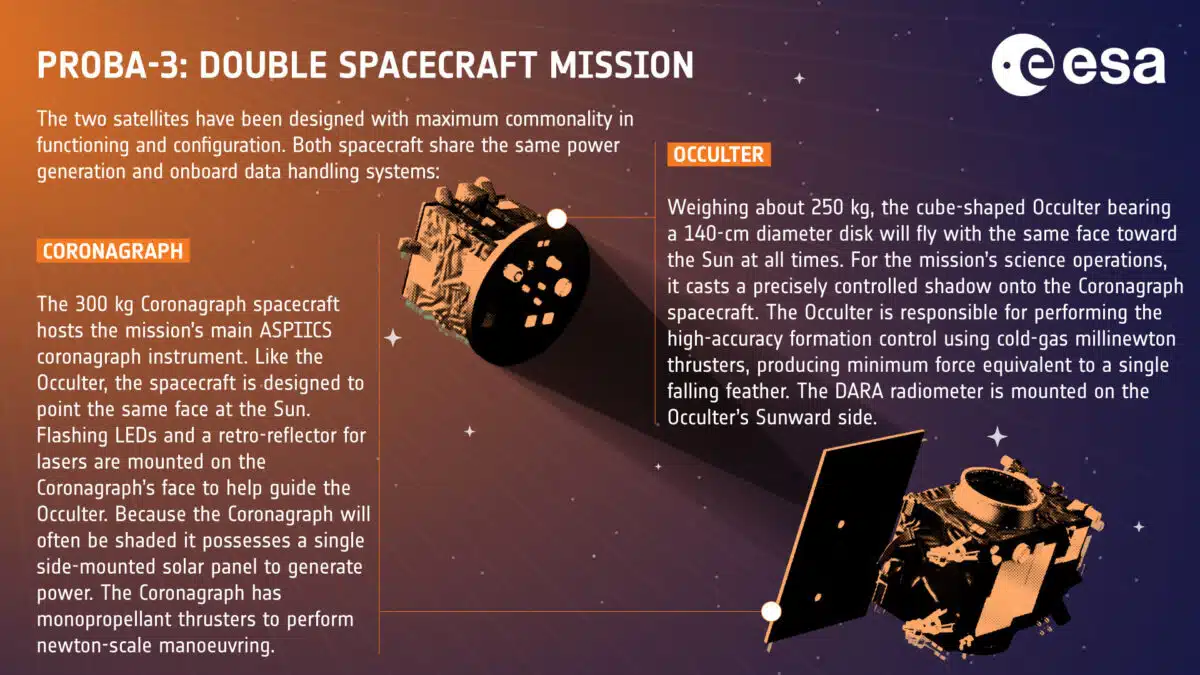 Proba-3: two satellites flying in formation to study the Sun with unprecedented precision. Credit: European Space Agency
A Fleeting Moment Of Sunlight Restored Communication
Engineers identified a critical opportunity when the tumbling spacecraft briefly exposed its solar panels to sunlight. That limited energy allowed them to attempt a reconnection.
Teams in Spain acted quickly and successfully re-established contact. According to ESA Director Josef Aschbacher, they “saw that some sunlight is actually hitting the solar panels.” Proba-3 has since regained a stable orientation.
“The spacecraft’s solar panel is facing the sun, powering the essential electronics on board, and charging the battery with the remaining power,” stated ESA officials, as quoted by Space.com. “After a month of floating in space and exposed to extreme cold, onboard systems need time to warm up before any major actions are taken.”
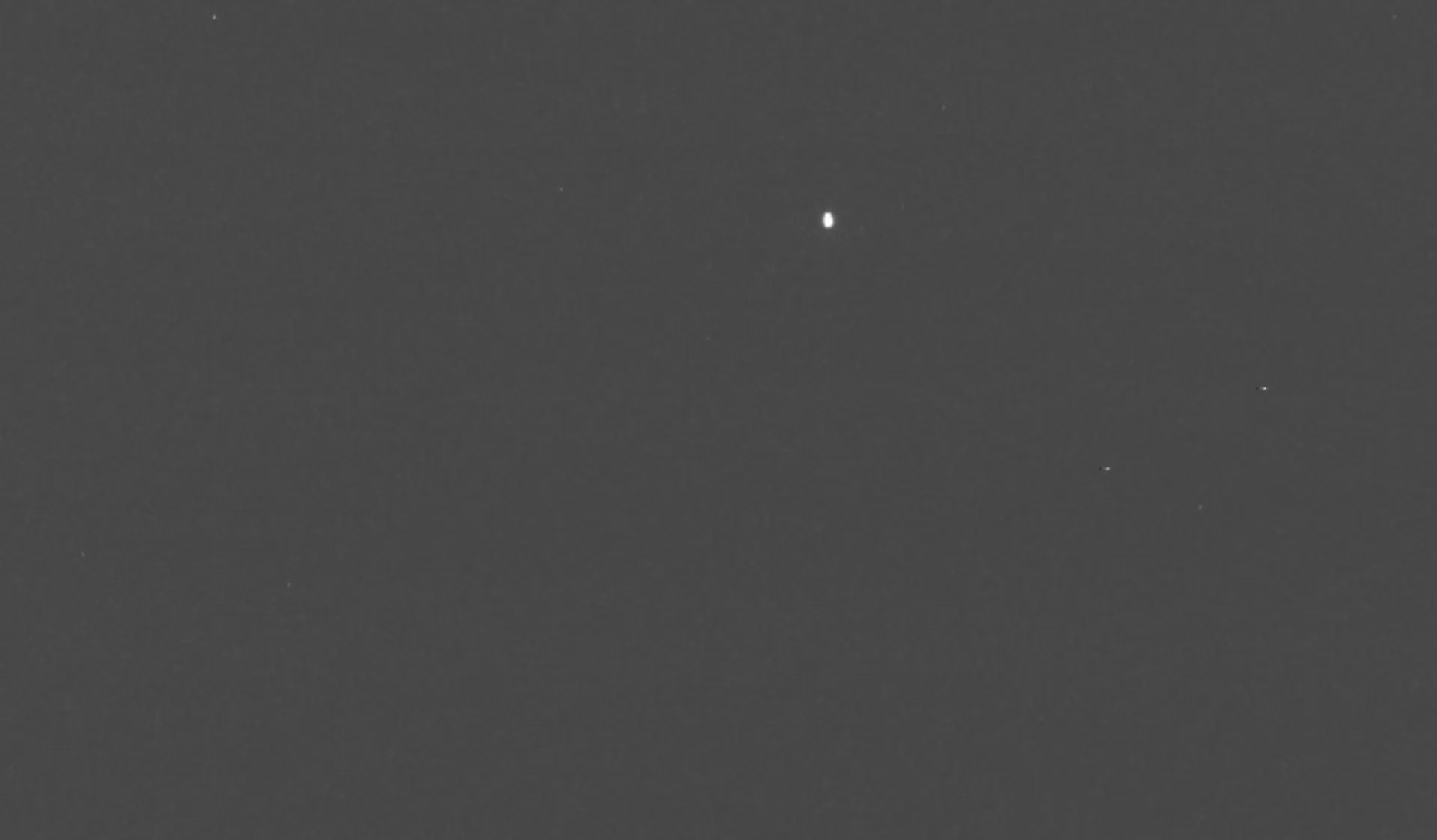 A view of the coronagraph from the occulter. Credit: ESA
System Checks Will Decide Next Phase
The second spacecraft, tasked with blocking the Sun’s light, remained operational and continued to track its partner throughout the incident. Part of the mission therefore remained active.
Engineers now turn their attention to evaluating the condition of the recovered spacecraft. Instruments will be switched back on step by step to determine any damage. As Proba-3 mission Manager Damien Galano said in a press release published by ESA on March 19, the return of communication is “a great relief,” as the coronagraph is central to the mission’s objectives.
But, the objective remains unchanged: to study the solar corona, a vast, still largely mysterious region spanning millions of kilometers