
A small, unassuming moss from Earth’s deserts is drawing serious attention from scientists studying life beyond our planet. Syntrichia caninervis, known for surviving extreme conditions, is now being considered as a potential pioneer species for Mars.
The search for organisms capable of enduring martian conditions has intensified as space agencies explore long-term missions. The challenge is not only to land on the Red Planet, but to sustain life.
That’s why scientists are getting really interested in certain extremophiles. In a study published in The Innovation, researchers from the Xinjiang Institute of Ecology and Geography state that Syntrichia caninervis stands out as a “promising pioneer for colonizing extraterrestrial environments” due to its exceptional resilience.
This Organism Survived Where Almost Nothing Can
This moss does not grow in gentle environments. It is commonly found in the Mojave Desert, where heat and drought dominate, but also in polar regions exposed to freezing temperatures.
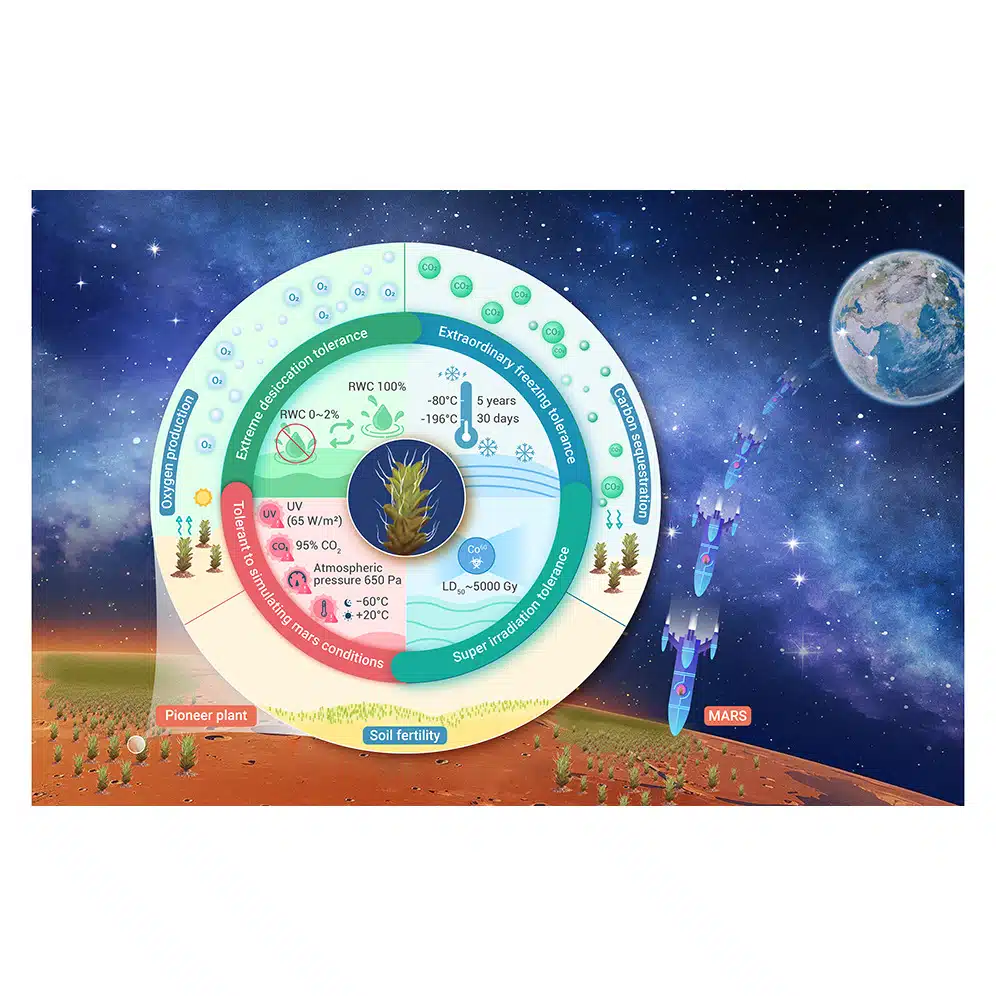 Diagram illustrating the tolerance of Syntrichia caninervis to extreme dehydration, freezing, and radiation under simulated Martian conditions. Credit: The Innovation
As explained in the study, Syntrichia caninervis can withstand temperatures down to -196°C. It also survives near-total dehydration, losing up to -98% of its moisture before recovering when exposed to water again.
Its appearance reflects these conditions, dark, dry, and compact, more functional than appealing. Still, this adaptability is exactly what researchers are looking for in the context of space exploration. Outside expert Prof Stuart McDaniel from the University of Florida agreed that the concept is worthwhile.
“Cultivating terrestrial plants is an important part of any long-term space mission because plants efficiently turn carbon dioxide and water into oxygen and carbohydrates – essentially the air and food that humans need to survive. Desert moss is not edible, but it could provide other important services in space.”
Surviving Radiation Where Most Life Cannot
Radiation remains one of the main barriers to life on Mars. The planet’s thin atmosphere allows high levels of cosmic radiation, including gamma rays, to reach the surface.
These rays can disrupt chemical bonds and cause severe genetic damage, often leading to death in most organisms. On Earth, the atmosphere filters much of this radiation, but Mars lacks such protection.
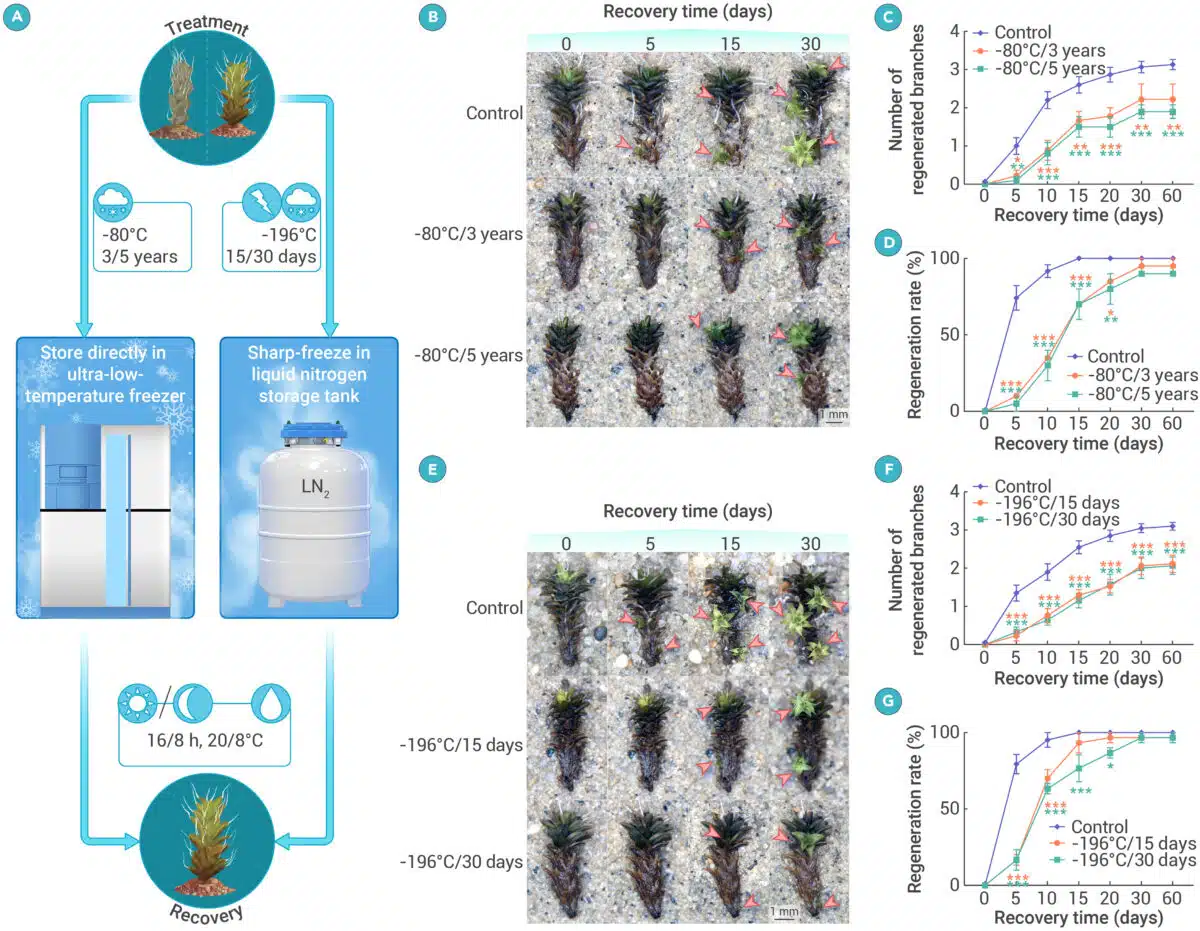 Experimental recovery of Syntrichia caninervis after extreme freezing conditions. Credit: The Innovation
Syntrichia caninervis shows a notable resistance to these conditions. Its ability to withstand gamma radiation adds to its potential as a candidate for survival during both the journey to Mars and prolonged exposure once there.
“This paper is exciting because it shows that desert moss survives short exposures to some of the stresses that are likely to be found on a trip to Mars, including very high levels of radiation, very cold temperatures, and very low oxygen levels”, added McDaniel.
A Pioneer Organism For Future Martian Ecosystems
Beyond simply surviving, this moss could play a role in modifying martian conditions. Its interaction with poor soils on Earth suggests it could gradually alter the composition of martian regolith.
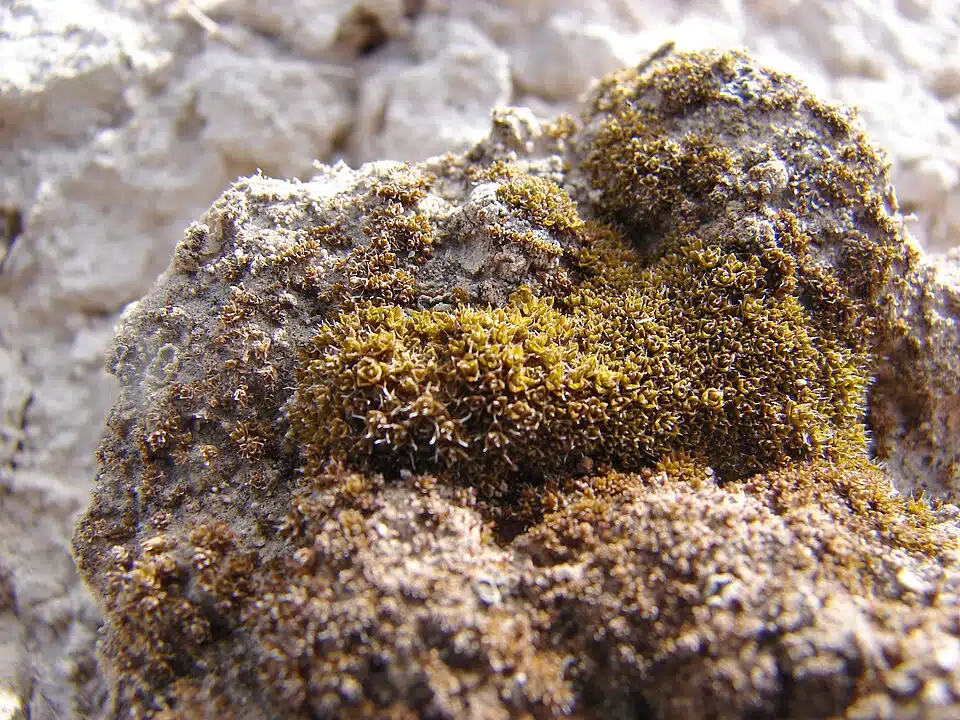 Syntrichia caninervis. Credit: Sheri Hagwood
As it grows, it may gradually improve the soil, making it easier for other life to take hold. The moss also produces oxygen, which could slightly shape the atmosphere over time. Researchers are now exploring its genes to see if its toughness could eventually be used to boost crops like wheat. And as Edward Guinan at Villanova University in Pennsylvania remarked:
“We have a long way to go,” he said. “But this lowly desert moss offers hope for making small portions of Mars habitable for humankind in the future.”