
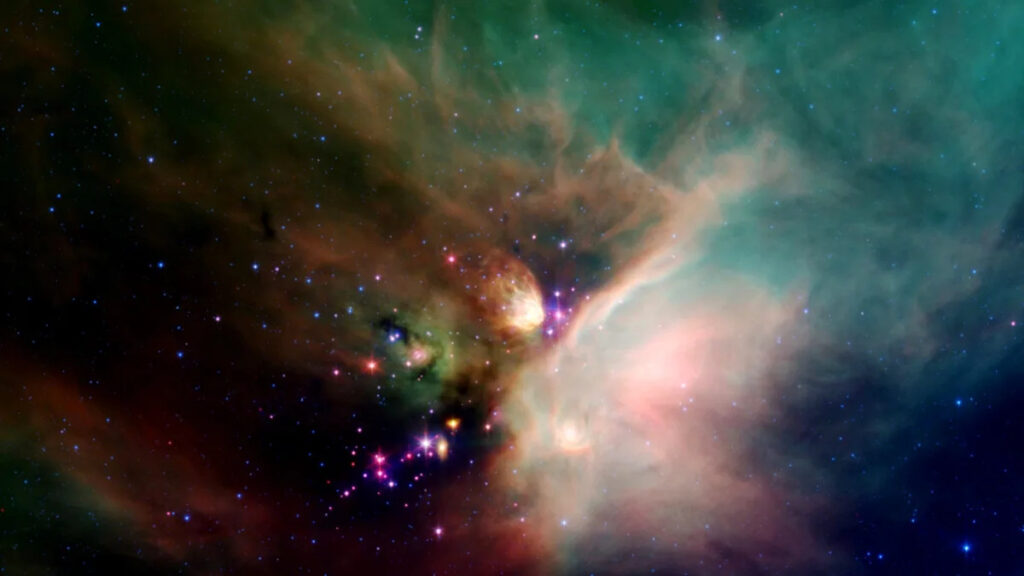
Every Thursday, Jezebel will yank you from this flaming dumpster planet and catapult you into the cosmos, delivering the most awe-inspiring and jaw-dropping astronomy news taking place right beyond our atmosphere—where humans don’t exist.
The news has been a lot for a while now, but lately—from Iran to #MomTok to ICE to Kylie Jenner maybe being a good actor—it’s felt especially overwhelming. More and more, I’ve found myself scrolling astronomy headlines on space.com or phys.org because contemplating the vast, never-ending universe now feels infinitely more manageable than reading another update about Pete “I’m a Warfighter” Hegseth.
I also deeply love reading astronomers talk about their work. For a bunch of space nerds, they’re really fucking good at poetically describing their research in a way that makes me feel inspired, as opposed to terrified, by the dark, bottomless void that is human existence.
When I was in the fourth grade, I wrote that when I grew up, I wanted to “work at NASA as one of the people who help with the lift-off of the space shuttles.” Non-Earth News isn’t that, exactly, but I will be metaphorically launching us into the stars, so I think it’s pretty damn close. Let’s go!
Fossil Stars
Mounted atop a mountain in northern Chile, a 13-foot telescope named after pioneering Puerto Rican astronomer Víctor M. Blanco has spent decades peering into the past. Mounted atop that telescope is a dark energy camera—which you can read about what that is here, but it’s cool—which recently captured a super ancient star that astronomers are comparing to discovering a dinosaur fossil.
“Discoveries like this are cosmic archaeology, uncovering rare stellar fossils that preserve the fingerprints of the universe’s first stars,” Chris Davis, National Science Foundation Program Director for NOIRLab, said in a statement. The universe’s first stars. Earth didn’t exist yet. Everything that ever was and will be was just floating pieces of cosmic dust.
The star, named PicII-503, was discovered 150,000 light-years from Earth, in the tiny dwarf Pictor II galaxy—which sits in the Pictor constellation—and is over 10 billion years old. The star has “the lowest concentration of iron ever seen beyond the Milky Way,” according to Space.com, as well as “a massive overabundance of carbon.” This is where my awe starts to feel a little like I’m about to fail my 11th-grade chemistry test, which signals it’s time for a quote from an astronomer.
“Discovering a star that unambiguously preserves the heavy metals from the first stars was at the edge of what we thought possible, given the extreme rarity of these objects,” Anirudh Chiti of Stanford University said in a statement about the discovery. “With the lowest iron abundance ever derived in any ultra-faint dwarf galaxy, PicII-503 provides a window into initial element production within a primordial system that is unprecedented.”
The “edge of what we thought possible.” What a gift it is to be alive among language and science and stars.
Dueling Planets
A “wildly” flickering star and floating mystery debris can, of course, only mean one thing: the planets were fighting.
Some 11,000 light-years away, astronomers at the University of Washington, while browsing telescope data from 2016, spotted a “catastrophic collision” between two planets. I guess needless fighting isn’t an inherent human trait. Devastating to learn.
While shit in space collides all the time, these dueling planets were special, since they most closely resemble what caused you and me and everyone we know to be walking around on this floating rock.
“There are only a few other planetary collisions of any kind on record, and none that bear so many similarities to the impact that created the Earth and moon,” Anastasios Tzanidakis, a doctoral candidate in astronomy at the University of Washington, told UW News. “If we can observe more moments like this elsewhere in the galaxy, it will teach us lots about the formation of our world.” Just think, in five billion years, maybe we’ll have a brand-new Earth to escape to—or whose inhabitants will be willing to rescue us. Whatever the vibes are that year, I guess.
We Come from…Random Rocks
Where did we come from? I personally love to imagine centuries upon centuries upon centuries of stardust swirling around Earth like the Fairy Godmother’s magic that turned Cinderella from a raggedy maid to a hottie. But it does feel like the more likely scenario is that we came from a bunch of random space trash collected on a random rock that just crashed into Earth one day. The human race is definitely less fairy tale princess and more something weird emerging from a pile of junk.
Science recently possibly confirmed this! While there are various hypotheses for how life on Earth began, a new study from Nature Astronomy found that the asteroid Ryugu contains the “five nucleobases” considered the “building blocks of DNA and RNA—the genetic material inherent to all life on Earth,” according to Gizmodo. This would suggest that life began because a bunch of asteroids with all this material kept crashing into Earth, eventually converging to create the elements necessary for capitalism, McDonald’s, fracking, and your worst ex.
Samples of Ryugu have been collected by the Japan Aerospace Exploration Agency (JAXA) since 2018, when its spacecraft completed its four-year mission to land on the asteroid. Since then, there has been tons of research on various samples, but this is the first time a study has detected all five nucleobases.
If asteroids carried life to Earth, surely they must have carried life to other planets, too, right…?
[Gizmodo and Nature Astronomy]
Like what you just read? You’ve got great taste. Subscribe to Jezebel, and for $5 a month or $50 a year, you’ll get access to a bunch of subscriber benefits, including getting to read the next article (and all the ones after that) ad-free. Plus, you’ll be supporting independent journalism—which, can you even imagine not supporting independent journalism in times like these? Yikes.