
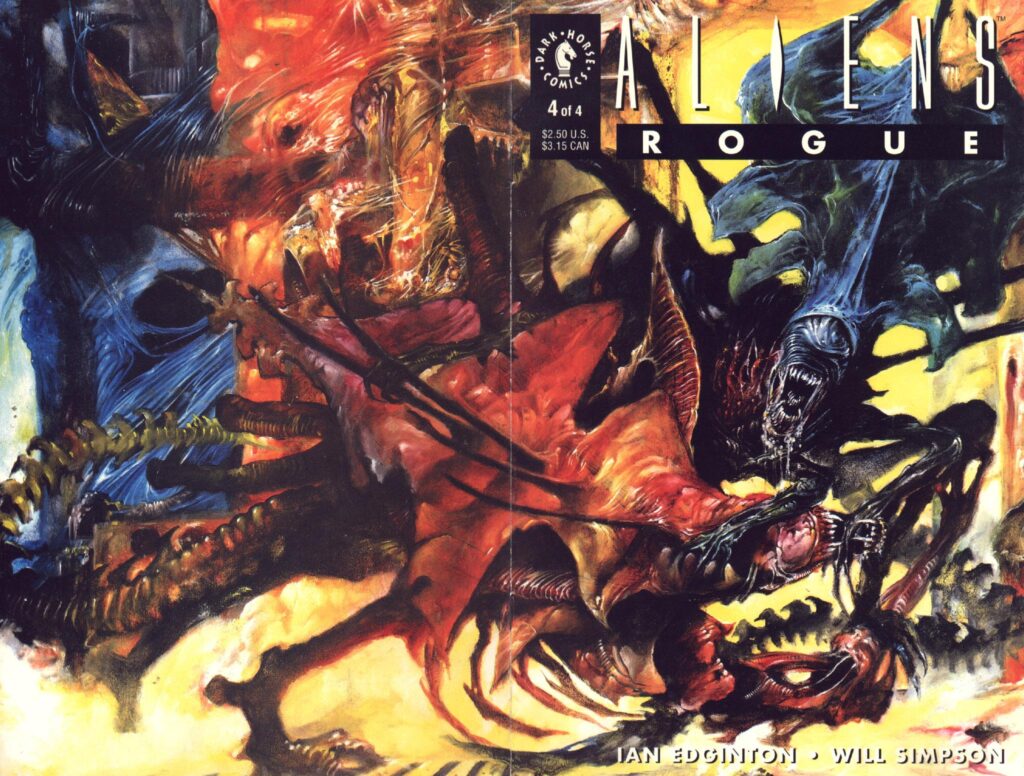
This is an interview with veteran comic book writer Ian Edginton. With a career spanning decades, Edginton has left a permanent mark on the sci-fi and horror genres, working on everything from 2000 AD and Judge Dredd to Star Trek and Doctor Who. To Alien and Predator fans, however, he is behind many expanded universe stories, including the ‘mad scientist’ horror of Aliens: Rogue, the cyberpunk-infused Aliens vs. Predator: Eternal, and the silent Predator tale Rite of Passage. In this interview, we discuss his inspirations, his penchant for ‘body horror,’ the creation of the Alien King, and his thoughts on the franchise’s evolution under Ridley Scott and Marvel.
Ian appeared on Episode 139 of the AvPGalaxy Podcast. You can watch the interview below and read on for a transcription. Please note that the accompanying transcript has been edited for clarity and brevity.
Fandom and the Silent Hunt
Ian Edington
Aaron Percival: Could you just tell our audience a little bit about Ian outside of Alien and Predator? Who are you and what do you do?
Ian Edginton: I am a writer primarily of comic books. I am a dad to two children and a grumpy cat. I have far too many books for my own good. I primarily work for 2000 AD, home to Judge Dredd and things like that. I have a number of series there, such as Red Seas, which is like a fancy pirate thing, and Stickleback, which is a steampunk story. The artist, D’Israeli, and I did a series called Scarlet Traces, which was a sequel to War of the Worlds.
I have worked for Marvel, DC, and Dark Horse. I have done things for Iron Maiden and a couple of series for Kiss. I have done Big Finish audio for Doctor Who and some Torchwood. I have done a lot for Warhammer and Games Workshop as well. I am a jobbing writer, basically. It is just the ideas. Someone will ask if I want to come and write Doctor Who or Torchwood, and I say, “Yeah, okay, that is a really cool idea.” Once you accept that you are playing with someone else’s toys and property, it is great. Like with Aliens and Predator, they just said, “Come and do us a series,” and I was like, “Yeah, cool.” I have worked on Planet of the Apes, Star Trek, Star Wars, and Xena: Warrior Princess. I am used to the strictures that come with working on licensed properties.
Adam Zeller: Do you remember the first time you became aware of the Alien and the Predator?
Ian Edginton: I went to see Alien when it first opened in Birmingham on its first run. It was at the Gaumont, which was then the second biggest screen in Europe. It was a massive wrap-around cinema screen. I was underage, but we sneaked in. There was actually a queue outside and around the block. It was scary, but it was just the atmosphere. It was groundbreaking.
I can’t remember when I went to see Predator, but I went to see Predator on its first run as well. I definitely remember going to see Alien because it said in the newspapers that people were so scared they were throwing up. We were like, “Wow, what is it going to be like?” Then I went to see Aliens as well on the first run and that was just awesome. My friend Sean and I actually went back up to the box office, paid again, sat down, and saw it a second time on the same afternoon.
Aaron Percival: Which would you say is the favourite?
Ian Edginton: Oh, it is apples and pears. I have a big soft spot for Alien just because it is the “monster in the haunted house” kind of thing, big on atmosphere, and it was groundbreaking. Then Aliens is just loud and in your face. I think Alien maybe just edges it because it was groundbreaking. I do not think you can have a space movie with troopers in it, now that does not touch on the Colonial Marines. It is like Blade Runner; Blade Runner has its fingers in every kind of futuristic techno-noir movie now. I think it is the same with Aliens.
Predator is just big, loud, and stupid. You are not looking for any subtlety in Predator. For ages, I kept quoting Jesse Ventura: “You die here in a world of hurt.” It is just full of memorable lines. It is just loud, fun. I actually like Predator 2 as well. I think it is very much an 80s movie, but I liked how it extended the mythos. You saw the Adolini pistol and it hinted at a wider universe. I liked that. I am easily pleased.
Aaron Percival: Prior to working on Predator: Rite of Passage, were you familiar with what Dark Horse were doing?
Ian Edginton: Yeah, as a fan, I had picked up the Mark Verheiden series, the first one in black and white, and then the Den Beauvais one afterwards. I picked those series up and the Predator thing. It was still quite a novel thing back then; it is not like it is now, where there is so much licensed material. I read the Alan Dean Foster novels, of course. Back then, there was no internet, so you would pick up anything that related to the thing you wanted more of. I loved the Den Beauvais one; it was my first favourite because it looked so cool. The artwork was amazing.
In some respects, it kind of spoiled me because some of the other series afterwards did not quite match it. I wanted more like that. I had done the Terminator series for Dark Horse prior to that. I had done a couple of strips for Deadline, which was a pop culture magazine over here that was home to Tank Girl by Jamie Hewlett. Steve Pugh, a comic artist extraordinaire these days, and I did a couple of strips that got picked up by Dark Horse Presents. They said, “Do you want to come and do something else?” and then, “Do you want to do a Terminator series?” So, I did that. Then they said, “How do you feel about Aliens or Predator?” They said they had a spot in the new anthology that was coming up for a short story. That is how I started doing the AVP things.
Adam Zeller: Your first work with Dark Horse on these franchises was a Predator short called Rite of Passage. It is an entirely dialogue-less story that deals with a tribesman going up against a Predator. While comics are a visual medium, they still tend to rely on dialogue or thought boxes to provide context. Did you find it difficult to write something that did not rely on those elements?
Ian Edginton: I wanted to make it timeless. It could have been the 1920s or way back. It boils down to a young man and his rite of passage against the Predator. I did not want to date it with any references. I just wanted to keep it pared down, almost like a cave painting story. Initially, the editor said, “We are paying your page rate and you have not written any dialogue.” I said I could, and I did put some thought balloons in, but I did not want to over-embellish it. I wanted people to put their own interpretation on it. In the end, they went with it being pared down. They said, “No, you are actually right, it works better like this.” On the strength of that, they were more open to letting me do other AVP things. I think the next thing was Rogue.

Predator: Rite of Passage
Aaron Percival: I think one of the great things about Predator is it is really flexible in what you can do with storytelling. That kind of visual story is perfect and works really well.
Ian Edginton: Yes, Rick Leonardi did the artwork. He did a superlative job. It was great.
Adam Zeller: I definitely think the lack of dialogue or thought bubbles worked really well for that comic. Honestly, reviewing it before this podcast, it kind of made me think of the premise for the upcoming film a little bit. Do you get that, too, Aaron?
Aaron Percival: From what we know of the film, yeah. You just seem to be pre-empting a lot of what they would do in the future, Ian.
Ian Edginton: Well, I do not know, but it is a very fertile medium to play in. I like to write intelligent adventure and action stories. I am not an overly cerebral writer. I just like to have fun and primarily be entertained. I just want people to be entertained at the end of the day. A good ride, a few shocks, a few laughs, and a couple of “wow, that was cool” moments. My work here is done.