
24
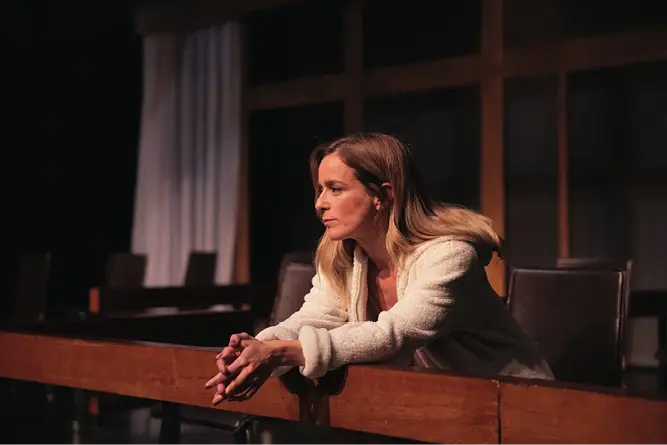
Margarida has the critics at her feet, more than 150 performances sold out in Portugal; she did not come here to prove anything, she came to give. But there is something in Macau, a particular story; she gives herself to that passion. And you can feel it; in the room and inside us. To watch her on stage, at that level, tears the garments of emotion; in the person one likes, the artist one loves explodes. There must be a word for this; I just do not know which one, it transcends me.
It is more than what she is – it is what she makes us become. Greatness seeps in and projects us outward; she shares it – it becomes ours because it is hers. At First Sight (À Primeira Vista), the Literary Festival’s act of resistance, softens the blow dealt by Rodrigo Leão’s inability to attend – flights cancelled by war.
It is a pity, but it does not hurt; because at the heights of Rota das Letras – brilliant in every sense – Margarida’s strength, quality and artistry are music from another planet. She is an inverted comet; the light she gives off is not dying, it expands, it illuminates; it travels in the infinity of performance: Vila-Nova is brutal, brilliant, unforgettable.
Margarida Vila-Nova is a star, that much is already known; but to see and feel the light she radiates throws us into another universe. She said it herself: “I had a great deal of love to give here.” We could feel that. At First Sight flooded the Festival with an unforgettable cocktail: relevance in its theme, quality in the staging… and an actress from another world
The play’s central dilemma is consent. A woman has sex when she wants to; it should be unthinkable that a man does not understand that. But there are many brutes… and that is a drama women live through, so often in silence, with fear, pain and shame. Because it hurts, it weakens, it kills from within… and the world outside is cruel. There is the law and there are the men who ignore, doubt, humiliate, deny.
Read also: Portuguese delegation highlights challenges after visiting Macau
It is not the law life deserves – it is life as it is – that must urgently be denounced, fought and condemned. Why does a woman decide to sue someone she has even slept with; an office colleague who even attracts her, with whom she had sex half an hour before the rape that follows? Because at that moment she is unwell; she does not want to, she says no; she thrashes to free her arms, she screams with her mouth covered. She is a rape victim, full stop; but then come all the webs of commas…
Why does a competent, fierce, self-assured lawyer lose in court the battle for decency? Because the system wants proof; and contradiction is always easier; because in the victim’s skin go coldness, lucidity, confidence… The victim is already in a state of fragility; she faces distrust, investigation, the power of the lawyer who raped her, the judge, the prosecutor, the lawyers… men who intimidate her; they do not understand – they do not want to understand.
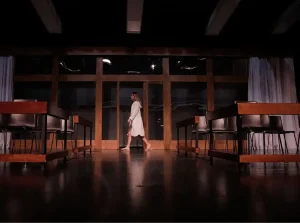
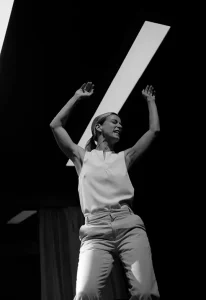
The text is sublime, Tiago Guedes’ direction does it justice, but it is the actress inhabiting Margarida who throws us off balance, who leaves us breathless; there is another dimension there. She enters fully into persona; full of ego, self-esteem, the illusion of success; then plunges into drama, pain and fragility; within the same “set” she is victim, woman, man, aggressor, defendant, lawyer, prosecutor, judge… she laughs, cries, mocks, suffers, thinks, loses herself… the stage has no limits.
Read also: Domestic violence: APAV supported 50,495 women in the last four years in Portugal
In an hour and a half of monologue, at a dizzying pace, Margarida moves from one character to another with ever-rising – and unbroken – intensity; with infinite plasticity, she uses the set in every corner, ties together every loose end, in a marathon that robs us of normality. She grips us with that look which says: you are not leaving here, I really want to tell you this, you are going to have to listen. No one lets go of her; that is her world, the world she wants to give us.
I have known for a long time that the camera adores her, truly delights in her. I am not even speaking of soap operas, a stage that also suits her; I mean films. In every one I have seen, when the camera settles on her, it wants nothing else; she has a magnetic pull, and the viewer surrenders to that force. But on stage there is an admirable new world; an indelible mark, a brand of Portuguese-language theatre. In what world did this happen? Macau Cultural Centre – Script Road Festival. That is not something to be forgotten.
You Might Be Interested In