
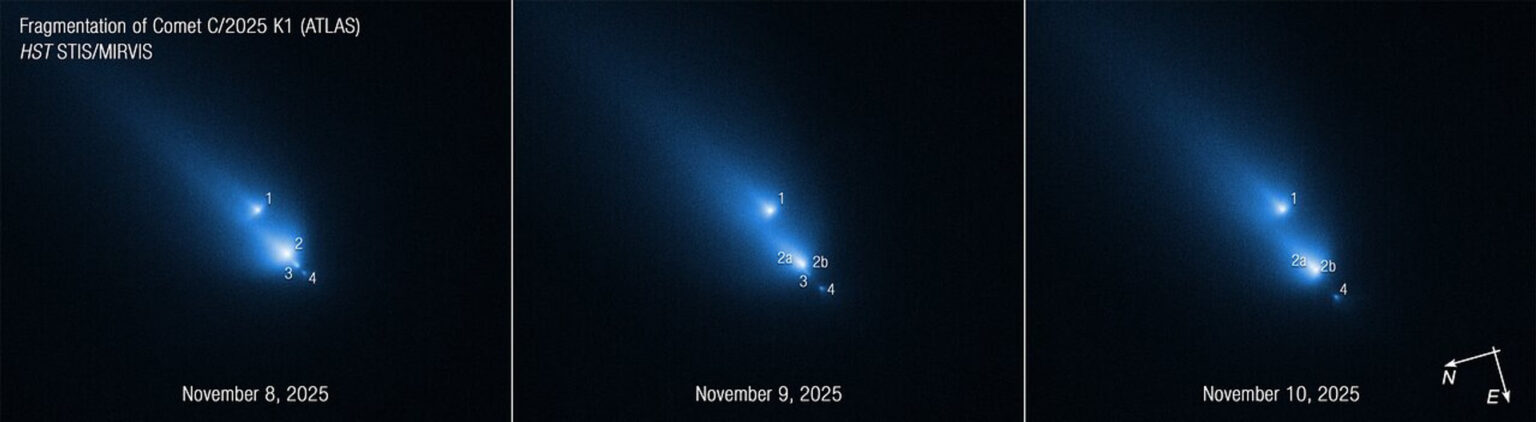
ESA and NASA have released a very rare image of Comet K1 as it disintegrated as it exited the solar system. It was captured by the Hubble Space Telescope. The agencies say the chances of this happening during the observation were incredibly small.
Comet K1, whose full name is Comet C/2025 K1 (ATLAS), has passed its closest approach to the Sun and is leaving the Solar System, and although it was intact just a few days ago, it has now broken into at least four pieces.

Comet K1 was not the original target of Hubble’s observations, and these images were captured by chance. Attention was drawn to it only after the main object of the study became inaccessible for observation.
“Sometimes the best science happens by accident,” said study co-author John Noonan, a research professor in the Department of Physics at Auburn University in Alabama, USA. “This comet got observed because our original comet was not viewable due to some new technical constraints after we won our proposal. We had to find a new target — and right when we observed it, it happened to break apart, which is the slimmest of slim chances.”
Noonan didn’t know K1 was disintegrating until he reviewed the images the day after Hubble took them.
“While I was taking an initial look at the data, I saw that there were four comets in those images when we only proposed to look at one,” Noonan said.
Hubble captured the breakup of Comet K1 into at least four fragments, each with its own coma—a fuzzy shell of gas and dust surrounding the comet’s icy nucleus. The telescope clearly distinguished these fragments, which at the time appeared as faint specks to ground-based telescopes.
“Comets are leftovers of the era of Solar System formation, so they’re made of ‘old stuff’ — the primordial materials that made our Solar System. But they are not pristine — they’ve been heated, they’ve been irradiated by the Sun and by cosmic rays. So, when looking at a comet’s composition, the question that we always have is, ‘Is this a primitive property or is this due to evolution?’ By cracking open a comet, you can see the ancient material that has not been processed,” said lead researcher Dennis Bodewits.
Share:
Посилання скопійовано