

Friday, 20 March 2026, 1:03 pm
Opinion: Martin LeFevre – Meditations
The more Homo sapiens accumulates knowledge and develops
high technology, the less intelligent we are becoming as a
species. Why are humans an inverse in the
universe?
Though I’m sometimes accused of it, I’ve
never understood why anyone would try to save this mad, dark
world. It’s not about saving the world; it’s about
inwardly saving oneself and humanity, which are basically
the same thing.
Science cannot do so because
knowledge, however accurate and extensive, requires
application, and fitting application flows from
intelligence, which is a completely distinct potential of
the human brain than the accumulation of
knowledge.
Also, scientists are human, with all the
same confusions and conflicts all humans have. So when
scientists try to explain subjective experience, as
neuroscientists are trying to do, science goes
wrong.
Science, rightly and necessarily, is an
outward-oriented endeavor. It is not the inward exploration
of human nature and behavior essential for
self-understanding.
We assume humans are an
intelligent species, but we are not. An intelligent species
does not bring about the Sixth Mass Extinction in the
history of life on its planet. The havoc that man, a
sentient, potentially sapient species is wreaking on the
biosphere cannot be compared and conflated with the five
previous mass extinction events from asteroids or
continent-wide volcanism.
An intelligent species is
not one that accepts war as a given, much less reverts to
trench warfare and lays the groundwork for AI-controlled
war.
Advertisement – scroll to continue reading
An intelligent species is not one that views the
desperate migration and suffering of millions of people in
nationalistic terms.
Finally, an intelligent species
is not one that resigns to a world divided into the
obscenely rich and the immiserated poor.
So what is
intelligence?
Intelligence is self-awareness and
right action in an individual, and a flourishing balance
with nature by a sapient species. Thus intelligence
transcends science and knowledge, much less technology and
“artificial intelligence.”
With all due respect to
science, it simply won’t work “to bring together experts
across a broad range of scientific disciplines to help solve
the greatest predicaments and puzzles that face our
species,” as the proposed “School of Cosmic Future” at
the University of Toronto intends to do.
Its
underlying, unexamined premises are: 1. That science can
save humanity; 2. That the different disciplines of science
can be woven together to form whole solutions; and 3. That
scientific experts, or experts of any kind, are primary, the
authorities we should turn to for solutions.
What
other recourse do we have except science for addressing, as
Sir Martin Rees, Britain’s Astronomer Royal, says, “the
urgency of a situation where humanity has attained the
ability to destroy itself along with the rest of the
biosphere?”
The Enlightenment cornerstone of reason
was essential to do science, but is woefully inadequate for
our self-understanding. Though it sounds unassailable, the
idea that “taking collective action based on evidence and
reason” is the way ahead simply doesn’t hold up to the
overwhelming evidence of man’s past and present.
The
hard-won facts about the nature of reality since Galileo are
not immutable truths, as every true scientist says, but
prima facie evidence for prevailing paradigms and theories,
painstakingly achieved and tentatively held.
Therefore
insights that expand a field of knowledge are one thing, and
the state of insight beyond knowledge and the known is
totally another. Fully awakening the human brain’s
capacity for insight beyond ideas and knowledge is what is
urgently necessary to save humanity, the earth and
ourselves.
Psychological revolution isn’t a mass
movement. When people and human consciousness are ready, it
will only take a few human beings, irrespective of culture
and background, to ignite the only true revolution. As
individuals we contain human consciousness as a whole in
microcosm. So it’s our highest responsibility to make
space for non-dualistic observation, inclusive attentiveness
and transmutation.
Time is the great impediment to
individual and communal transformation. When the
psychological movement of time ends by undividedly attending
to the movement of thought within oneself, a state of
insight ensues in which one is silently and directly aware
of the mystery of life and the harmony of the
universe.
Is humankind in a state of transition from
an increasingly destructive sentient species to an ever more
intelligent sapient species? At best and with faith,
yes.
So how many intelligent species are there in the
Milky Way?
Frank Drake, a pioneering astronomer and
astrophysicist who came up with the Drake Equation,
estimated 10,000. But the number now ranges from thousands
to millions in our galaxy alone, which is just one of 2
trillion galaxies in the universe.
Technological
species that survive the type of collective polycrisis
humankind is presently facing by bringing about an
indispensable inner revolution, and thereby making the leap
to a higher order of consciousness, would have transcended
time inwardly, and perhaps be capable of exceeding
space-time physically.
However a genuinely intelligent
species wouldn’t and probably couldn’t communicate with
a planetarily destructive species like Homo sapiens until we
make the transition to an intelligent species. And it’s
entirely up to each potentially intelligent species to make
the transition. That falls to the individual, not to some
fantasy of class or mass movements.
The evolution of
‘higher thought’ gave us the neural capacity not just
for high science and technology, which we’ve been using to
destroy the earth and humanity, but for conscious awareness
of the inviolability and intelligence that imbues nature and
the universe.
After a period of passive observation
yielding a meditation next to the creek, I sat near the
great oak at the entrance that anchors Lower Park. It has an
ancient presence of stately grandeur and strength, with
huge, gnarled branches stretching toward the sun and arching
down and touching the high grass.
The numinous
permeates nature and the cosmos, except for man. The beauty
and strength of nature is not in man because our minds and
brains are dominated and occluded by thought, continuously
busy with knowledge, experience and self-concern. Take the
space to sit still and be attentively aware in
nature.
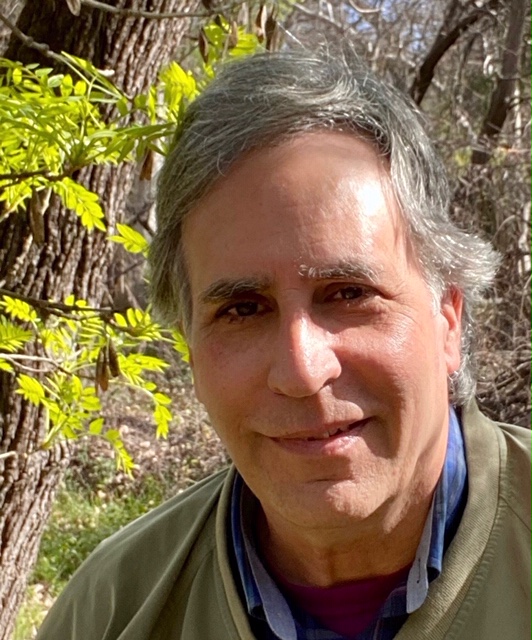
Martin
LeFevre
Scoop Contributor
Martin LeFevre is a contemplative and philosopher.
His sui generis “Meditations” explore spiritual, philosophical and political questions relating to the polycrisis facing humanity.
lefevremartin77@gmail