
 Dr. Universe: What Is A White Hole? — Darwin, 11, British Columbia, Canada and Rubal, 9, Australia
Dear Darwin and Rubal,
Before I read your question, I had never heard of a white hole. So, I scampered over to my friend Vivienne Baldassare to find out more. She’s an astrophysicist at Washington State University.
She told me that, so far, white holes are just an idea. It’s what happens if you take math about black holes and work it backwards. “White holes are really the mathematical inverse of a black hole,” Baldassare said. “But we have no reason to think they exist right now.”
A black hole is an area in space that has gobs of gravity.
We’re familiar with the gravity we experience on Earth. That’s the force that holds everything—our bodies, our buildings, even the oceans—on Earth. It’s why we don’t float off into space. That gravity happens because our planet is super big. All the matter that makes the Earth pulls on our bodies.
A black hole is made of matter, too. It’s crammed together into a super small space. Scientists say it’s dense—super tightly packed together. The pull of gravity in a black hole is so strong that nothing can escape—not even light. Something inside a black hole would need to travel faster than the speed of light to get away. Since nothing can move that fast, nothing can ever get out.
A white hole would be the opposite. It would be a region in space where nothing could ever go fast enough to get in. It might be a one-way space fountain that spews matter out into space.
A black hole forms when a massive star dies. Its core collapses and makes an explosion called a supernova. Then all that remaining matter crushes together into a dense point. It’s unclear what natural event could cause a white hole. To make it work mathematically on paper, you run time backwards. It’s hard to imagine that happening in real life. But if it did, there could be incredible implications.
“Some theories suggest that maybe white holes are on the other side of black holes in another universe,” Baldassare said. “So, we’d have a black hole in our universe, and it would lead to a white hole in another universe—but it’s all very theoretical.”
If that sounds like a fun way to travel between universes, I’m sorry to say that nobody could survive a trip like that. They’d be squeezed into noodles by the gravity in the black hole—called spaghettification—long before they popped out through the white hole.
But don’t completely give up on finding white holes. People have been thinking about space objects like black holes since way back in the 1600s. That’s wild because we didn’t confirm black holes were real until 1971. The first ever photo of a black hole happened in 2019. And those are super big or super common objects. “There are super massive black holes that are millions and billions of times the mass of the sun,” Baldassare said. “And then there are smaller black holes all over the place. Every galaxy has millions of them.”
Maybe it’ll just take some time to get our paws on a matter-spewing space fountain.
Sincerely,
Dr. Universe
Ask Dr. Universe is a science-education project from Washington State University. Visit AskDrUniverse.wsu.edu to read more Q&A’s, or to send in a science question of your own – or that of a kid you know – for a chance to be featured in a future Q&A. Or you can write to: Ask Dr. Universe Washington State University ITB 2013B Pullman, WA 99164
This is the first photo ever taken of a black hole. It’s at the center of the M87 galaxy—about 55 million light years from Earth. ©Event Horizon Telescope Collaboration.
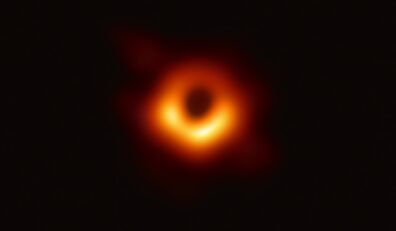
The Event Horizon Telescope (EHT) — a planet-scale array of eight ground-based radio telescopes forged through international collaboration — was designed to capture images of a black hole. In coordinated press conferences across the globe, EHT researchers revealed that they succeeded, unveiling the first direct visual evidence of the supermassive black hole in the centre of Messier 87 and its shadow. The shadow of a black hole seen here is the closest we can come to an image of the black hole itself, a completely dark object from which light cannot escape. The black hole’s boundary — the event horizon from which the EHT takes its name — is around 2.5 times smaller than the shadow it casts and measures just under 40 billion km across. While this may sound large, this ring is only about 40 microarcseconds across — equivalent to measuring the length of a credit card on the surface of the Moon. Although the telescopes making up the EHT are not physically connected, they are able to synchronize their recorded data with atomic clocks — hydrogen masers — which precisely time their observations. These observations were collected at a wavelength of 1.3 mm during a 2017 global campaign. Each telescope of the EHT produced enormous amounts of data – roughly 350 terabytes per day – which was stored on high-performance helium-filled hard drives. These data were flown to highly specialised supercomputers — known as correlators — at the Max Planck Institute for Radio Astronomy and MIT Haystack Observatory to be combined. They were then painstakingly converted into an image using novel computational tools developed by the collaboration.