
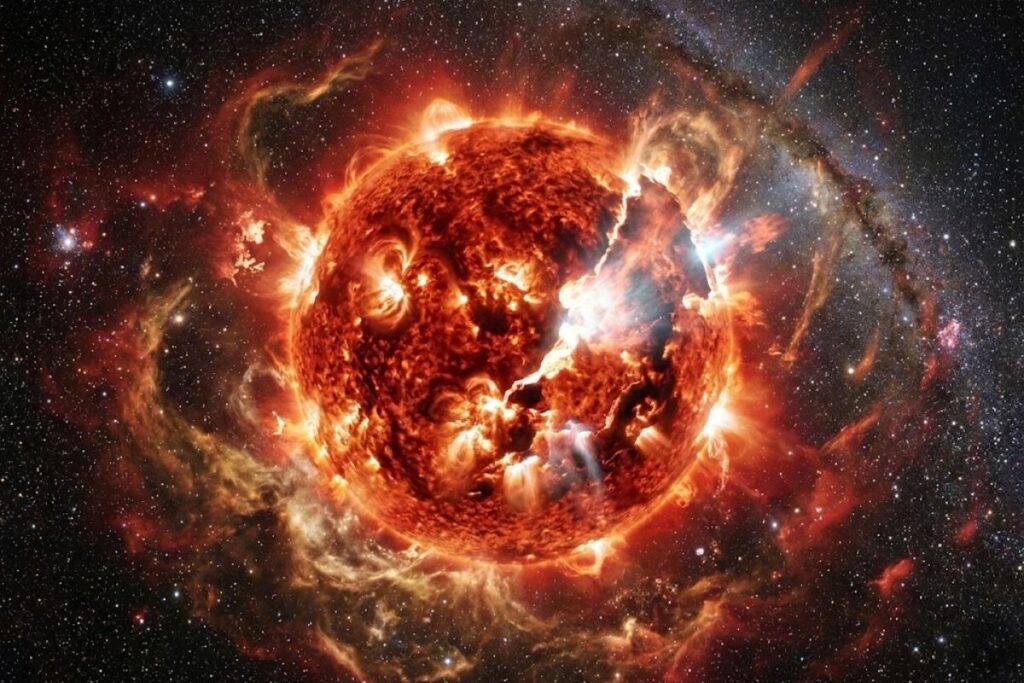
The story of WOH G64 is noteworthy precisely because it challenges what is expected of… the biggest stars in the universeInstead of a slow and predictable change, astronomers saw the star alter its very “appearance” in 2014, when its color changed and its surface temperature increased, without clear signs of an explosion or major eruption.
This detail, which seems simple, becomes gigantic when you look at the context: the WOH G64 has approximately… 28 times the mass of the Sun, is approximately 160.000 light years from Earth and exhibits such extreme dimensions and brightness that any rapid change turns into a important message about how massive stars can end their lives and why some destinations still don’t click with models.
What the telescopes saw and why it goes off-script.
Over more than three decades of observations, WOH G64 has shown behavior that, on the scale of the cosmos, seems too fast. In 2014, researchers recorded a color change associated with an increase in surface temperature, a sign that the star was leaving behind the aspect of extreme red supergiant and moving on to the one of yellow hypergiantThe point that captures attention is the contrast: The transition was rapid in cosmic terms..
The strange thing is that this turnaround wasn’t accompanied by the kind of evidence that usually “stamps” abrupt changes in massive stars — like a striking eruption or a detectable explosion. Usually, when something changes rapidly in the sky, violence is involved.Fusions, bursts of light, or the explosive ending. Here, what appears is an expressive transformation, but without the obvious signature of a destructive event in the observed interval.
The WOH G64 scale, in numbers that change perspective.
To understand why WOH G64 came onto the radar as a special case, one must consider the size of the object. Compared to the Sun, its The brightness is approximately 300.000 times greater. and his The diameter is approximately 1.500 times larger.. It’s not a “big” star, it’s a star that distorts intuition.Because any variation on the surface can involve volumes and energies that go beyond the everyday realm of more “common” stellar astronomy.
The scale becomes even more concrete with a comparison: if WOH G64 occupied the place of the Sun, its surface would extend approximately to a region between the orbits of Jupiter and SaturnAnd, in an example that illustrates the absurdity, traveling at the speed of light would take approximately six hours to go around the circumference of the star. When an object of this size changes “color” on a human scale, it’s not a detail, it’s a clue.
Where does WOH G64 fit into the massive star puzzle?
As the biggest stars in the universe Lifespans are shorter than that of stars like the Sun because they burn their fuel much more intensely. WOH G64 has approximately… 10 million years, a number that, for a massive star, can signify advanced maturity. The comparison with the Sun reinforces the contrast: the Sun is about 4,5 billion years and, according to the estimates presented, it would still have about 5 billion years ahead. The “rhythm” of a star’s life changes radically with its mass.
This is where the mass of WOH G64 becomes a sort of border zone. Stars with mass between eight and 23 times that of the Sun They tend to follow a relatively expected path: they evolve into red supergiants and, eventually, They explode like supernovas.. For masses between 23 and 30 times that of the SunThe destination becomes less clear: there could be a supernova, there could be… direct collapse forming a black holeOr there may be an intermediate transitional phase (such as the yellow hypergiant phase) before the end. With 28 solar masses, WOH G64 falls precisely in the range where certainty becomes a question.
Why does the change from red to yellow have such a significant impact?
The color of a star is not aesthetic: it is a physical indicator linked, among other things, to surface temperatureWhat was observed in 2014 was a change consistent with surface heating, something that, in this type of object, suggests that the star was not just “oscillating” from one day to the next, but undergoing a deeper alteration in the state of its outer layer. Switching from red to yellow is like changing phases right before our eyes.
The crucial detail is what didn’t appear: no clear evidence, within the observed timeframe, of a large eruption or explosion that would directly justify the rapid change. And that’s precisely where the scientific unease arises: No current stellar model can fully explain the transformation.In other words, it’s not just a “pretty” mystery; it’s the kind of case that puts both theory and observation to the test, because it forces us to ask if there are missing pieces in the physics, if there’s a lack of data, or if the star is showing a rare path that is almost never caught in the act.
The hypotheses raised and what each would imply.
One possibility being discussed is that WOH G64 underwent a violent episode before the period covered by modern measurements, something that could have left the star with a more “reddish” appearance, and that it is now returning to its more yellow state. quiescentmore stable. If this interpretation is correct, the change observed in 2014 would be less of an unexpected leap and more of a return to a condition that was not previously recorded in detail.
Another hypothesis is even more intriguing: interaction with a possible companion star could have temporarily mimicked The appearance of a red supergiant. In simple terms, the star might not have been “that red” by nature at that time, but may have displayed misleading signals due to effects related to the system’s environment. This would change how observed evolution is interpreted.Because the color and spectrum could be reflecting not only the star, but also external processes that alter how it is seen.
The binary system’s clue and why it complicates everything.
Observations indicate that WOH G64 may be gravitationally bound to another star, forming a binary system. This fact alone is enough to increase the complexity, because binary systems open doors to interactions that solitary stars do not have: gravitational perturbations, matter transfer, changes in the outer envelope, and changes in how brightness and color appear to us.
The point is that the researchers were unable to determine the size and characteristics of the companion star. Even so, they highlighted that the two stars… They may merge at some point.A merger, when it happens, tends to be a transformative event, but what matters here is the uncertainty. It’s impossible to say for sure when, how, or even if this will be the way forward.Still, only the possibility of an invisible companion helps explain why WOH G64 seems “off-script” among the biggest stars in the universe.
What could be considered an “extreme event” in this context, and why has the case become so publicized?
When astronomers talk about the end of life for massive stars, they are looking at a few possible outcomes: a bright supernova, a collapse that could generate a black hole, or transitions involving rapid changes in the outer structure. What makes WOH G64 a showcase is the combination of factors: it is in a mass range where its fate is uncertain, it exhibited a remarkable transformation in 2014, and it does so within a human lifetime of observations. It is rare to see a giant star “change state” with this level of clarity and apparent speed.
Therefore, continuous monitoring is considered essential: the more the system is monitored, the greater the chance of separating genuine internal evolution from the effects of the environment, companion, or an unrecorded previous event. If WOH G64 is truly nearing its end, it may help answer a long-standing question: Do stars with masses between 23 and 30 solar masses explode, collapse directly, or go through intermediate phases that we don’t yet fully understand? And even if the “extreme event” is not imminent in human terms, the simple act of monitoring the changes already provides data capable of reshaping hypotheses.
WOH G64 has become a natural laboratory for discussing the the biggest stars in the universe In short: the change from red to yellow in 2014, without the obvious signature of a major explosion, places the star in territory where models still don’t quite manage to balance the books. 28 solar massesGiven its extreme brightness and size, and the possibility of being in a binary system, it appears as a case that could clarify or complicate how stellar giants actually end their lives.
With information from the portal Reuters.
If you had to bet on one scenario, which seems most plausible: a return to a “normal” yellow state, the effect of the companion masking its appearance, or a real omen of the end? And, more importantly: what kind of observation do you think would be crucial to move WOH G64 out of the realm of mystery and into the realm of explanation?