
“This is a huge relief,” said mission manager Damien Galano.
The European Space Agency has re-established communication with a satellite from the Proba-3 mission after losing contact with it a month ago, AFP reported.
The mission, launched in 2024 for a two-year duration, uses two spacecraft flying in precise formation to simulate a solar eclipse more than 60,000 kilometres above Earth. This allows scientists to study the Sun’s corona, its little-known outer atmosphere. One spacecraft carries a 1.4-metre shield that blocks the Sun’s light, while the other observes the corona from the shadow.
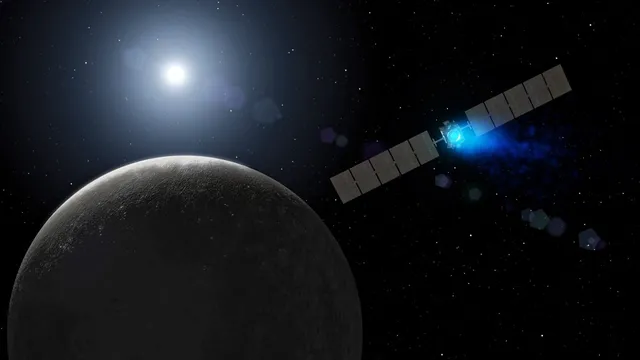
The problem occurred on February 14, when the second spacecraft, equipped with the key coronagraph instrument, lost its orientation. A chain reaction caused its solar panel to turn away from the Sun, draining the batteries and forcing the spacecraft into survival mode. It has since been drifting silently in space.
“Something like a miracle happened – we managed to reconnect with the spacecraft,” ESA Director Josef Aschbacher said.
The companion satellite continued to track its “lost” partner. A team in Spain noticed that, as the spacecraft was tumbling, some sunlight was briefly reaching its solar panels and used that window to restore communication. The panels are now facing the Sun again and the batteries are recharging. The next step is to reactivate the instruments and assess any damage.
“This is a huge relief,” said mission manager Damien Galano.
The Sun’s corona, stretching millions of kilometres, remains poorly understood because it is invisible to the naked eye and conventional telescopes due to the Sun’s intense brightness. Unlike rare total eclipses on Earth, Proba-3 will provide between 10 and 12 hours of observations per week over two years. | BGNES