
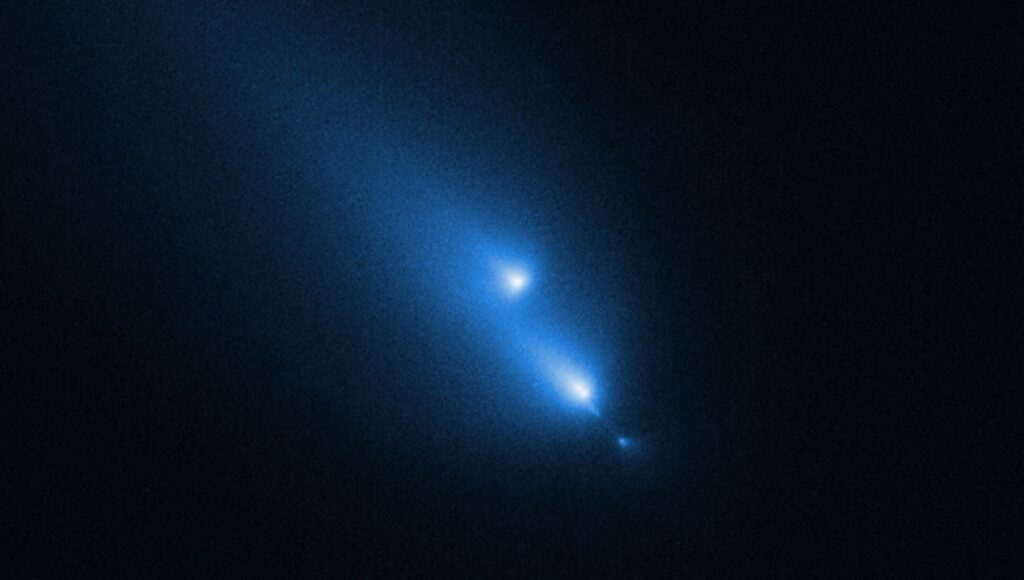
In late 2025, the space community witnessed the dramatic demise of comet C/2025 K1 (ATLAS). This object was first detected in May 2025 by an asteroid early-warning system. The comet was quite large: its diameter was about 8 km, which is significantly larger than the average size of such objects. In addition, it had an unusual chemical composition with an unusually low carbon content, which immediately caught the researchers’ attention.
On October 8, 2025, K1 reached its perihelion—the point in its orbit closest to the Sun. The comet passed 49 million kilometers from the Sun. This fire and gravity test is often the last one for these icy wanderers. At first, it seemed that K1 was a “tough nut to crack” and had passed perihelion unscathed. However, the grueling journey had a delayed effect. By early November, astronomers had noticed that the comet had begun to literally break apart.
A fortunate turn of events
The most interesting part of this story is the role played by the famous Hubble Telescope. The fact that it recorded the comet’s breakup was the result of an incredible series of events. The scientists had planned to use the telescope to observe a completely different object, but due to technical limitations, their original target became inaccessible.
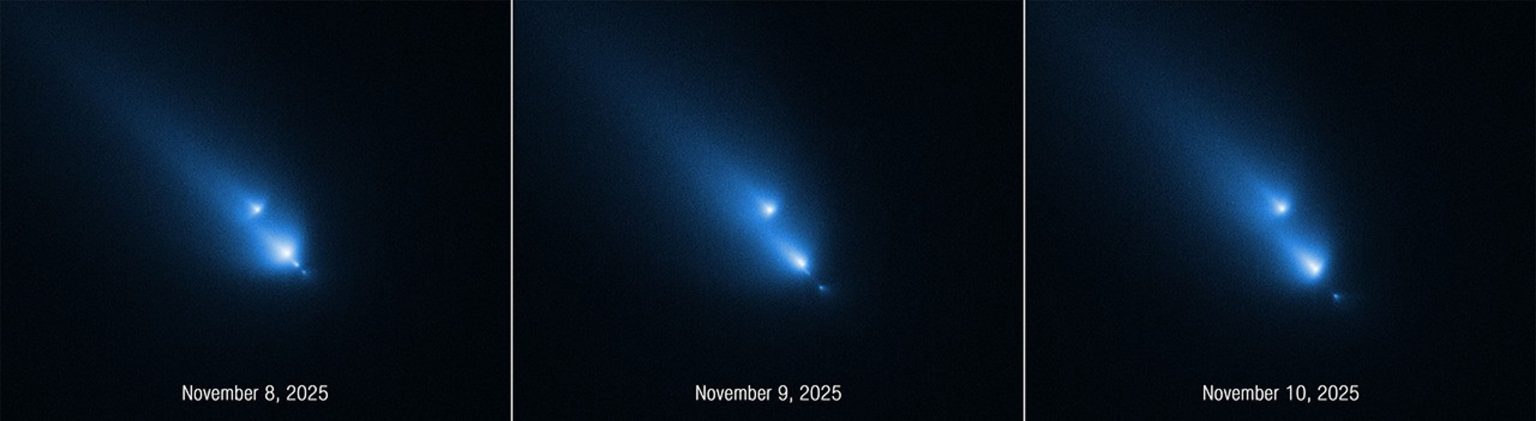 A series of images showing the disintegration of comet C/2025 K1 (ATLAS), taken by the Hubble Space Telescope, was captured over three consecutive days: November 8, 9, and 10, 2025. This is the first time Hubble has observed a comet at such an early stage of its disintegration. Image: NASA, ESA
“Sometimes the best science happens by accident,” explains John Noonan, a professor at Auburn University. “We had to find a new target in a hurry, and we chose K1 just as it was beginning to disintegrate.”
The Hubble images are impressive: the comet has broken apart into at least four large fragments, each with its own coma—a cloud of gas and dust. One of these fragments subsequently crumbled into even smaller pieces right before the researchers’ eyes.
Mystery of the belated flash
This accidental observation gave scientists a rare opportunity to “turn back the clock” and reconstruct the chronology of the disaster in detail. However, a mystery arose: there was a significant time lag between the moment of the breakup and the sudden increase in the comet’s brightness, which was observed by ground-based telescopes. Logically, the exposed ice should have ignited instantly. So why was there a delay?
Astronomers have put forward two main theories:
Dust veil: perhaps the newly exposed ice was first covered with a thin layer of dry dust, and only after this dust was blown away, the intense evaporation began.
Internal pressure: Heat slowly penetrated the fragments, creating excess pressure until they exploded in an expanding cloud of dust.
The end of the space journey
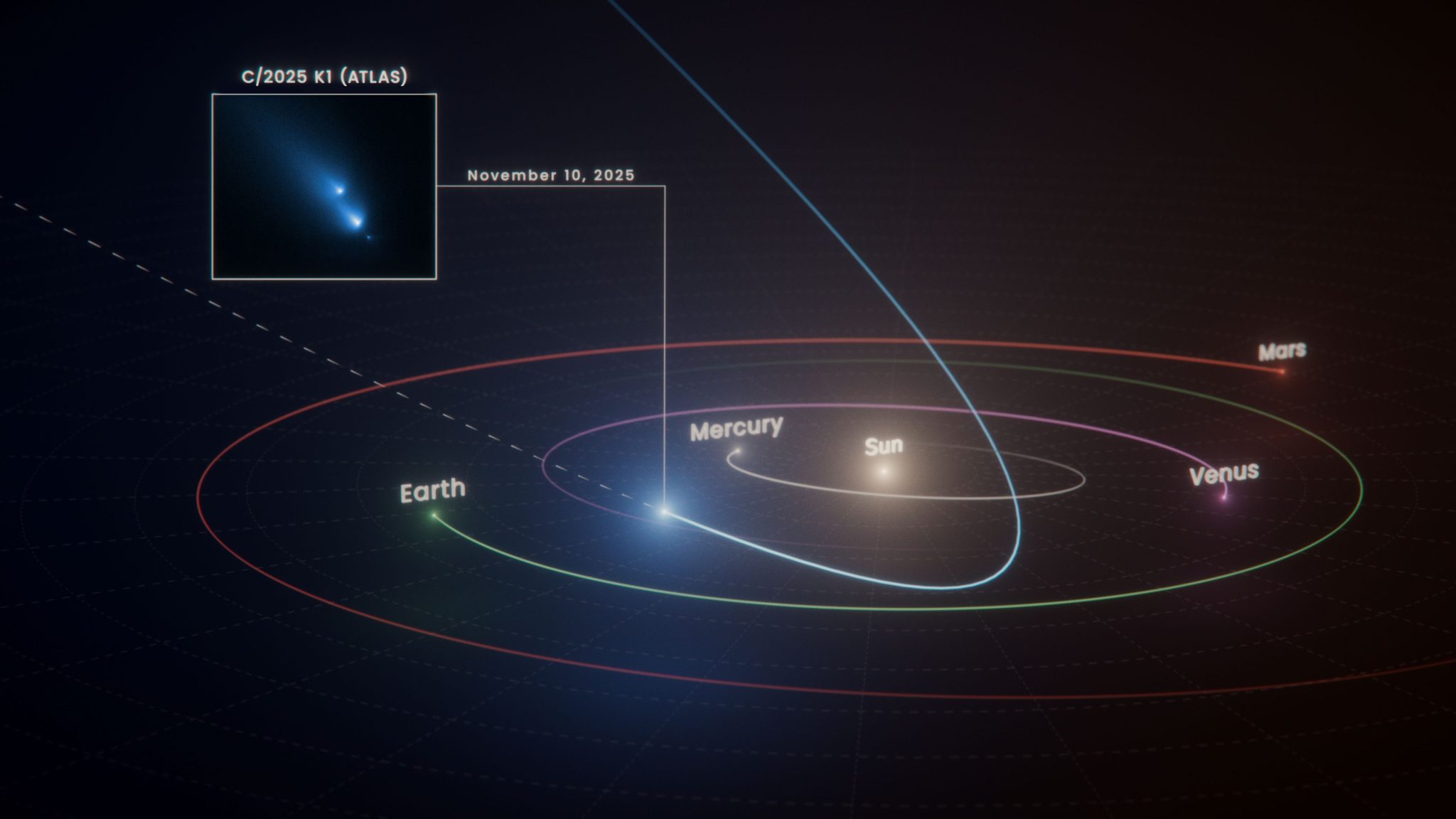 This diagram shows the trajectory of comet C/2025 K1 (ATLAS), or K1, as it passes close to the Sun and begins its journey beyond the Solar System. Image credit: NASA, ESA, STScI
Thanks to Hubble, humanity was able to witness a comet breaking apart for the first time just a few days after the event, instead of weeks later, as is usually the case. This provides invaluable insight into the physics of processes occurring on the surface of cometary nuclei.
Unfortunately, comet K1 no longer exists. It is now nothing more than a cloud of space debris orbiting 400 million kilometers from Earth. Its trajectory takes it beyond the Solar System, so this traveler will never return to our door.
We previously reported on how an asteroid hunter captured an interstellar comet.
According to NASA