
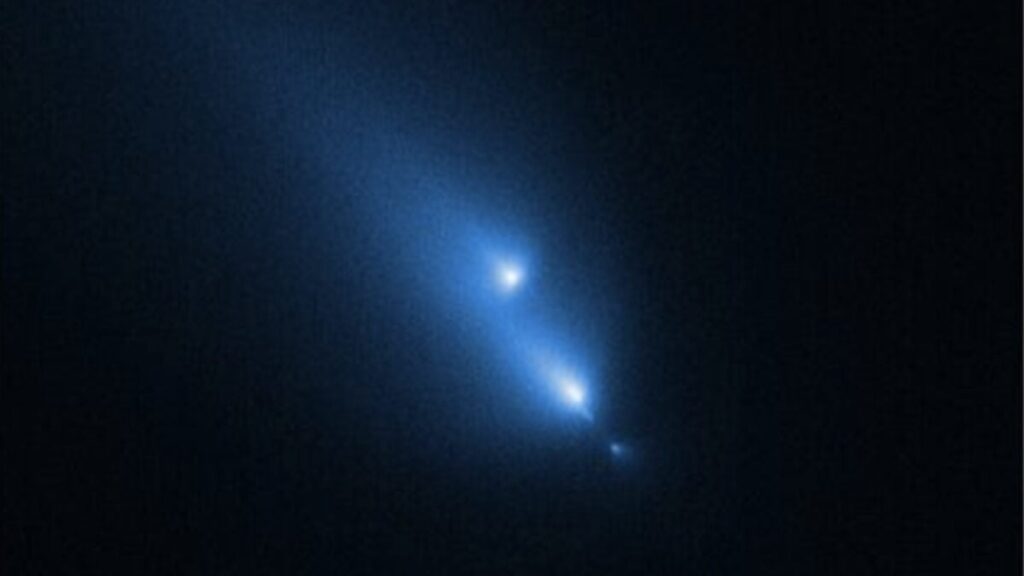
In November 2025, a comet began disintegrating into pieces after a heated close encounter with the Sun. In a twist of fate, the Hubble space telescope happened to be observing the comet as it broke apart, capturing its demise in a series of images.
“Sometimes the best science happens by accident,” John Noonan, a research professor in the Department of Physics at Auburn University in Alabama and co-investigator of the event, said in a statement. “This comet got observed because our original comet was not viewable due to some new technical constraints after we won our proposal. We had to find a new target—and right when we observed it, it happened to break apart, which is the slimmest of slim chances.” The Hubble observations are detailed in a new study published in the Icarus journal.
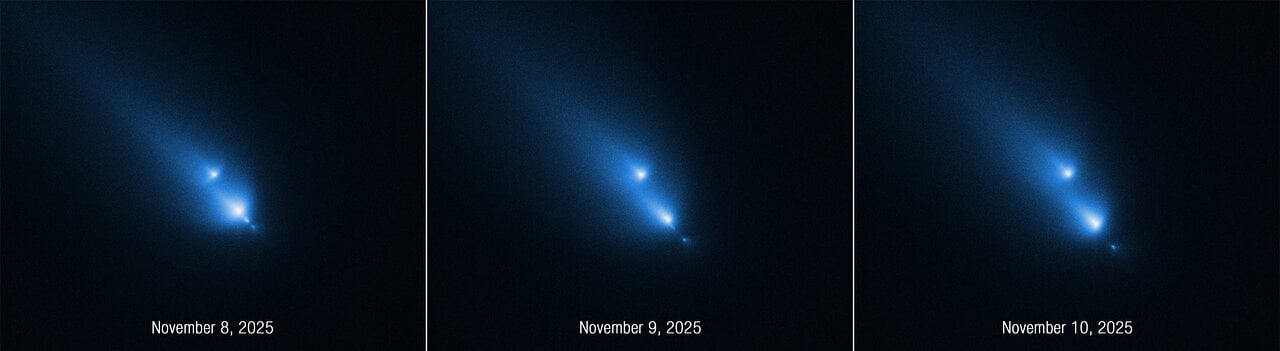 This series of Hubble Space Telescope images of the fragmenting comet C/2025 K1 (ATLAS), or K1 for short, was taken over the course of three consecutive days: Credit: NASA, ESA, D. Bodewits (Auburn). Image processing: J. DePasquale (STScI) Tough breakup
Astronomers first spotted comet C/2025 K1 (ATLAS), or comet K1 for short, in May 2025, a long-period comet originating from the Oort Cloud. The comet was heading toward its closest approach to the Sun on October 8, 2025, coming within 30 million miles (49 million kilometers) of our host star.
The comet’s perihelion, its closest approach to the star, was inside Mercury’s orbit, about one-third the distance between Earth and the Sun. During perihelion, the comet experiences intense heating and maximum stress, and long-period comets like K-1 tend to fall apart soon after their solar rendezvous.
Comet K1 was one of the unlucky ones and didn’t survive its perihelion. Instead, it disintegrated into oblivion. The team behind the recent images wasn’t aware that the comet had begun fragmenting until the Hubble images came into view. “While I was taking an initial look at the data, I saw that there were four comets in those images when we only proposed to look at one,” Noonan said. “So we knew this was something really, really special.”
In a series of images taken in November 2025, a month after the comet’s closest approach to the Sun, Hubble captured K1 fragmenting into four pieces, each with a distinct coma. “The irony is now we’re just studying a regular comet and it crumbles in front of our eyes,” Dennis Bodewits, a professor in Auburn University’s Department of Physics and principal investigator behind the study, said in a statement.
Comet snapshots
Thanks to Hubble’s precision, the telescope was able to clearly resolve each of the fragments while ground-based observatories viewed them as fuzzy, bright blobs.
The team behind the images estimates K1 began to disintegrate around eight days before Hubble began snapping photos of the comet. Hubble captured three 20-second images from November 8 through November 10, 2025. During that time, one of K1’s smaller pieces also broke apart.
“Never before has Hubble caught a fragmenting comet this close to when it actually fell apart. Most of the time, it’s a few weeks to a month later. And in this case, we were able to see it just days after,” Noonan said. “This is telling us something very important about the physics of what’s happening at the comet’s surface. We may be seeing the timescale it takes to form a substantial dust layer that can then be ejected by the gas.”
The comet is now a collection of fragments around 240 million miles (400 million kilometers) away from Earth, on its way out of the solar system to never return again. “Hubble’s chance observation of K1 will help us understand why some long-period comets split apart and give us a first view of their interiors,” Colin Snodgrass, a professor at the University of Edinburgh, Scotland, and co-author of the paper, said in a statement.